
About This Book
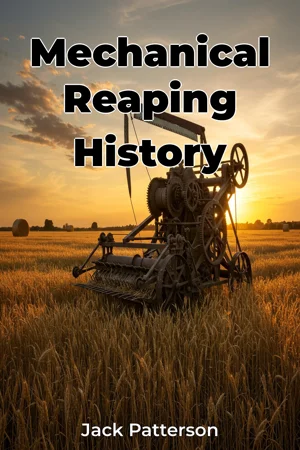
How did a single invention transform the global agricultural landscape, forever altering the relationship between humanity and the harvest? "Mechanical Reaping History" delves into the fascinating evolution of mechanical reaping devices, examining their profound impact on labor efficiency and societal structures. This book will explore not only the intricate engineering behind these machines but also the historical and social contexts that shaped their development and adoption. This investigation centers around three key themes: the technological progression of reaping machines, the consequent changes in agricultural labor practices, and the socio-economic ramifications of these shifts. Understanding these topics is crucial for appreciating the complex interplay between technological innovation and societal evolution. Prior knowledge of basic agricultural practices and industrial revolution concepts will provide context, though the book is designed to be accessible to a wide audience. The central argument of "Mechanical Reaping History" asserts that the mechanization of reaping, while significantly increasing harvest efficiency, had a multifaceted impact that rippled through rural communities, reshaping labor dynamics, land ownership, and even migration patterns. This argument is vital for understanding the broader consequences of agricultural mechanization throughout history and its continued relevance in contemporary discussions about automation and labor. The book is structured to guide the reader through a comprehensive exploration of this topic. It begins by introducing the rudimentary precursors to mechanical reapers, setting the stage for the emergence of more sophisticated designs. The narrative then progresses through major developmental phases, with dedicated chapters examining pivotal inventions like the McCormick and Hussey reapers, and subsequent refinements that led to self-propelled combine harvesters. The culmination of the argument explores the long-term impacts on rural economies and the displacement of agricultural labor, alongside an evaluation of the environmental aspects of large-scale mechanized farming. The evidence presented in this book is drawn from a wealth of archival research, including patents, agricultural journals, census data, and personal accounts from the period. Engineering schematics and contemporary illustrations provide visual insights into the mechanics of these inventions. This multi-faceted approach grounds the historical narrative in tangible realities. "Mechanical Reaping History" connects to several interdisciplinary fields. Firstly, it intersects with economic history by analyzing the economic consequences of increased agricultural productivity and labor displacement. Secondly, it relates to social history by examining the social changes that occurred in rural communities as a result of mechanization. Finally, it ties into environmental studies by considering the ecological impacts of large-scale mechanized agriculture. These interdisciplinary connections enrich the book's argument by providing a broader perspective on the consequences of technological innovation. This book offers a unique perspective by integrating a detailed analysis of the engineering aspects of reaping machines with a nuanced understanding of their social and economic repercussions. It avoids a purely technological determinist view, instead emphasizing the complex interplay between invention, social context, and human agency. Written in a clear and accessible academic style, "Mechanical Reaping History" targets a broad audience, including students and researchers in agricultural history, technological innovation, and economic development, as well as anyone interested in the history of agriculture and its impact on society. The book’s value lies in its comprehensive synthesis of technological and socio-economic perspectives on the mechanization of reaping. As a work of historical analysis within the genres of mechanical engineering and history, this book adheres to established academic standards of rigor and citation. While the book covers the major developments in mechanical reaping history, it intentionally focuses on the period between the early 19th century and mid-20th century, acknowledging that developments after that time warrant a separate, more specialized study. The information presented in "Mechanical Reaping History" has practical applications for understanding contemporary debates about automation and its impact on the workforce. By examining the historical consequences of agricultural mechanization, we can gain insights into the potential challenges and opportunities presented by automation in other sectors of the economy. The book also addresses ongoing debates about the environmental sustainability of modern agriculture. By examining the historical trajectory of agricultural mechanization, it sheds light on the long-term ecological consequences of intensive farming practices and informs current efforts to develop more sustainable agricultural systems.
How did a single invention transform the global agricultural landscape, forever altering the relationship between humanity and the harvest? "Mechanical Reaping History" delves into the fascinating evolution of mechanical reaping devices, examining their profound impact on labor efficiency and societal structures. This book will explore not only the intricate engineering behind these machines but also the historical and social contexts that shaped their development and adoption. This investigation centers around three key themes: the technological progression of reaping machines, the consequent changes in agricultural labor practices, and the socio-economic ramifications of these shifts. Understanding these topics is crucial for appreciating the complex interplay between technological innovation and societal evolution. Prior knowledge of basic agricultural practices and industrial revolution concepts will provide context, though the book is designed to be accessible to a wide audience. The central argument of "Mechanical Reaping History" asserts that the mechanization of reaping, while significantly increasing harvest efficiency, had a multifaceted impact that rippled through rural communities, reshaping labor dynamics, land ownership, and even migration patterns. This argument is vital for understanding the broader consequences of agricultural mechanization throughout history and its continued relevance in contemporary discussions about automation and labor. The book is structured to guide the reader through a comprehensive exploration of this topic. It begins by introducing the rudimentary precursors to mechanical reapers, setting the stage for the emergence of more sophisticated designs. The narrative then progresses through major developmental phases, with dedicated chapters examining pivotal inventions like the McCormick and Hussey reapers, and subsequent refinements that led to self-propelled combine harvesters. The culmination of the argument explores the long-term impacts on rural economies and the displacement of agricultural labor, alongside an evaluation of the environmental aspects of large-scale mechanized farming. The evidence presented in this book is drawn from a wealth of archival research, including patents, agricultural journals, census data, and personal accounts from the period. Engineering schematics and contemporary illustrations provide visual insights into the mechanics of these inventions. This multi-faceted approach grounds the historical narrative in tangible realities. "Mechanical Reaping History" connects to several interdisciplinary fields. Firstly, it intersects with economic history by analyzing the economic consequences of increased agricultural productivity and labor displacement. Secondly, it relates to social history by examining the social changes that occurred in rural communities as a result of mechanization. Finally, it ties into environmental studies by considering the ecological impacts of large-scale mechanized agriculture. These interdisciplinary connections enrich the book's argument by providing a broader perspective on the consequences of technological innovation. This book offers a unique perspective by integrating a detailed analysis of the engineering aspects of reaping machines with a nuanced understanding of their social and economic repercussions. It avoids a purely technological determinist view, instead emphasizing the complex interplay between invention, social context, and human agency. Written in a clear and accessible academic style, "Mechanical Reaping History" targets a broad audience, including students and researchers in agricultural history, technological innovation, and economic development, as well as anyone interested in the history of agriculture and its impact on society. The book’s value lies in its comprehensive synthesis of technological and socio-economic perspectives on the mechanization of reaping. As a work of historical analysis within the genres of mechanical engineering and history, this book adheres to established academic standards of rigor and citation. While the book covers the major developments in mechanical reaping history, it intentionally focuses on the period between the early 19th century and mid-20th century, acknowledging that developments after that time warrant a separate, more specialized study. The information presented in "Mechanical Reaping History" has practical applications for understanding contemporary debates about automation and its impact on the workforce. By examining the historical consequences of agricultural mechanization, we can gain insights into the potential challenges and opportunities presented by automation in other sectors of the economy. The book also addresses ongoing debates about the environmental sustainability of modern agriculture. By examining the historical trajectory of agricultural mechanization, it sheds light on the long-term ecological consequences of intensive farming practices and informs current efforts to develop more sustainable agricultural systems.
"Mechanical Reaping History" explores the evolution of reaping machines and their profound impact on agriculture and society. The book argues that while mechanization dramatically increased harvest efficiency, it also reshaped rural communities by altering labor dynamics, land ownership, and migration patterns. Readers will discover how innovations like the McCormick and Hussey reapers transformed agricultural practices, leading to the development of combine harvesters and large-scale mechanized farming. The book examines the technological progression of reaping machines, the resulting changes in agricultural labor practices, and the socio-economic ramifications of these shifts. For example, the rise of mechanical reapers significantly reduced the need for manual labor, leading to both increased productivity and displacement of agricultural workers. This exploration provides a valuable perspective on the relationship between technological innovation and societal evolution. Beginning with the rudimentary precursors to mechanical reapers, the narrative progresses through major developmental phases, culminating in an evaluation of the long-term impacts on rural economies and the environment. The book uniquely integrates an analysis of the engineering aspects of reaping machines with an understanding of their social and economic consequences, making it valuable for those interested in mechanical engineering, history, and the history of agriculture.
Book Details
ISBN
9788233995768
Publisher
Publifye AS
Your Licenses
You don't own any licenses for this book
Purchase a license below to unlock this book and download the EPUB.
Purchase License
Select a tier to unlock this book
Need bulk licensing?
Contact us for enterprise agreements.