
About This Book
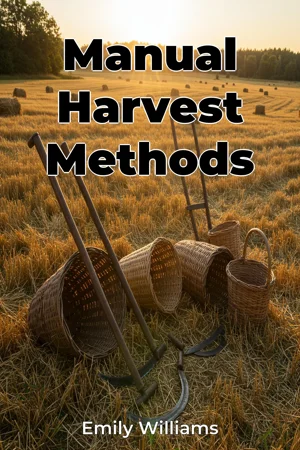
How did humanity feed itself for millennia before the advent of tractors and combines? "Manual Harvest Methods" delves into the intricate world of pre-industrial crop gathering, exploring the diverse techniques, tools, and social structures that sustained communities for centuries. This book examines the ingenuity and adaptability of agricultural practices before mechanization, revealing a wealth of knowledge often overlooked in modern agricultural studies. This investigation focuses on three central themes: the diverse range of hand tools employed in harvesting, the communal labor systems that governed crop gathering, and the ecological knowledge embedded within these practices. These themes are important because they offer crucial insights into sustainable agriculture, food security, and the relationship between humans and the environment – issues of increasing relevance in today's world. Understanding these historical methods provides a valuable perspective on the potential and limitations of low-input, ecologically-aware agriculture. The historical context is crucial. For thousands of years, agriculture relied entirely on human and animal power. Societies developed sophisticated techniques tailored to specific crops, climates, and terrains. This book draws on ethnographic studies of traditional farming communities around the world and historical agricultural records from various regions. The reader should ideally have a basic understanding of agricultural principles and world history. The central argument of "Manual Harvest Methods" is that pre-industrial harvesting techniques were not simply primitive or inefficient precursors to modern methods, but rather sophisticated, ecologically-adapted systems that maximized yields while minimizing environmental impact. The book challenges the assumption that mechanization represents the only path to agricultural progress. The book begins with an introduction to the history of agriculture and the rise of manual harvesting techniques and the main concepts. It then proceeds with three main sections: * **Tools of the Harvest:** This part catalogs and analyzes a wide array of hand tools used for harvesting, from sickles and scythes to digging sticks and specialized implements for particular crops. It examines the design, manufacture, and use of these tools, as well as their impact on labor productivity and crop quality. * **Labor and Community:** This section explores the social organization of harvesting, focusing on communal labor systems, cooperative strategies, and the role of women and children in the harvest process. It also examines the distribution of harvested crops and access to land and resources. * **Ecological Understandings:** This section examines the environmental knowledge embedded in traditional harvesting practices. It explores how farmers understood and managed soil fertility, water resources, and pest control, as well as the ecological consequences of different harvesting techniques. The book culminates by synthesizing these findings to offer insights into the potential of integrating traditional knowledge with modern agricultural practices to promote sustainability and resilience. The arguments are supported by a diverse range of evidence, including detailed descriptions of harvesting techniques, analyses of labor productivity, and comparisons of environmental impacts. Quantitative data from historical records and agricultural surveys are combined with qualitative insights from ethnographic studies. "Manual Harvest Methods" connects to several other fields of study, including anthropology, environmental history, and sustainable agriculture. By bridging these disciplines, the book offers a more holistic understanding of the relationship between agriculture, society, and the environment. This work distinguishes itself through its interdisciplinary approach and its focus on the ecological dimensions of pre-industrial harvesting. It emphasizes practical knowledge and sustainability, offering evidence-based arguments instead of anecdotal observations. The tone is academic but accessible, aiming to present complex information in a clear and engaging manner. Technical terms are explained, and examples are provided to illustrate key concepts. The primary audience includes agricultural historians, anthropologists, environmental scientists, and anyone interested in sustainable agriculture and food systems. It would also be valuable to practitioners seeking to incorporate traditional knowledge into modern farming practices. As a work of non-fiction, the book strives for accuracy, objectivity, and thoroughness in its presentation of information. The scope is global, encompassing a wide range of crops and regions but the book does not extensively cover post-harvest processing. The information presented can be applied to inform modern agricultural practices, promote food security, and foster a deeper understanding of the relationship between humans and the environment. The application of certain traditional harvesting techniques to modern agriculture may be met with skepticism by parties that are proponents of mechanized agriculture and biotechnology. The book addresses these debates by presenting evidence-based arguments for the value of traditional knowledge and practices.
How did humanity feed itself for millennia before the advent of tractors and combines? "Manual Harvest Methods" delves into the intricate world of pre-industrial crop gathering, exploring the diverse techniques, tools, and social structures that sustained communities for centuries. This book examines the ingenuity and adaptability of agricultural practices before mechanization, revealing a wealth of knowledge often overlooked in modern agricultural studies. This investigation focuses on three central themes: the diverse range of hand tools employed in harvesting, the communal labor systems that governed crop gathering, and the ecological knowledge embedded within these practices. These themes are important because they offer crucial insights into sustainable agriculture, food security, and the relationship between humans and the environment – issues of increasing relevance in today's world. Understanding these historical methods provides a valuable perspective on the potential and limitations of low-input, ecologically-aware agriculture. The historical context is crucial. For thousands of years, agriculture relied entirely on human and animal power. Societies developed sophisticated techniques tailored to specific crops, climates, and terrains. This book draws on ethnographic studies of traditional farming communities around the world and historical agricultural records from various regions. The reader should ideally have a basic understanding of agricultural principles and world history. The central argument of "Manual Harvest Methods" is that pre-industrial harvesting techniques were not simply primitive or inefficient precursors to modern methods, but rather sophisticated, ecologically-adapted systems that maximized yields while minimizing environmental impact. The book challenges the assumption that mechanization represents the only path to agricultural progress. The book begins with an introduction to the history of agriculture and the rise of manual harvesting techniques and the main concepts. It then proceeds with three main sections: * **Tools of the Harvest:** This part catalogs and analyzes a wide array of hand tools used for harvesting, from sickles and scythes to digging sticks and specialized implements for particular crops. It examines the design, manufacture, and use of these tools, as well as their impact on labor productivity and crop quality. * **Labor and Community:** This section explores the social organization of harvesting, focusing on communal labor systems, cooperative strategies, and the role of women and children in the harvest process. It also examines the distribution of harvested crops and access to land and resources. * **Ecological Understandings:** This section examines the environmental knowledge embedded in traditional harvesting practices. It explores how farmers understood and managed soil fertility, water resources, and pest control, as well as the ecological consequences of different harvesting techniques. The book culminates by synthesizing these findings to offer insights into the potential of integrating traditional knowledge with modern agricultural practices to promote sustainability and resilience. The arguments are supported by a diverse range of evidence, including detailed descriptions of harvesting techniques, analyses of labor productivity, and comparisons of environmental impacts. Quantitative data from historical records and agricultural surveys are combined with qualitative insights from ethnographic studies. "Manual Harvest Methods" connects to several other fields of study, including anthropology, environmental history, and sustainable agriculture. By bridging these disciplines, the book offers a more holistic understanding of the relationship between agriculture, society, and the environment. This work distinguishes itself through its interdisciplinary approach and its focus on the ecological dimensions of pre-industrial harvesting. It emphasizes practical knowledge and sustainability, offering evidence-based arguments instead of anecdotal observations. The tone is academic but accessible, aiming to present complex information in a clear and engaging manner. Technical terms are explained, and examples are provided to illustrate key concepts. The primary audience includes agricultural historians, anthropologists, environmental scientists, and anyone interested in sustainable agriculture and food systems. It would also be valuable to practitioners seeking to incorporate traditional knowledge into modern farming practices. As a work of non-fiction, the book strives for accuracy, objectivity, and thoroughness in its presentation of information. The scope is global, encompassing a wide range of crops and regions but the book does not extensively cover post-harvest processing. The information presented can be applied to inform modern agricultural practices, promote food security, and foster a deeper understanding of the relationship between humans and the environment. The application of certain traditional harvesting techniques to modern agriculture may be met with skepticism by parties that are proponents of mechanized agriculture and biotechnology. The book addresses these debates by presenting evidence-based arguments for the value of traditional knowledge and practices.
"Manual Harvest Methods" explores the often-overlooked world of pre-industrial agriculture, revealing how societies sustained themselves for millennia using hand tools, communal labor, and deep ecological knowledge. The book delves into the ingenuity required to develop harvesting techniques tailored to specific crops, climates, and terrains. For example, the design and use of tools like sickles and scythes impacted labor productivity and crop quality. It highlights the importance of understanding these historical methods for insights into sustainable agriculture and food security. The book's unique value lies in its interdisciplinary approach, combining agricultural history, anthropology, and environmental science to challenge the assumption that mechanization is the only path to progress. It emphasizes the ecological dimensions of traditional harvesting, arguing that these practices were sophisticated systems that maximized yields while minimizing environmental impact. The book progresses logically, first introducing the history of agriculture, then examining the tools of harvest, labor and community structures, and ecological understandings embedded within these practices.
Book Details
ISBN
9788233995744
Publisher
Publifye AS
Your Licenses
You don't own any licenses for this book
Purchase a license below to unlock this book and download the EPUB.
Purchase License
Select a tier to unlock this book
Need bulk licensing?
Contact us for enterprise agreements.