
About This Book
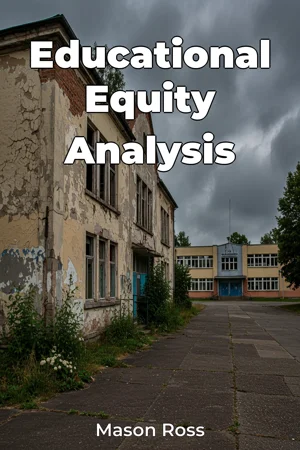
Why do some schools flourish while others struggle? "Educational Equity Analysis" investigates the profound impact of disparities in school funding and resources on student achievement, offering a rigorous examination grounded in socioeconomic research and statistical data. This book tackles a complex issue with far-reaching consequences for individuals, communities, and society as a whole. This study explores three core areas: the tangible effects of unequal financial investment in schools, the less visible influence of resource allocation disparities (including teacher quality and access to technology), and the compounded impact of these inequalities on students from disadvantaged socioeconomic backgrounds. These topics are of critical importance because they directly influence the life trajectories of students and contribute to systemic inequalities within the broader society. Understanding and addressing these issues is essential for creating a more just and equitable educational system. The book operates within a rich historical context, tracing the evolution of school funding models and resource distribution strategies in relation to broader socioeconomic trends. It considers landmark court cases, policy changes, and demographic shifts that have shaped the current landscape of educational inequality. No prior expertise is needed, as the concepts are clearly defined, and statistical methods are presented in an accessible manner. The central thesis asserts that persistent inequalities in school funding and resource allocation directly impede student achievement, perpetuating cycles of poverty and limiting opportunities for social mobility. This argument is crucial because it challenges the notion that educational outcomes are solely determined by individual effort, highlighting the significant role of systemic factors. The book is structured in four parts. First, it introduces fundamental concepts of educational equity, funding models, and resource allocation strategies. Second, it explores the statistical relationship between financial inputs and academic outputs, using regression analyses and comparative studies to demonstrate the impact of funding disparities on test scores, graduation rates, and college enrollment. Third, the research expands to qualitative factors such as teacher quality, curriculum design, and access to technology, illustrating how these resources mediate the relationship between funding and student achievement. Finally, it examines the compounded effects of socioeconomic disadvantage, revealing how inequalities in school funding exacerbate existing challenges faced by students from low-income families and marginalized communities. The analysis relies on an extensive dataset comprising school district budgets, student demographic information, standardized test scores, and socioeconomic indicators from national databases and state educational agencies. The book also incorporates qualitative research, including case studies of schools with varying levels of funding and resources. This book connects to several interdisciplinary fields, including economics, sociology, and public policy. By integrating economic models of human capital development, sociological theories of social stratification, and public policy frameworks for educational reform, the study offers a comprehensive perspective on the multifaceted nature of educational inequality. "Educational Equity Analysis" distinguishes itself through its multi-method approach, combining quantitative data analysis with qualitative case studies to provide a nuanced understanding of the complex interplay between funding, resources, and student achievement. Written in a clear, academic tone, this book is intended for educators, policymakers, researchers, and anyone else committed to understanding and addressing educational inequality. It provides valuable insights for those seeking to promote equitable funding models, improve resource allocation strategies, and close achievement gaps. As an academic work in the social science genre, the book adheres to the standards of rigorous research, data-driven analysis, and evidence-based argumentation. It acknowledges the limitations of its scope, focusing primarily on the relationship between funding, resources, and student achievement while recognizing the influence of other factors such as family background and community support. The information presented has practical applications for policymakers seeking to reform school funding models, school administrators striving to improve resource allocation strategies, and educators working to support students from disadvantaged backgrounds. This book addresses ongoing debates about the effectiveness of different school funding models and the role of government intervention in promoting educational equity. By presenting rigorous empirical evidence, it aims to inform these debates and contribute to the development of evidence-based policies.
Why do some schools flourish while others struggle? "Educational Equity Analysis" investigates the profound impact of disparities in school funding and resources on student achievement, offering a rigorous examination grounded in socioeconomic research and statistical data. This book tackles a complex issue with far-reaching consequences for individuals, communities, and society as a whole. This study explores three core areas: the tangible effects of unequal financial investment in schools, the less visible influence of resource allocation disparities (including teacher quality and access to technology), and the compounded impact of these inequalities on students from disadvantaged socioeconomic backgrounds. These topics are of critical importance because they directly influence the life trajectories of students and contribute to systemic inequalities within the broader society. Understanding and addressing these issues is essential for creating a more just and equitable educational system. The book operates within a rich historical context, tracing the evolution of school funding models and resource distribution strategies in relation to broader socioeconomic trends. It considers landmark court cases, policy changes, and demographic shifts that have shaped the current landscape of educational inequality. No prior expertise is needed, as the concepts are clearly defined, and statistical methods are presented in an accessible manner. The central thesis asserts that persistent inequalities in school funding and resource allocation directly impede student achievement, perpetuating cycles of poverty and limiting opportunities for social mobility. This argument is crucial because it challenges the notion that educational outcomes are solely determined by individual effort, highlighting the significant role of systemic factors. The book is structured in four parts. First, it introduces fundamental concepts of educational equity, funding models, and resource allocation strategies. Second, it explores the statistical relationship between financial inputs and academic outputs, using regression analyses and comparative studies to demonstrate the impact of funding disparities on test scores, graduation rates, and college enrollment. Third, the research expands to qualitative factors such as teacher quality, curriculum design, and access to technology, illustrating how these resources mediate the relationship between funding and student achievement. Finally, it examines the compounded effects of socioeconomic disadvantage, revealing how inequalities in school funding exacerbate existing challenges faced by students from low-income families and marginalized communities. The analysis relies on an extensive dataset comprising school district budgets, student demographic information, standardized test scores, and socioeconomic indicators from national databases and state educational agencies. The book also incorporates qualitative research, including case studies of schools with varying levels of funding and resources. This book connects to several interdisciplinary fields, including economics, sociology, and public policy. By integrating economic models of human capital development, sociological theories of social stratification, and public policy frameworks for educational reform, the study offers a comprehensive perspective on the multifaceted nature of educational inequality. "Educational Equity Analysis" distinguishes itself through its multi-method approach, combining quantitative data analysis with qualitative case studies to provide a nuanced understanding of the complex interplay between funding, resources, and student achievement. Written in a clear, academic tone, this book is intended for educators, policymakers, researchers, and anyone else committed to understanding and addressing educational inequality. It provides valuable insights for those seeking to promote equitable funding models, improve resource allocation strategies, and close achievement gaps. As an academic work in the social science genre, the book adheres to the standards of rigorous research, data-driven analysis, and evidence-based argumentation. It acknowledges the limitations of its scope, focusing primarily on the relationship between funding, resources, and student achievement while recognizing the influence of other factors such as family background and community support. The information presented has practical applications for policymakers seeking to reform school funding models, school administrators striving to improve resource allocation strategies, and educators working to support students from disadvantaged backgrounds. This book addresses ongoing debates about the effectiveness of different school funding models and the role of government intervention in promoting educational equity. By presenting rigorous empirical evidence, it aims to inform these debates and contribute to the development of evidence-based policies.
"Educational Equity Analysis" delves into the critical link between school funding, resource allocation, and student achievement, revealing how disparities perpetuate educational inequality. This academic work examines the tangible effects of unequal financial investment and the less visible influence of resource disparities, such as teacher quality and technology access. It highlights how these factors compound to disproportionately impact disadvantaged students. The book explores the evolution of school funding models within a historical context, considering court cases, policy changes, and socioeconomic trends. A key insight is how unequal funding directly impedes student achievement, challenging the notion that individual effort alone determines educational outcomes. Statistical analyses and comparative studies demonstrate the impact of funding disparities on test scores, graduation rates, and college enrollment. Structured in four parts, the book progresses from fundamental concepts to statistical relationships, then expands to qualitative factors before examining the compounded effects of socioeconomic disadvantage. Through quantitative data analysis and qualitative case studies, "Educational Equity Analysis" offers a nuanced understanding, making it a valuable resource for educators, policymakers, and researchers committed to understanding and addressing educational inequality.
Book Details
ISBN
9788233995478
Publisher
Publifye AS
Your Licenses
You don't own any licenses for this book
Purchase a license below to unlock this book and download the EPUB.
Purchase License
Select a tier to unlock this book
Need bulk licensing?
Contact us for enterprise agreements.