
About This Book
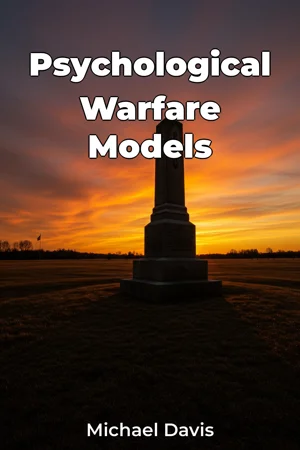
How has the battle for hearts and minds shaped the outcomes of military conflicts throughout history? This book, "Psychological Warfare Models," delves into the intricate strategies and cognitive underpinnings of psychological warfare, exploring its evolution and impact on modern conflict. This is important because in an era defined by information dominance, understanding the principles of psychological warfare is crucial for military strategists, policymakers, and anyone seeking to comprehend the dynamics of contemporary global conflicts. First, the book establishes a solid historical foundation, examining key instances of psychological warfare from ancient times to the present day. This historical overview provides context for understanding the evolution of these strategies and their adaptation to different cultural and technological landscapes. Second, the book analyzes diverse theoretical models drawn from cognitive psychology and behavioral science. These models offer insights into how propaganda, persuasion, and psychological manipulation can influence target audiences, affecting morale, decision-making, and overall behavior. The central argument is that effective psychological warfare is not merely about disseminating propaganda; it requires a nuanced understanding of human psychology, cultural contexts, and strategic objectives. This argument is vital because it challenges conventional notions of warfare and highlights the critical role of cognitive factors in achieving military and political success. The book is structured to systematically explore these concepts. It begins by defining psychological warfare and its historical roots. It then transitions into an examination of core psychological principles, such as cognitive biases, social influence, and emotional manipulation, that underpin these strategies. The subsequent sections present detailed case studies of psychological warfare campaigns from different conflicts, analyzing their effectiveness and ethical implications. The culmination of the book explores the future of psychological warfare, considering the impact of emerging technologies like artificial intelligence and social media. Evidence will be drawn from a wide range of sources, including declassified military documents, academic research in psychology and communication studies, and firsthand accounts from individuals involved in psychological warfare operations. The book will also incorporate quantitative data, such as survey results and media analytics, to assess the impact of specific campaigns. This book bridges the gap between military history, psychology, and communication studies. It offers a comprehensive and interdisciplinary perspective on psychological warfare, demonstrating its relevance to fields such as political science and international relations. What sets this book apart is its emphasis on integrating psychological models with military strategies, providing a framework for analyzing and understanding the complexities of psychological warfare. The writing style will be academic yet accessible, ensuring that the information is presented in a clear, engaging, and unbiased manner. The primary audience includes military professionals, intelligence analysts, policymakers, scholars of military history and psychology, and anyone seeking a deeper understanding of modern warfare. The scope of the book is broad, covering various historical periods and geographical regions, but it will also acknowledge its limitations, focusing primarily on state-sponsored psychological warfare campaigns. The insights from this book can be directly applied to improving strategic communication, enhancing resilience against disinformation, and developing ethical guidelines for psychological operations. The book will address ongoing debates surrounding the ethics and legality of psychological warfare, acknowledging diverse perspectives and promoting critical evaluation of these controversial practices.
How has the battle for hearts and minds shaped the outcomes of military conflicts throughout history? This book, "Psychological Warfare Models," delves into the intricate strategies and cognitive underpinnings of psychological warfare, exploring its evolution and impact on modern conflict. This is important because in an era defined by information dominance, understanding the principles of psychological warfare is crucial for military strategists, policymakers, and anyone seeking to comprehend the dynamics of contemporary global conflicts. First, the book establishes a solid historical foundation, examining key instances of psychological warfare from ancient times to the present day. This historical overview provides context for understanding the evolution of these strategies and their adaptation to different cultural and technological landscapes. Second, the book analyzes diverse theoretical models drawn from cognitive psychology and behavioral science. These models offer insights into how propaganda, persuasion, and psychological manipulation can influence target audiences, affecting morale, decision-making, and overall behavior. The central argument is that effective psychological warfare is not merely about disseminating propaganda; it requires a nuanced understanding of human psychology, cultural contexts, and strategic objectives. This argument is vital because it challenges conventional notions of warfare and highlights the critical role of cognitive factors in achieving military and political success. The book is structured to systematically explore these concepts. It begins by defining psychological warfare and its historical roots. It then transitions into an examination of core psychological principles, such as cognitive biases, social influence, and emotional manipulation, that underpin these strategies. The subsequent sections present detailed case studies of psychological warfare campaigns from different conflicts, analyzing their effectiveness and ethical implications. The culmination of the book explores the future of psychological warfare, considering the impact of emerging technologies like artificial intelligence and social media. Evidence will be drawn from a wide range of sources, including declassified military documents, academic research in psychology and communication studies, and firsthand accounts from individuals involved in psychological warfare operations. The book will also incorporate quantitative data, such as survey results and media analytics, to assess the impact of specific campaigns. This book bridges the gap between military history, psychology, and communication studies. It offers a comprehensive and interdisciplinary perspective on psychological warfare, demonstrating its relevance to fields such as political science and international relations. What sets this book apart is its emphasis on integrating psychological models with military strategies, providing a framework for analyzing and understanding the complexities of psychological warfare. The writing style will be academic yet accessible, ensuring that the information is presented in a clear, engaging, and unbiased manner. The primary audience includes military professionals, intelligence analysts, policymakers, scholars of military history and psychology, and anyone seeking a deeper understanding of modern warfare. The scope of the book is broad, covering various historical periods and geographical regions, but it will also acknowledge its limitations, focusing primarily on state-sponsored psychological warfare campaigns. The insights from this book can be directly applied to improving strategic communication, enhancing resilience against disinformation, and developing ethical guidelines for psychological operations. The book will address ongoing debates surrounding the ethics and legality of psychological warfare, acknowledging diverse perspectives and promoting critical evaluation of these controversial practices.
"Psychological Warfare Models" explores the profound impact of battles fought for hearts and minds throughout military history. It examines how psychological warfare, incorporating propaganda, persuasion, and manipulation, has evolved and influenced modern conflicts. The book argues that successful psychological warfare requires a deep understanding of human psychology and cultural contexts, challenging traditional views of warfare by highlighting the importance of cognitive factors. For example, understanding cognitive biases can be as crucial as battlefield tactics. The book uniquely combines psychological models with military strategies, providing a framework for analyzing the complexities of strategic communication and military history. Beginning with a historical overview, the book progresses to analyze psychological principles like social influence and emotional manipulation. Detailed case studies from various conflicts illustrate the effectiveness and ethical implications of these campaigns. The book concludes by considering the future of psychological warfare, including the impact of technologies like AI, making it invaluable for military strategists and anyone interested in understanding information dominance.
Book Details
ISBN
9788233994785
Publisher
Publifye AS
Your Licenses
You don't own any licenses for this book
Purchase a license below to unlock this book and download the EPUB.
Purchase License
Select a tier to unlock this book
Need bulk licensing?
Contact us for enterprise agreements.