
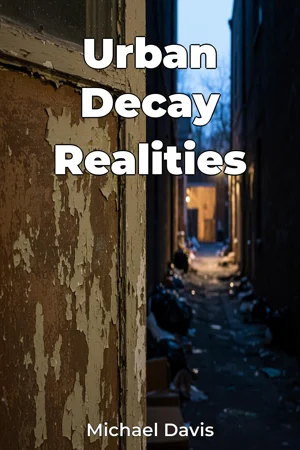
About This Book
Why do some neighborhoods thrive while others crumble? "Urban Decay Realities" confronts this pressing question, dissecting the complex interplay of factors that lead to the decline of urban spaces. This book is a crucial exploration for anyone seeking to understand the social, political, and economic forces shaping our cities. This book delves into three core areas: deteriorating infrastructure, housing neglect, and community disinvestment. Deteriorating infrastructure, from crumbling roads and bridges to outdated water systems, poses immediate safety risks and hinders economic activity. Housing neglect, characterized by abandoned buildings, substandard living conditions, and a lack of affordable options, creates cycles of poverty and instability. Community disinvestment, the systemic withdrawal of resources and opportunities from specific neighborhoods, further exacerbates these problems, fostering an environment of hopelessness and decline. Understanding these elements is paramount to formulating effective urban renewal strategies. To fully grasp these issues, "Urban Decay Realities" provides a historical context, examining the legacy of discriminatory housing policies, biased urban renewal projects, and the impact of globalization on local economies. The book assumes a basic understanding of urban planning principles and economic theory, providing accessible explanations of key concepts relevant to the discussion. The central argument is that urban decay is not simply a matter of neglect, but a consequence of deliberate policy choices and systemic inequalities that perpetuate a cycle of decline. This argument is critical because it challenges conventional narratives that often blame residents or market forces, instead focusing on the role of power structures and institutional failures. The book's structure begins with an introduction to the core concepts of urban decay, setting the stage for a deeper exploration of infrastructure, housing, and community investment through dedicated chapters. Each section develops the argument with case studies and empirical analysis, highlighting the interconnectedness of these issues. The book culminates with a discussion of potential solutions and strategies for reversing urban decay, emphasizing the importance of community-led initiatives and equitable resource allocation. Practical applications are explored through policy recommendations and examples of successful revitalization projects. "Urban Decay Realities" relies on a range of evidence, including statistical data on housing markets, infrastructure spending, and poverty rates; case studies of cities facing urban decay; and analyses of urban planning policies and their impact on communities. The book draws on academic research, government reports, and community surveys to provide a comprehensive and nuanced understanding of the issues. This book connects to several other fields, including sociology (examining social stratification and inequality), economics (analyzing market failures and investment patterns), and political science (investigating the role of government policies and power dynamics). These connections enhance the book's argument by providing a holistic perspective on the complex challenges of urban decay. "Urban Decay Realities" offers a unique perspective by integrating insights from urban planning studies with on-the-ground observations and community perspectives. This multidisciplinary approach allows for a more nuanced understanding of the lived experiences of those affected by urban decay. Written in a fact-based and analytical style, the book is intended for students, policymakers, urban planners, and anyone interested in understanding the complexities of urban development. It is valuable to those seeking a deeper understanding of the root causes of urban decline and potential solutions. As a work of social science and politics, the book adheres to the conventions of academic rigor, including extensive citations and a balanced presentation of diverse viewpoints. While the book aims to provide a broad overview of urban decay, its scope is limited to industrialized nations, focusing primarily on examples from the United States and Europe. The information in "Urban Decay Realities" can be applied practically by policymakers seeking to develop effective urban renewal strategies, community organizers advocating for equitable resource allocation, and individuals seeking to understand the forces shaping their communities. The book addresses ongoing debates regarding the role of gentrification in urban revitalization, the effectiveness of various anti-poverty programs, and the balance between private investment and public intervention in addressing urban decay. By presenting diverse perspectives and analyzing the evidence, "Urban Decay Realities" aims to foster a more informed and productive dialogue about the future of our cities.
Why do some neighborhoods thrive while others crumble? "Urban Decay Realities" confronts this pressing question, dissecting the complex interplay of factors that lead to the decline of urban spaces. This book is a crucial exploration for anyone seeking to understand the social, political, and economic forces shaping our cities. This book delves into three core areas: deteriorating infrastructure, housing neglect, and community disinvestment. Deteriorating infrastructure, from crumbling roads and bridges to outdated water systems, poses immediate safety risks and hinders economic activity. Housing neglect, characterized by abandoned buildings, substandard living conditions, and a lack of affordable options, creates cycles of poverty and instability. Community disinvestment, the systemic withdrawal of resources and opportunities from specific neighborhoods, further exacerbates these problems, fostering an environment of hopelessness and decline. Understanding these elements is paramount to formulating effective urban renewal strategies. To fully grasp these issues, "Urban Decay Realities" provides a historical context, examining the legacy of discriminatory housing policies, biased urban renewal projects, and the impact of globalization on local economies. The book assumes a basic understanding of urban planning principles and economic theory, providing accessible explanations of key concepts relevant to the discussion. The central argument is that urban decay is not simply a matter of neglect, but a consequence of deliberate policy choices and systemic inequalities that perpetuate a cycle of decline. This argument is critical because it challenges conventional narratives that often blame residents or market forces, instead focusing on the role of power structures and institutional failures. The book's structure begins with an introduction to the core concepts of urban decay, setting the stage for a deeper exploration of infrastructure, housing, and community investment through dedicated chapters. Each section develops the argument with case studies and empirical analysis, highlighting the interconnectedness of these issues. The book culminates with a discussion of potential solutions and strategies for reversing urban decay, emphasizing the importance of community-led initiatives and equitable resource allocation. Practical applications are explored through policy recommendations and examples of successful revitalization projects. "Urban Decay Realities" relies on a range of evidence, including statistical data on housing markets, infrastructure spending, and poverty rates; case studies of cities facing urban decay; and analyses of urban planning policies and their impact on communities. The book draws on academic research, government reports, and community surveys to provide a comprehensive and nuanced understanding of the issues. This book connects to several other fields, including sociology (examining social stratification and inequality), economics (analyzing market failures and investment patterns), and political science (investigating the role of government policies and power dynamics). These connections enhance the book's argument by providing a holistic perspective on the complex challenges of urban decay. "Urban Decay Realities" offers a unique perspective by integrating insights from urban planning studies with on-the-ground observations and community perspectives. This multidisciplinary approach allows for a more nuanced understanding of the lived experiences of those affected by urban decay. Written in a fact-based and analytical style, the book is intended for students, policymakers, urban planners, and anyone interested in understanding the complexities of urban development. It is valuable to those seeking a deeper understanding of the root causes of urban decline and potential solutions. As a work of social science and politics, the book adheres to the conventions of academic rigor, including extensive citations and a balanced presentation of diverse viewpoints. While the book aims to provide a broad overview of urban decay, its scope is limited to industrialized nations, focusing primarily on examples from the United States and Europe. The information in "Urban Decay Realities" can be applied practically by policymakers seeking to develop effective urban renewal strategies, community organizers advocating for equitable resource allocation, and individuals seeking to understand the forces shaping their communities. The book addresses ongoing debates regarding the role of gentrification in urban revitalization, the effectiveness of various anti-poverty programs, and the balance between private investment and public intervention in addressing urban decay. By presenting diverse perspectives and analyzing the evidence, "Urban Decay Realities" aims to foster a more informed and productive dialogue about the future of our cities.
"Urban Decay Realities" examines the multifaceted issue of urban decline, exploring why some urban areas prosper while others deteriorate. The book delves into the interconnected problems of deteriorating infrastructure, housing neglect, and community disinvestment, revealing how these factors contribute to a cycle of decay. For example, the book highlights how outdated infrastructure not only poses safety risks but also hinders economic activity, while housing neglect creates instability and poverty. The book argues that urban decay is not accidental but rather a consequence of deliberate policy choices and systemic inequalities. By presenting historical context and examining discriminatory housing policies, the book challenges conventional narratives that often blame residents or market forces. Each chapter builds upon this argument, using case studies and empirical analysis to highlight the connections between infrastructure, housing, and community investment. The book concludes by offering potential solutions and strategies, emphasizing the importance of community-led initiatives and equitable resource allocation for successful urban revitalization.
Book Details
ISBN
9788233994334
Publisher
Publifye AS
Your Licenses
You don't own any licenses for this book
Purchase a license below to unlock this book and download the EPUB.
Purchase License
Select a tier to unlock this book
Need bulk licensing?
Contact us for enterprise agreements.