
About This Book
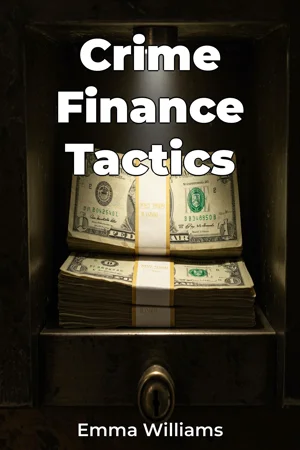
How do criminal organizations successfully integrate illicit proceeds into the legitimate global economy, and what countermeasures prove most effective against their sophisticated financial networks? "Crime Finance Tactics" delves into the intricate methods employed by criminals to launder money and evade financial controls, drawing upon extensive research in both finance and criminology to provide a comprehensive understanding of this persistent global challenge. This book examines the core strategies of money laundering, the evolution of financial control mechanisms, and the intersection of these tactics with broader economic trends. Its significance lies in offering practical insights for policymakers, financial institutions, and law enforcement agencies seeking to combat financial crime more effectively. The book provides critical context by tracing the historical development of money laundering techniques alongside the parallel evolution of regulatory frameworks designed to prevent them. Foundational financial concepts, such as risk assessment, due diligence, and regulatory compliance, are explained in detail to establish a clear understanding of the existing countermeasures. The central argument underscores that effective financial crime prevention requires a multi-faceted approach that combines robust regulatory oversight, technological innovation, and international cooperation. "Crime Finance Tactics" is structured to provide a logical and detailed exploration of its core themes. The introduction lays the groundwork by defining money laundering and outlining its various stages, from placement and layering to integration. The book then develops its argument through several key sections. First, it dissects traditional money laundering methods, such as structuring, trade-based laundering, and the use of shell companies. Second, it examines emerging tactics, including the exploitation of cryptocurrencies, online payment platforms, and the art market. Third, it analyzes the effectiveness of current financial control measures, such as anti-money laundering (AML) regulations, Know Your Customer (KYC) procedures, and international sanctions. The book culminates by proposing enhancements to existing strategies and advocating for greater collaboration between public and private sector entities. The analysis presented is supported by a wide range of evidence, including case studies, statistical data, and analyses of legal frameworks. Original datasets from financial regulators and law enforcement agencies are incorporated to provide unique insights into the scale and nature of financial crime. The book integrates findings from diverse academic fields, including economics, law, and sociology, to offer a holistic perspective on the challenges of financial crime prevention. The book connects to fields such as international relations through exploring cross-border money laundering schemes, to technology through investigation into cryptocurrency regulation, and to political science through analysis of policy implementation. A distinguishing feature of "Crime Finance Tactics" is its focus on the practical implications of academic research for real-world practitioners. The book adopts a professional and analytical tone to ensure the content is accessible to a broad audience, including finance professionals, law enforcement officers, and academics. The intended audience includes compliance officers, auditors, investigators, and policymakers seeking a detailed exposition of financial crime tactics and effective countermeasures. This book fulfills the standards of the 'Finance' and 'True Crime' genres by providing a rigorous examination of criminal activities and their financial underpinnings. While the book provides a comprehensive overview of money laundering techniques, its scope is primarily limited to methods used by criminal organizations, and does not cover the complexities of tax evasion or other financial crimes. The information presented offers practical guidance for enhancing existing AML/KYC procedures, improving risk management frameworks, and strengthening international cooperation in the fight against financial crime. The book engages with ongoing debates surrounding the regulation of cryptocurrencies and the effectiveness of current AML regulations. The conclusion emphasizes the need for continuous monitoring of financial crime trends and adaptation of strategies to stay ahead of increasingly sophisticated criminal networks.
How do criminal organizations successfully integrate illicit proceeds into the legitimate global economy, and what countermeasures prove most effective against their sophisticated financial networks? "Crime Finance Tactics" delves into the intricate methods employed by criminals to launder money and evade financial controls, drawing upon extensive research in both finance and criminology to provide a comprehensive understanding of this persistent global challenge. This book examines the core strategies of money laundering, the evolution of financial control mechanisms, and the intersection of these tactics with broader economic trends. Its significance lies in offering practical insights for policymakers, financial institutions, and law enforcement agencies seeking to combat financial crime more effectively. The book provides critical context by tracing the historical development of money laundering techniques alongside the parallel evolution of regulatory frameworks designed to prevent them. Foundational financial concepts, such as risk assessment, due diligence, and regulatory compliance, are explained in detail to establish a clear understanding of the existing countermeasures. The central argument underscores that effective financial crime prevention requires a multi-faceted approach that combines robust regulatory oversight, technological innovation, and international cooperation. "Crime Finance Tactics" is structured to provide a logical and detailed exploration of its core themes. The introduction lays the groundwork by defining money laundering and outlining its various stages, from placement and layering to integration. The book then develops its argument through several key sections. First, it dissects traditional money laundering methods, such as structuring, trade-based laundering, and the use of shell companies. Second, it examines emerging tactics, including the exploitation of cryptocurrencies, online payment platforms, and the art market. Third, it analyzes the effectiveness of current financial control measures, such as anti-money laundering (AML) regulations, Know Your Customer (KYC) procedures, and international sanctions. The book culminates by proposing enhancements to existing strategies and advocating for greater collaboration between public and private sector entities. The analysis presented is supported by a wide range of evidence, including case studies, statistical data, and analyses of legal frameworks. Original datasets from financial regulators and law enforcement agencies are incorporated to provide unique insights into the scale and nature of financial crime. The book integrates findings from diverse academic fields, including economics, law, and sociology, to offer a holistic perspective on the challenges of financial crime prevention. The book connects to fields such as international relations through exploring cross-border money laundering schemes, to technology through investigation into cryptocurrency regulation, and to political science through analysis of policy implementation. A distinguishing feature of "Crime Finance Tactics" is its focus on the practical implications of academic research for real-world practitioners. The book adopts a professional and analytical tone to ensure the content is accessible to a broad audience, including finance professionals, law enforcement officers, and academics. The intended audience includes compliance officers, auditors, investigators, and policymakers seeking a detailed exposition of financial crime tactics and effective countermeasures. This book fulfills the standards of the 'Finance' and 'True Crime' genres by providing a rigorous examination of criminal activities and their financial underpinnings. While the book provides a comprehensive overview of money laundering techniques, its scope is primarily limited to methods used by criminal organizations, and does not cover the complexities of tax evasion or other financial crimes. The information presented offers practical guidance for enhancing existing AML/KYC procedures, improving risk management frameworks, and strengthening international cooperation in the fight against financial crime. The book engages with ongoing debates surrounding the regulation of cryptocurrencies and the effectiveness of current AML regulations. The conclusion emphasizes the need for continuous monitoring of financial crime trends and adaptation of strategies to stay ahead of increasingly sophisticated criminal networks.
"Crime Finance Tactics" exposes the complex world of money laundering and financial crime, detailing how criminal organizations integrate illicit proceeds into the global financial system. It explores the evolution of these tactics alongside regulatory frameworks designed to combat them. Did you know that trade-based laundering, using import/export transactions to disguise the movement of funds, is a common method? The book also highlights how criminals exploit cryptocurrencies and online platforms, necessitating stronger international cooperation and updated financial control measures like AML and KYC. The book progresses logically, starting with the basics of money laundering—placement, layering, and integration—before dissecting traditional methods like shell companies and emerging tactics involving digital currencies. It analyzes the effectiveness of current AML regulations and advocates for enhanced strategies. A key focus is on practical implications for professionals in finance and law enforcement, offering guidance on improving risk assessment and strengthening AML/KYC procedures to effectively combat financial crime.
Book Details
ISBN
9788233994099
Publisher
Publifye AS
Your Licenses
You don't own any licenses for this book
Purchase a license below to unlock this book and download the EPUB.
Purchase License
Select a tier to unlock this book
Need bulk licensing?
Contact us for enterprise agreements.