
About This Book
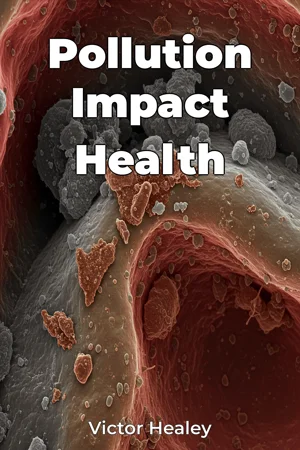
Are the very air we breathe and the cities we inhabit inadvertently making us sick? "Pollution Impact Health" delves into the intricate relationship between urban pollution, particulate matter, and the rising prevalence of allergic and respiratory conditions. This book offers a comprehensive examination of how environmental factors in urban centers contribute to a public health crisis. We will primarily explore two key topics: the composition and sources of urban pollutants, particularly particulate matter (PM), and the biological mechanisms through which these pollutants trigger or exacerbate respiratory and allergic diseases. Understanding these areas is crucial because the exponential growth of urban populations worldwide has led to a corresponding increase in air pollution exposure, making respiratory ailments a leading cause of morbidity and mortality. For context, it’s important to remember that the industrial revolution marked a turning point, introducing new pollutants into the atmosphere on a massive scale. Over the past century, urbanization has concentrated these pollutants, creating hotspots of respiratory distress. The reader should possess a basic understanding of respiratory physiology and immunology to fully appreciate the biological pathways discussed, but we provide detailed explanations throughout the book. The central argument of "Pollution Impact Health" is that sustained exposure to urban pollution, specifically PM2.5 and PM10, acts as a significant environmental risk factor contributing to the development and severity of allergic and respiratory diseases such as asthma, allergic rhinitis, and chronic obstructive pulmonary disease (COPD). This argument is vital because it challenges conventional understandings by highlighting the preventable role of environmental factors in conditions often attributed solely to genetics or lifestyle. The book unfolds in a structured manner. First, we introduce the concept of urban air pollution, defining various pollutants and their origins. Second, we examine the body’s response to particulate matter, explaining how PM triggers inflammation and immune dysregulation in the respiratory tract through major points covering: a) chemical composition PM; b) aerodynamic properties determining deposition in the respiratory tract; c) immune activation pathways in the lungs. Third, we link specific pollutants to specific health outcomes, drawing evidence from epidemiological studies and toxicological research. Finally, we consolidate the argument with exploring potential mitigation strategies and public health interventions aimed at reducing pollution exposure and improving respiratory health in urban environments. The book will be supported by a wide range of evidence, including epidemiological studies correlating pollution levels with disease prevalence, toxicological research examining the effects of pollutants on respiratory cells and animal models, and air quality data from monitoring stations worldwide. We will analyze data pulled from the World Health Organization's Global Air Quality Database and integrate findings from longitudinal cohort studies tracking respiratory health in urban populations. "Pollution Impact Health" has interdisciplinary connections to urban planning, environmental policy, and preventative medicine. Urban planning strategies that prioritize green spaces and sustainable transportation can reduce pollution emissions. Environmental policies regulating industrial emissions and promoting cleaner energy sources are essential for improving air quality. Preventative medicine can help identify and protect vulnerable populations from the harmful effects of pollution. A unique aspect of this book is its focus on the synergistic effects of multiple pollutants. Rather than examining individual pollutants in isolation, we explore how mixtures of particulate matter, ozone, nitrogen oxides, and other chemicals interact to amplify their negative health impacts. The presentation in the book is academic but accessible, aiming to bridge the gap between scientific research and public understanding. This book is for public health professionals, environmental scientists, urban planners, healthcare providers, and concerned citizens interested in understanding the health impacts of urban pollution. It is valuable to them as it consolidates dispersed research into a single evidence base. This book aligns with the expectations of the Public Health and Environment genres by providing a fact-based analysis of a pressing environmental health issue. The book's scope is limited to the respiratory and allergic health effects of urban air pollution, with less emphasis on other health impacts like cardiovascular disease or neurological disorders. The information in this work can be applied to inform public policy decisions related to air quality standards, promote personal protective measures such as wearing masks during high pollution days, and encourage community-level initiatives to reduce pollution emissions. Some areas are addressed within the context of the book that are subject to ongoing debates, such as the effectiveness of various air filtration technologies and the ethical considerations of implementing pollution control measures. However, we will engage with the book’s perspective and approach in an objective and balanced manner.
Are the very air we breathe and the cities we inhabit inadvertently making us sick? "Pollution Impact Health" delves into the intricate relationship between urban pollution, particulate matter, and the rising prevalence of allergic and respiratory conditions. This book offers a comprehensive examination of how environmental factors in urban centers contribute to a public health crisis. We will primarily explore two key topics: the composition and sources of urban pollutants, particularly particulate matter (PM), and the biological mechanisms through which these pollutants trigger or exacerbate respiratory and allergic diseases. Understanding these areas is crucial because the exponential growth of urban populations worldwide has led to a corresponding increase in air pollution exposure, making respiratory ailments a leading cause of morbidity and mortality. For context, it’s important to remember that the industrial revolution marked a turning point, introducing new pollutants into the atmosphere on a massive scale. Over the past century, urbanization has concentrated these pollutants, creating hotspots of respiratory distress. The reader should possess a basic understanding of respiratory physiology and immunology to fully appreciate the biological pathways discussed, but we provide detailed explanations throughout the book. The central argument of "Pollution Impact Health" is that sustained exposure to urban pollution, specifically PM2.5 and PM10, acts as a significant environmental risk factor contributing to the development and severity of allergic and respiratory diseases such as asthma, allergic rhinitis, and chronic obstructive pulmonary disease (COPD). This argument is vital because it challenges conventional understandings by highlighting the preventable role of environmental factors in conditions often attributed solely to genetics or lifestyle. The book unfolds in a structured manner. First, we introduce the concept of urban air pollution, defining various pollutants and their origins. Second, we examine the body’s response to particulate matter, explaining how PM triggers inflammation and immune dysregulation in the respiratory tract through major points covering: a) chemical composition PM; b) aerodynamic properties determining deposition in the respiratory tract; c) immune activation pathways in the lungs. Third, we link specific pollutants to specific health outcomes, drawing evidence from epidemiological studies and toxicological research. Finally, we consolidate the argument with exploring potential mitigation strategies and public health interventions aimed at reducing pollution exposure and improving respiratory health in urban environments. The book will be supported by a wide range of evidence, including epidemiological studies correlating pollution levels with disease prevalence, toxicological research examining the effects of pollutants on respiratory cells and animal models, and air quality data from monitoring stations worldwide. We will analyze data pulled from the World Health Organization's Global Air Quality Database and integrate findings from longitudinal cohort studies tracking respiratory health in urban populations. "Pollution Impact Health" has interdisciplinary connections to urban planning, environmental policy, and preventative medicine. Urban planning strategies that prioritize green spaces and sustainable transportation can reduce pollution emissions. Environmental policies regulating industrial emissions and promoting cleaner energy sources are essential for improving air quality. Preventative medicine can help identify and protect vulnerable populations from the harmful effects of pollution. A unique aspect of this book is its focus on the synergistic effects of multiple pollutants. Rather than examining individual pollutants in isolation, we explore how mixtures of particulate matter, ozone, nitrogen oxides, and other chemicals interact to amplify their negative health impacts. The presentation in the book is academic but accessible, aiming to bridge the gap between scientific research and public understanding. This book is for public health professionals, environmental scientists, urban planners, healthcare providers, and concerned citizens interested in understanding the health impacts of urban pollution. It is valuable to them as it consolidates dispersed research into a single evidence base. This book aligns with the expectations of the Public Health and Environment genres by providing a fact-based analysis of a pressing environmental health issue. The book's scope is limited to the respiratory and allergic health effects of urban air pollution, with less emphasis on other health impacts like cardiovascular disease or neurological disorders. The information in this work can be applied to inform public policy decisions related to air quality standards, promote personal protective measures such as wearing masks during high pollution days, and encourage community-level initiatives to reduce pollution emissions. Some areas are addressed within the context of the book that are subject to ongoing debates, such as the effectiveness of various air filtration technologies and the ethical considerations of implementing pollution control measures. However, we will engage with the book’s perspective and approach in an objective and balanced manner.
"Pollution Impact Health" investigates the alarming connection between urban pollution and respiratory health, particularly the role of particulate matter (PM) in triggering allergic diseases and conditions like asthma and COPD. The book argues that sustained exposure to PM2.5 and PM10 acts as a significant environmental risk factor, challenging assumptions that these diseases are solely attributable to genetics or lifestyle. One intriguing insight is the focus on the synergistic effects of multiple pollutants, where the combination of particulate matter, ozone, and nitrogen oxides amplifies negative health impacts. This exploration is crucial given the exponential growth of urban populations and the corresponding rise in air pollution exposure. The book unfolds logically, beginning with defining urban air pollution and its origins. It then examines the body's response to particulate matter, detailing how PM triggers inflammation and immune dysregulation in the respiratory tract. Evidence from epidemiological studies and toxicological research is presented to link specific pollutants to specific health outcomes. The book is uniquely valuable to public health professionals, environmental scientists, and concerned citizens by consolidating dispersed research into a single evidence base, presenting it in an academic yet accessible manner, bridging the gap between scientific research and public understanding. Finally, the book explores potential mitigation strategies and public health interventions aimed at reducing pollution exposure in urban environments. By examining data from organizations like the World Health Organization, "Pollution Impact Health" offers a comprehensive understanding of this critical environmental and public health issue.
Book Details
ISBN
9788233993382
Publisher
Publifye AS
Your Licenses
You don't own any licenses for this book
Purchase a license below to unlock this book and download the EPUB.
Purchase License
Select a tier to unlock this book
Need bulk licensing?
Contact us for enterprise agreements.