
About This Book
Are we overlooking the most fundamental element of sustainable agriculture: the soil itself? "Soil Fertility Management" delves into the critical role of natural soil enhancement methods and strategic crop rotation in achieving long-term agricultural productivity and environmental health. This book explores two central themes: first, the revitalization of soil ecosystems through natural amendments and biological processes, and second, the optimization of crop yields and soil health through carefully planned crop rotations. These topics are paramount because they offer alternatives to conventional agricultural practices that often degrade soil quality and rely heavily on synthetic inputs. Understanding the history of agricultural practices and their impact on soil is crucial. This book provides a necessary overview, touching on the shift from traditional farming methods to industrialized agriculture, highlighting the subsequent soil degradation, erosion, and loss of biodiversity. While no prior in-depth knowledge is required, a basic understanding of agricultural principles or environmental science will be beneficial for the reader. The central argument presented is that a shift towards soil-centric agricultural practices is not only environmentally responsible but also economically viable in the long run. It posits that by understanding and harnessing natural soil processes, we can reduce our dependence on synthetic fertilizers and pesticides, leading to healthier ecosystems and more resilient agricultural systems. This argument is vital because it challenges the conventional wisdom that high yields can only be achieved through intensive chemical inputs. The book is structured to guide the reader through a comprehensive understanding of soil fertility management. It begins by introducing core concepts of soil science, examining the physical, chemical, and biological properties of soil and their influence on plant growth. The subsequent section explores various natural soil enhancement methods, including the use of cover crops, compost, biochar, and other organic amendments. Each method is analyzed in terms of its impact on soil structure, nutrient availability, water retention, and microbial activity. A vital aspect is the exploration of crop rotation strategies, detailing how different crop sequences can improve soil health, break pest and disease cycles, and enhance nutrient cycling. Later chapters cover practical implementations, showcasing successful case studies from diverse agricultural settings, and concludes by projecting to the future of soil management, addressing the challenges posed by climate change and the increasing demand for food. The evidence presented in the book draws from a wide range of sources, including peer-reviewed scientific studies, field experiments, and agricultural research reports. The book also incorporates data from long-term agricultural trials, providing empirical support for the effectiveness of natural soil enhancement methods and crop rotation strategies, further enriched by soil analysis data and case studies. "Soil Fertility Management" also connects to several other fields, including ecology, economics, and public health. By understanding the ecological interactions within the soil ecosystem, we can develop more sustainable agricultural practices. The economic analysis of soil management practices demonstrates the long-term cost-effectiveness of investing in soil health. And the connection to public health stems from the fact that healthier soils produce more nutritious crops, contributing to improved human well-being. This work offers a unique perspective by integrating the latest scientific research with practical, on-farm applications. It emphasizes a holistic approach to soil management, viewing the soil as a living ecosystem rather than simply a medium for plant growth. Written in an accessible and informative style, "Soil Fertility Management" is intended for a broad audience, including farmers, agricultural extension agents, students, researchers, and anyone interested in sustainable agriculture and environmental conservation. It is designed to appeal to those seeking practical solutions for improving soil health and reducing their reliance on synthetic inputs. As a work in the life sciences and nature genres, it delivers scientifically sound information while highlighting the natural processes at play in soil fertility. The book focuses on methodologies and scientific findings, excluding anecdotal stories. While the book aims to provide a comprehensive overview of soil fertility management, it primarily emphasizes temperate agricultural systems, with less focus on tropical or arid environments, although the underlying principles remain globally applicable. Readers will gain practical knowledge and tools for implementing soil-friendly practices on their own farms or in their communities. They will learn how to assess soil health, select appropriate cover crops, develop effective crop rotation plans, and produce high-quality compost. The book also addresses the ongoing debate surrounding organic versus conventional agriculture, offering a balanced perspective on the role of synthetic inputs in modern agriculture while advocating for a more sustainable and soil-centric approach.
Are we overlooking the most fundamental element of sustainable agriculture: the soil itself? "Soil Fertility Management" delves into the critical role of natural soil enhancement methods and strategic crop rotation in achieving long-term agricultural productivity and environmental health. This book explores two central themes: first, the revitalization of soil ecosystems through natural amendments and biological processes, and second, the optimization of crop yields and soil health through carefully planned crop rotations. These topics are paramount because they offer alternatives to conventional agricultural practices that often degrade soil quality and rely heavily on synthetic inputs. Understanding the history of agricultural practices and their impact on soil is crucial. This book provides a necessary overview, touching on the shift from traditional farming methods to industrialized agriculture, highlighting the subsequent soil degradation, erosion, and loss of biodiversity. While no prior in-depth knowledge is required, a basic understanding of agricultural principles or environmental science will be beneficial for the reader. The central argument presented is that a shift towards soil-centric agricultural practices is not only environmentally responsible but also economically viable in the long run. It posits that by understanding and harnessing natural soil processes, we can reduce our dependence on synthetic fertilizers and pesticides, leading to healthier ecosystems and more resilient agricultural systems. This argument is vital because it challenges the conventional wisdom that high yields can only be achieved through intensive chemical inputs. The book is structured to guide the reader through a comprehensive understanding of soil fertility management. It begins by introducing core concepts of soil science, examining the physical, chemical, and biological properties of soil and their influence on plant growth. The subsequent section explores various natural soil enhancement methods, including the use of cover crops, compost, biochar, and other organic amendments. Each method is analyzed in terms of its impact on soil structure, nutrient availability, water retention, and microbial activity. A vital aspect is the exploration of crop rotation strategies, detailing how different crop sequences can improve soil health, break pest and disease cycles, and enhance nutrient cycling. Later chapters cover practical implementations, showcasing successful case studies from diverse agricultural settings, and concludes by projecting to the future of soil management, addressing the challenges posed by climate change and the increasing demand for food. The evidence presented in the book draws from a wide range of sources, including peer-reviewed scientific studies, field experiments, and agricultural research reports. The book also incorporates data from long-term agricultural trials, providing empirical support for the effectiveness of natural soil enhancement methods and crop rotation strategies, further enriched by soil analysis data and case studies. "Soil Fertility Management" also connects to several other fields, including ecology, economics, and public health. By understanding the ecological interactions within the soil ecosystem, we can develop more sustainable agricultural practices. The economic analysis of soil management practices demonstrates the long-term cost-effectiveness of investing in soil health. And the connection to public health stems from the fact that healthier soils produce more nutritious crops, contributing to improved human well-being. This work offers a unique perspective by integrating the latest scientific research with practical, on-farm applications. It emphasizes a holistic approach to soil management, viewing the soil as a living ecosystem rather than simply a medium for plant growth. Written in an accessible and informative style, "Soil Fertility Management" is intended for a broad audience, including farmers, agricultural extension agents, students, researchers, and anyone interested in sustainable agriculture and environmental conservation. It is designed to appeal to those seeking practical solutions for improving soil health and reducing their reliance on synthetic inputs. As a work in the life sciences and nature genres, it delivers scientifically sound information while highlighting the natural processes at play in soil fertility. The book focuses on methodologies and scientific findings, excluding anecdotal stories. While the book aims to provide a comprehensive overview of soil fertility management, it primarily emphasizes temperate agricultural systems, with less focus on tropical or arid environments, although the underlying principles remain globally applicable. Readers will gain practical knowledge and tools for implementing soil-friendly practices on their own farms or in their communities. They will learn how to assess soil health, select appropriate cover crops, develop effective crop rotation plans, and produce high-quality compost. The book also addresses the ongoing debate surrounding organic versus conventional agriculture, offering a balanced perspective on the role of synthetic inputs in modern agriculture while advocating for a more sustainable and soil-centric approach.
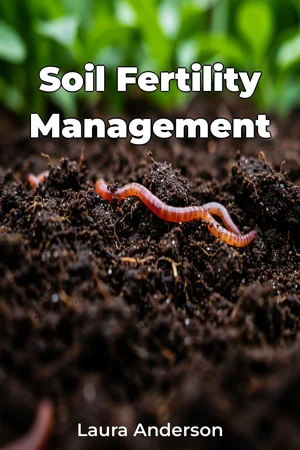
"Soil Fertility Management" explores the critical role of soil health in sustainable agriculture, advocating for natural soil enhancement and strategic crop rotation. The book emphasizes revitalizing soil ecosystems using organic amendments and optimizing crop yields through planned rotations, offering an alternative to conventional, input-heavy methods. Readers will discover how understanding soil's biological processes can lead to more resilient and environmentally friendly agricultural systems. The book begins with the basics of soil science, examining its physical, chemical, and biological properties and their impact on plant growth. Subsequent chapters detail natural enhancement methods like cover crops and compost, analyzing their effects on soil structure and nutrient availability. The book also explores crop rotation strategies to improve soil health and break pest cycles. By integrating research with practical applications, "Soil Fertility Management" presents a holistic approach, viewing soil as a living ecosystem, and concludes with case studies and a projection of future soil management in the face of climate change.
Book Details
ISBN
9788233993009
Publisher
Publifye AS
Your Licenses
You don't own any licenses for this book
Purchase a license below to unlock this book and download the EPUB.
Purchase License
Select a tier to unlock this book
Need bulk licensing?
Contact us for enterprise agreements.