
About This Book
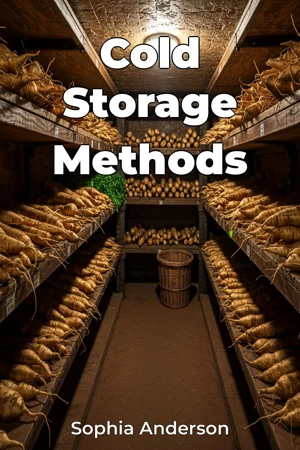
How can we feed a growing world population sustainably without relying on energy-intensive refrigeration? "Cold Storage Methods" explores the physics behind non-electric food preservation and innovative storage system designs, offering a comprehensive guide to extending the shelf life of food using natural thermal principles. This book delves into the crucial role of thermal physics in developing effective and sustainable food preservation techniques, particularly in regions where access to electricity is limited or unreliable. This is becoming increasingly relevant as climate change impacts strain conventional cooling methods. We will investigate two key concepts: passive cooling and controlled atmosphere storage. Passive cooling explores designs and methods to use natural phenomena such as evaporative cooling, radiative cooling, and geothermal cooling to maintain low storage temperatures. Controlled atmosphere storage focuses on modifying the gaseous composition of the storage environment to slow down spoilage processes. Understanding these principles allows for the design of storage solutions that minimize reliance on external energy sources. Historically, many civilizations developed sophisticated food preservation techniques based on observations of natural phenomena. These age-old practices, often overlooked in our modern, electricity-driven world, offer valuable insights into sustainable preservation. This book bridges the gap between traditional knowledge and modern scientific understanding, providing a physics-based analysis of these techniques. While some familiarity with basic physics concepts, such as heat transfer and thermodynamics, will be helpful, the book is written to be accessible to a broad audience. The central argument of "Cold Storage Methods" is that a deep understanding of thermal physics allows for the design, optimization, and widespread implementation of non-electric food preservation systems. These methods are crucial for food security, reducing food waste, and promoting sustainable agriculture, especially in developing countries and off-grid communities. The book is structured to systematically build upon foundational concepts. First, we introduce the fundamental principles of heat transfer, thermodynamics, and psychrometry as they relate to food preservation. Then, we explore various passive cooling methods, dedicating chapters to evaporative cooling, radiative cooling, earth-air heat exchangers, and nocturnal cooling. We also delve into the principles of controlled atmosphere storage, discussing the effects of modifying oxygen, carbon dioxide, and ethylene levels on food spoilage. The book culminates in a discussion of integrated storage system designs, incorporating multiple passive cooling and controlled atmosphere techniques to achieve optimal preservation. Practical applications and case studies demonstrate the effectiveness of these methods in diverse climates and agricultural settings. The evidence presented in "Cold Storage Methods" is drawn from a variety of sources, including peer-reviewed scientific literature, experimental data from laboratory studies, and field observations of existing non-electric storage systems. In addition, we incorporate unique data from our own research on the performance of novel passive cooling designs in different climatic regions. Modeling based on computational fluid dynamics and heat transfer simulations is used to support our conclusions. This book bridges physics with agricultural science, engineering, and even economics. By understanding the physics of food preservation, agricultural scientists can develop crops better suited for long-term storage. Engineers can design more efficient and cost-effective storage systems. Economists can analyze the economic viability and social impact of implementing these technologies in different communities. This book offers a fresh perspective by applying rigorous scientific analysis to traditional practices and promoting interdisciplinary collaboration. The approach of "Cold Storage Methods" is to provide a scientifically grounded understanding of non-electric food preservation, moving beyond anecdotal evidence and subjective assessments. The objective is to provide the reader with the knowledge and tools necessary to design and implement effective storage solutions tailored to specific needs and environments. This book is targeted towards a broad audience, including agricultural scientists, engineers, policymakers, farmers, and anyone interested in sustainable food systems. It will be particularly valuable to individuals and organizations working in rural development, disaster relief, and off-grid communities. As a work of applied physics, the book emphasizes empirical data, mathematical models, and engineering design principles, adhering to the conventions of scientific rigor and evidence-based analysis associated with this genre. The scope of the book is limited to non-electric food preservation techniques, primarily focusing on methods suitable for short- to medium-term storage. It does not cover industrial-scale refrigeration or food processing technologies. The information presented in "Cold Storage Methods" can be practically applied by farmers to reduce post-harvest losses, by engineers to design sustainable storage facilities, and by policymakers to promote food security in vulnerable regions. While there is general agreement on the benefits of reducing food waste, debates exist regarding the optimal methods for achieving this goal. This book offers a unique perspective by emphasizing the potential of passive cooling and controlled atmosphere storage as cost-effective and environmentally friendly solutions.
How can we feed a growing world population sustainably without relying on energy-intensive refrigeration? "Cold Storage Methods" explores the physics behind non-electric food preservation and innovative storage system designs, offering a comprehensive guide to extending the shelf life of food using natural thermal principles. This book delves into the crucial role of thermal physics in developing effective and sustainable food preservation techniques, particularly in regions where access to electricity is limited or unreliable. This is becoming increasingly relevant as climate change impacts strain conventional cooling methods. We will investigate two key concepts: passive cooling and controlled atmosphere storage. Passive cooling explores designs and methods to use natural phenomena such as evaporative cooling, radiative cooling, and geothermal cooling to maintain low storage temperatures. Controlled atmosphere storage focuses on modifying the gaseous composition of the storage environment to slow down spoilage processes. Understanding these principles allows for the design of storage solutions that minimize reliance on external energy sources. Historically, many civilizations developed sophisticated food preservation techniques based on observations of natural phenomena. These age-old practices, often overlooked in our modern, electricity-driven world, offer valuable insights into sustainable preservation. This book bridges the gap between traditional knowledge and modern scientific understanding, providing a physics-based analysis of these techniques. While some familiarity with basic physics concepts, such as heat transfer and thermodynamics, will be helpful, the book is written to be accessible to a broad audience. The central argument of "Cold Storage Methods" is that a deep understanding of thermal physics allows for the design, optimization, and widespread implementation of non-electric food preservation systems. These methods are crucial for food security, reducing food waste, and promoting sustainable agriculture, especially in developing countries and off-grid communities. The book is structured to systematically build upon foundational concepts. First, we introduce the fundamental principles of heat transfer, thermodynamics, and psychrometry as they relate to food preservation. Then, we explore various passive cooling methods, dedicating chapters to evaporative cooling, radiative cooling, earth-air heat exchangers, and nocturnal cooling. We also delve into the principles of controlled atmosphere storage, discussing the effects of modifying oxygen, carbon dioxide, and ethylene levels on food spoilage. The book culminates in a discussion of integrated storage system designs, incorporating multiple passive cooling and controlled atmosphere techniques to achieve optimal preservation. Practical applications and case studies demonstrate the effectiveness of these methods in diverse climates and agricultural settings. The evidence presented in "Cold Storage Methods" is drawn from a variety of sources, including peer-reviewed scientific literature, experimental data from laboratory studies, and field observations of existing non-electric storage systems. In addition, we incorporate unique data from our own research on the performance of novel passive cooling designs in different climatic regions. Modeling based on computational fluid dynamics and heat transfer simulations is used to support our conclusions. This book bridges physics with agricultural science, engineering, and even economics. By understanding the physics of food preservation, agricultural scientists can develop crops better suited for long-term storage. Engineers can design more efficient and cost-effective storage systems. Economists can analyze the economic viability and social impact of implementing these technologies in different communities. This book offers a fresh perspective by applying rigorous scientific analysis to traditional practices and promoting interdisciplinary collaboration. The approach of "Cold Storage Methods" is to provide a scientifically grounded understanding of non-electric food preservation, moving beyond anecdotal evidence and subjective assessments. The objective is to provide the reader with the knowledge and tools necessary to design and implement effective storage solutions tailored to specific needs and environments. This book is targeted towards a broad audience, including agricultural scientists, engineers, policymakers, farmers, and anyone interested in sustainable food systems. It will be particularly valuable to individuals and organizations working in rural development, disaster relief, and off-grid communities. As a work of applied physics, the book emphasizes empirical data, mathematical models, and engineering design principles, adhering to the conventions of scientific rigor and evidence-based analysis associated with this genre. The scope of the book is limited to non-electric food preservation techniques, primarily focusing on methods suitable for short- to medium-term storage. It does not cover industrial-scale refrigeration or food processing technologies. The information presented in "Cold Storage Methods" can be practically applied by farmers to reduce post-harvest losses, by engineers to design sustainable storage facilities, and by policymakers to promote food security in vulnerable regions. While there is general agreement on the benefits of reducing food waste, debates exist regarding the optimal methods for achieving this goal. This book offers a unique perspective by emphasizing the potential of passive cooling and controlled atmosphere storage as cost-effective and environmentally friendly solutions.
"Cold Storage Methods" examines the science behind preserving food without electricity, a crucial topic for sustainable agriculture, food security, and reducing food waste. It explores how understanding thermal physics can lead to effective, non-electric food preservation, particularly valuable for off-grid communities and regions with unreliable power. The book highlights two key areas: passive cooling, using natural phenomena like evaporative and radiative cooling, and controlled atmosphere storage, which modifies the storage environment to slow spoilage. Delving into age-old practices through a modern scientific lens, the book bridges traditional knowledge with physics. For example, understanding heat transfer principles allows for optimization of storage designs. The book begins with thermodynamics and heat transfer fundamentals, progressing to various passive cooling methods and controlled atmosphere principles, before culminating in integrated storage system designs. Case studies illustrate the effectiveness of these methods across diverse climates. The book's unique value lies in its rigorous, physics-based analysis, offering a scientific approach to traditional methods. It targets agricultural scientists, engineers, and policymakers, providing the knowledge to design sustainable storage solutions. By presenting empirical data, mathematical models, and engineering design principles, "Cold Storage Methods" emphasizes the practicality of non-electric food preservation.
Book Details
ISBN
9788233992965
Publisher
Publifye AS
Your Licenses
You don't own any licenses for this book
Purchase a license below to unlock this book and download the EPUB.
Purchase License
Select a tier to unlock this book
Need bulk licensing?
Contact us for enterprise agreements.