
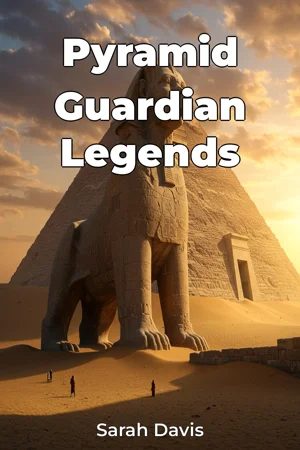
About This Book
What secrets truly lie buried beneath the sands, and what guardians, real or imagined, have stood watch over these ancient monuments? "Pyramid Guardian Legends" delves into the fascinating world of beliefs surrounding the sacred pyramids of various cultures, exploring the myths of spirits, divine protectors, and creatures said to safeguard these powerful structures. This book examines how these legends intertwine with religious practices, historical events, and the very fabric of these societies. The core of our investigation focuses on three key areas: the evolution of guardian spirit beliefs, the historical context of pyramid construction and usage, and the comparative analysis of guardian myths across different cultures. Understanding these topics is crucial because they reveal how ancient civilizations perceived the afterlife, power, and the role of the divine in their daily lives. Furthermore, myths serve as a window into the societal values, fears, and hopes of the people who created them, providing invaluable insights into their worldviews. To fully appreciate the significance of pyramid guardian legends, we provide a detailed historical backdrop. We begin with an overview of pyramid construction techniques, the social structures necessary for such monumental projects, and the religious beliefs that motivated their construction. This context allows readers to understand why specific guardians were chosen and how their roles mirrored the needs and anxieties of the societies they protected. It is a vital piece of the puzzle, essential for understanding the profound connection between ancient cultures and their pyramids. The central argument of this book is that pyramid guardian legends, far from being mere fantastical stories, represent complex systems of belief that legitimized religious authority, reinforced social hierarchies, and provided a framework for understanding the unknown. These legends acted as both a deterrent against tomb raiding and a spiritual map for navigating the afterlife. "Pyramid Guardian Legends" is structured in three distinct sections. The first section introduces the concept of guardian spirits and their evolving roles from early animistic beliefs to more complex pantheons. The second section analyzes specific myths and legends associated with pyramids in different cultures, including Egypt, Mesoamerica, and Asia, examining the specific creatures and deities assigned to guardianship. The final section synthesizes these findings, arguing for the interconnectedness of these beliefs and their importance in understanding ancient civilizations. The evidence presented is drawn from a variety of sources, including archaeological findings, ancient texts, religious scriptures, and comparative mythology. We incorporate data from recent excavations that shed new light on burial practices and religious rituals associated with pyramids. We also analyze artistic representations of guardians found within pyramids and on related artifacts, offering a visual dimension to our analysis. This study cuts across several disciplines. It engages with religious studies through the examination of ancient belief systems. It draws on history to provide factual context for pyramid construction and usage. And it uses anthropology to understand the societal function of myth and legend. By integrating these fields, we offer a holistic understanding of pyramid guardian legends. This book adopts a comparative mythological approach, highlighting both the similarities and differences between guardian beliefs across different cultures. We challenge the notion that these beliefs are simply superstitious, arguing instead that they represent sophisticated philosophical and religious systems. The book's tone is scholarly yet accessible, aiming to engage both academic audiences and general readers interested in ancient history, mythology, and religion. The goal is to present complex information in a clear and engaging manner, avoiding jargon where possible and providing clear definitions of key terms. The target audience includes students and scholars of ancient history, religion, and mythology, as well as general readers with an interest in these topics. The book offers value by providing a comprehensive overview of pyramid guardian legends, synthesizing information from diverse sources, and presenting a fresh perspective on the role of myth in shaping ancient societies. As a work of non-fiction, this book adheres to the principles of factual accuracy, objectivity, and evidence-based analysis. We strive to present a balanced view of existing scholarship, acknowledging different interpretations and controversies where appropriate. The scope of this book is limited to the investigation of pyramid guardian legends in select cultures. We acknowledge that there are other forms of ancient monumental architecture and related mythologies that fall outside the purview of this specific study. The information presented in "Pyramid Guardian Legends" has practical applications for understanding the cultural heritage of the societies that built these pyramids. It can also inform contemporary discussions about the preservation of ancient sites and the ethics of archaeological research. Throughout the book, we address ongoing debates about the interpretation of ancient religious texts and the reconstruction of ancient belief systems. By engaging with these debates, we aim to provide a nuanced and critical perspective on the subject matter.
What secrets truly lie buried beneath the sands, and what guardians, real or imagined, have stood watch over these ancient monuments? "Pyramid Guardian Legends" delves into the fascinating world of beliefs surrounding the sacred pyramids of various cultures, exploring the myths of spirits, divine protectors, and creatures said to safeguard these powerful structures. This book examines how these legends intertwine with religious practices, historical events, and the very fabric of these societies. The core of our investigation focuses on three key areas: the evolution of guardian spirit beliefs, the historical context of pyramid construction and usage, and the comparative analysis of guardian myths across different cultures. Understanding these topics is crucial because they reveal how ancient civilizations perceived the afterlife, power, and the role of the divine in their daily lives. Furthermore, myths serve as a window into the societal values, fears, and hopes of the people who created them, providing invaluable insights into their worldviews. To fully appreciate the significance of pyramid guardian legends, we provide a detailed historical backdrop. We begin with an overview of pyramid construction techniques, the social structures necessary for such monumental projects, and the religious beliefs that motivated their construction. This context allows readers to understand why specific guardians were chosen and how their roles mirrored the needs and anxieties of the societies they protected. It is a vital piece of the puzzle, essential for understanding the profound connection between ancient cultures and their pyramids. The central argument of this book is that pyramid guardian legends, far from being mere fantastical stories, represent complex systems of belief that legitimized religious authority, reinforced social hierarchies, and provided a framework for understanding the unknown. These legends acted as both a deterrent against tomb raiding and a spiritual map for navigating the afterlife. "Pyramid Guardian Legends" is structured in three distinct sections. The first section introduces the concept of guardian spirits and their evolving roles from early animistic beliefs to more complex pantheons. The second section analyzes specific myths and legends associated with pyramids in different cultures, including Egypt, Mesoamerica, and Asia, examining the specific creatures and deities assigned to guardianship. The final section synthesizes these findings, arguing for the interconnectedness of these beliefs and their importance in understanding ancient civilizations. The evidence presented is drawn from a variety of sources, including archaeological findings, ancient texts, religious scriptures, and comparative mythology. We incorporate data from recent excavations that shed new light on burial practices and religious rituals associated with pyramids. We also analyze artistic representations of guardians found within pyramids and on related artifacts, offering a visual dimension to our analysis. This study cuts across several disciplines. It engages with religious studies through the examination of ancient belief systems. It draws on history to provide factual context for pyramid construction and usage. And it uses anthropology to understand the societal function of myth and legend. By integrating these fields, we offer a holistic understanding of pyramid guardian legends. This book adopts a comparative mythological approach, highlighting both the similarities and differences between guardian beliefs across different cultures. We challenge the notion that these beliefs are simply superstitious, arguing instead that they represent sophisticated philosophical and religious systems. The book's tone is scholarly yet accessible, aiming to engage both academic audiences and general readers interested in ancient history, mythology, and religion. The goal is to present complex information in a clear and engaging manner, avoiding jargon where possible and providing clear definitions of key terms. The target audience includes students and scholars of ancient history, religion, and mythology, as well as general readers with an interest in these topics. The book offers value by providing a comprehensive overview of pyramid guardian legends, synthesizing information from diverse sources, and presenting a fresh perspective on the role of myth in shaping ancient societies. As a work of non-fiction, this book adheres to the principles of factual accuracy, objectivity, and evidence-based analysis. We strive to present a balanced view of existing scholarship, acknowledging different interpretations and controversies where appropriate. The scope of this book is limited to the investigation of pyramid guardian legends in select cultures. We acknowledge that there are other forms of ancient monumental architecture and related mythologies that fall outside the purview of this specific study. The information presented in "Pyramid Guardian Legends" has practical applications for understanding the cultural heritage of the societies that built these pyramids. It can also inform contemporary discussions about the preservation of ancient sites and the ethics of archaeological research. Throughout the book, we address ongoing debates about the interpretation of ancient religious texts and the reconstruction of ancient belief systems. By engaging with these debates, we aim to provide a nuanced and critical perspective on the subject matter.
"Pyramid Guardian Legends" explores the captivating myths and beliefs surrounding the guardians of ancient pyramids across various cultures. It delves into how these legends reflect the religious practices, historical events, and societal values of civilizations that built these monumental structures. These guardians, whether spirits, divine protectors, or mythical creatures, were believed to safeguard the sacred pyramids. The book reveals how these myths acted not only as deterrents against tomb raiding but also as spiritual maps for navigating the afterlife. The book examines the evolution of guardian spirit beliefs, the historical context of pyramid construction, and a comparative analysis of guardian myths across different cultures, including those in Egypt, Mesoamerica, and Asia. It provides a detailed historical backdrop, covering pyramid construction techniques, social structures, and religious motivations. This approach allows readers to grasp why specific guardians were chosen and how their roles mirrored societal anxieties. The exploration of archaeological findings offers insights into burial practices and religious rituals, enriching our understanding of these ancient cultures. It highlights that pyramid guardian legends represent complex systems of belief that legitimized religious authority and reinforced social hierarchies. The book adopts a comparative mythological approach, highlighting similarities and differences in guardian beliefs across cultures. It progresses through three sections: introducing guardian spirits, analyzing specific myths from different cultures, and synthesizing findings to demonstrate the interconnectedness of these beliefs. This comprehensive overview offers a fresh perspective on the role of myth in shaping ancient societies, making it valuable for both academic audiences and general readers interested in religion, history, and ancient civilizations.
Book Details
ISBN
9788233992293
Publisher
Publifye AS
Your Licenses
You don't own any licenses for this book
Purchase a license below to unlock this book and download the EPUB.
Purchase License
Select a tier to unlock this book
Need bulk licensing?
Contact us for enterprise agreements.