
About This Book
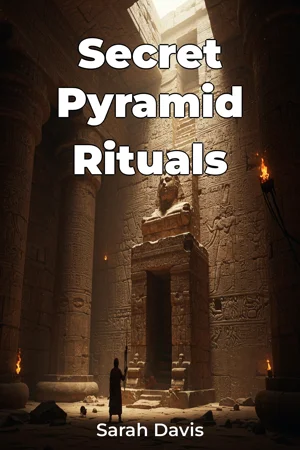
What secrets lie hidden within the towering pyramids and elaborate tombs of ancient civilizations? *Secret Pyramid Rituals* delves into the spiritual and religious ceremonies enacted within these monumental structures, offering a comprehensive exploration of the beliefs and practices that shaped ancient societies. This book will navigate the intricate world of pyramid temples and tombs, revealing the profound connections between earthly life and the divine realm as perceived by those who built and used them. This exploration focuses principally on the rituals performed and the associated theological underpinnings, specifically examining funerary rites connected to ensuring passage into the afterlife, royal rituals designed to legitimize and empower rulers, and solar cult ceremonies intended to maintain cosmic order and harmony. These topics are significant because they provide crucial insights into the worldview of past cultures, the nature of power and authority, and the human quest for immortality and spiritual enlightenment. The book provides a detailed historical context, drawing upon archaeological findings, textual analysis of ancient religious scripts, and comparative studies of different pyramid-building cultures, including Egypt, Mesoamerica, and other relevant regions. Readers will gain a foundational understanding of ancient religious beliefs, social hierarchies, and architectural symbolism before diving into the specifics of pyramid rituals. The central argument posits that pyramid rituals were complex performances integrating elements of cosmology, theology, and political ideology, serving not only to honor deities and the deceased but also to reinforce social structures and legitimize the ruling elite. Understanding these rituals provides a unique lens through which to interpret ancient power dynamics and the development of religious thought. The book is structured to provide a logical progression of knowledge. First, it introduces the architectural and symbolic significance of pyramids, highlighting their role as sacred spaces and cosmic models. Next, it investigates burial practices, exploring mummification processes, funerary texts, and the symbolic objects placed within tombs to aid the deceased in their journey through the underworld. Then, the focus shifts to temple rituals, examining the ceremonies performed to honor gods, maintain cosmic balance, and ensure the prosperity of the kingdom. Finally, the book culminates by discussing the legacy of these rituals and their lasting impact on subsequent religious and cultural traditions, analyzing real-world applications in understanding ancient cultures. The evidence presented is based on a wide array of sources, including archaeological excavations, hieroglyphic inscriptions, papyrus scrolls, and comparative analyses of religious texts from different cultures. Unique data sources, such as detailed records of temple inventories and accounts of royal ceremonies, are used to reconstruct the rituals as accurately as possible. This study connects to fields such as archaeology, religious studies, and art history. Archaeological findings provide the physical evidence of ritual practices, religious studies offer the interpretive framework for understanding their meaning, and art history illuminates the symbolic representations embedded in pyramid architecture and funerary art. These connections enhance the book's argument by providing a multi-faceted perspective on the subject matter. A unique feature of this book is its emphasis on reconstructing the sensory experience of pyramid rituals, drawing on insights from performance studies and anthropology. The book strives to recreate the sights, sounds, and smells that would have characterized these ceremonies, allowing readers to imagine themselves as participants in these ancient events. The book adopts a scholarly yet accessible tone, aimed at both academic researchers and general readers interested in ancient history and religion. Complex concepts are explained clearly and concisely, making the material engaging and understandable for a broad audience. The target audience includes students of history, archaeology, and religious studies, as well as anyone with a general interest in ancient civilizations and their spiritual practices. This book offers valuable insights into the beliefs and rituals that shaped the ancient world, providing a deeper understanding of the human experience across time and cultures. As a non-fiction work, it presents factual information supported by evidence to inform the reader. The scope of the book is limited to the study of ritual practices within pyramid temples and tombs, excluding other aspects of ancient society or religious life. This focus allows for an in-depth exploration of the chosen topic. The information presented can be applied practically to the interpretation of archaeological sites, the reconstruction of ancient religious beliefs, and the understanding of the cultural contexts in which these rituals were performed. The book directly addresses ongoing debates surrounding the interpretation of ancient religious texts and the reconstruction of ritual practices, offering new perspectives and challenging existing assumptions.
What secrets lie hidden within the towering pyramids and elaborate tombs of ancient civilizations? *Secret Pyramid Rituals* delves into the spiritual and religious ceremonies enacted within these monumental structures, offering a comprehensive exploration of the beliefs and practices that shaped ancient societies. This book will navigate the intricate world of pyramid temples and tombs, revealing the profound connections between earthly life and the divine realm as perceived by those who built and used them. This exploration focuses principally on the rituals performed and the associated theological underpinnings, specifically examining funerary rites connected to ensuring passage into the afterlife, royal rituals designed to legitimize and empower rulers, and solar cult ceremonies intended to maintain cosmic order and harmony. These topics are significant because they provide crucial insights into the worldview of past cultures, the nature of power and authority, and the human quest for immortality and spiritual enlightenment. The book provides a detailed historical context, drawing upon archaeological findings, textual analysis of ancient religious scripts, and comparative studies of different pyramid-building cultures, including Egypt, Mesoamerica, and other relevant regions. Readers will gain a foundational understanding of ancient religious beliefs, social hierarchies, and architectural symbolism before diving into the specifics of pyramid rituals. The central argument posits that pyramid rituals were complex performances integrating elements of cosmology, theology, and political ideology, serving not only to honor deities and the deceased but also to reinforce social structures and legitimize the ruling elite. Understanding these rituals provides a unique lens through which to interpret ancient power dynamics and the development of religious thought. The book is structured to provide a logical progression of knowledge. First, it introduces the architectural and symbolic significance of pyramids, highlighting their role as sacred spaces and cosmic models. Next, it investigates burial practices, exploring mummification processes, funerary texts, and the symbolic objects placed within tombs to aid the deceased in their journey through the underworld. Then, the focus shifts to temple rituals, examining the ceremonies performed to honor gods, maintain cosmic balance, and ensure the prosperity of the kingdom. Finally, the book culminates by discussing the legacy of these rituals and their lasting impact on subsequent religious and cultural traditions, analyzing real-world applications in understanding ancient cultures. The evidence presented is based on a wide array of sources, including archaeological excavations, hieroglyphic inscriptions, papyrus scrolls, and comparative analyses of religious texts from different cultures. Unique data sources, such as detailed records of temple inventories and accounts of royal ceremonies, are used to reconstruct the rituals as accurately as possible. This study connects to fields such as archaeology, religious studies, and art history. Archaeological findings provide the physical evidence of ritual practices, religious studies offer the interpretive framework for understanding their meaning, and art history illuminates the symbolic representations embedded in pyramid architecture and funerary art. These connections enhance the book's argument by providing a multi-faceted perspective on the subject matter. A unique feature of this book is its emphasis on reconstructing the sensory experience of pyramid rituals, drawing on insights from performance studies and anthropology. The book strives to recreate the sights, sounds, and smells that would have characterized these ceremonies, allowing readers to imagine themselves as participants in these ancient events. The book adopts a scholarly yet accessible tone, aimed at both academic researchers and general readers interested in ancient history and religion. Complex concepts are explained clearly and concisely, making the material engaging and understandable for a broad audience. The target audience includes students of history, archaeology, and religious studies, as well as anyone with a general interest in ancient civilizations and their spiritual practices. This book offers valuable insights into the beliefs and rituals that shaped the ancient world, providing a deeper understanding of the human experience across time and cultures. As a non-fiction work, it presents factual information supported by evidence to inform the reader. The scope of the book is limited to the study of ritual practices within pyramid temples and tombs, excluding other aspects of ancient society or religious life. This focus allows for an in-depth exploration of the chosen topic. The information presented can be applied practically to the interpretation of archaeological sites, the reconstruction of ancient religious beliefs, and the understanding of the cultural contexts in which these rituals were performed. The book directly addresses ongoing debates surrounding the interpretation of ancient religious texts and the reconstruction of ritual practices, offering new perspectives and challenging existing assumptions.
*Secret Pyramid Rituals* explores the fascinating religious ceremonies performed within ancient pyramids and tombs. It uncovers how these rituals connected earthly life with the divine, offering insights into the beliefs that shaped ancient societies. The book reveals intriguing facts, such as how funerary rites were crucial for ensuring passage into the afterlife and how solar cult ceremonies maintained cosmic order. The book delves into funerary rites, royal rituals, and solar cult ceremonies, providing a detailed historical context using archaeological findings and textual analysis. It begins by establishing the architectural and symbolic importance of pyramids and progresses to burial practices, temple rituals, and the lasting impact of these traditions. By reconstructing the sensory experiences of these rituals, it offers a unique perspective on ancient power dynamics and the evolution of religious thought, making it valuable to those interested in religion, history, and ancient civilizations.
Book Details
ISBN
9788233992217
Publisher
Publifye AS
Your Licenses
You don't own any licenses for this book
Purchase a license below to unlock this book and download the EPUB.
Purchase License
Select a tier to unlock this book
Need bulk licensing?
Contact us for enterprise agreements.