
About This Book
What secrets lie hidden within the colossal stones of the Aztec pyramids, silent witnesses to a complex civilization and its profound relationship with the divine? "Aztec Pyramid Myths" delves into the heart of these monumental structures, exploring their religious significance and the intricate pantheon of gods they honored. This exploration is crucial for understanding not only the religious practices of the Aztecs but also their worldview, social structure, and the very fabric of their society. This book provides an in-depth examination of Aztec pyramid construction, function, and symbolism within the context of Aztec religious beliefs and cosmological understanding. We will explore the historical, social, and religious environment that led to the construction of these pyramids. No prior knowledge is required, as the book begins with a foundational overview of Aztec history and culture. The central argument of "Aztec Pyramid Myths" is that these pyramids were not merely temples, but rather complex representations of the Aztec cosmos, designed to facilitate communication with the gods and maintain the balance of the universe. Understanding this symbolism reveals profound insights into Aztec theology and ritual practices. The book unfolds in three major sections. The first section introduces the Aztec civilization, its origins, and the key deities that formed the core of their religious beliefs, such as Huitzilopochtli, Tlaloc, and Quetzalcoatl. The second section focuses on the pyramids themselves, examining their architectural design, construction methods, and the rituals performed within their sacred spaces. We analyze specific examples, such as the Templo Mayor in Tenochtitlan, detailing the offerings, sacrifices, and ceremonies conducted there. The third section explores the mythological narratives associated with the pyramids and the gods they represented, revealing how these stories shaped Aztec understanding of the world and their place within it. The book culminates by discussing the lasting legacy of the Aztec pyramids and how they continue to resonate in modern Mexican culture and identity. Evidence presented in this book draws from archaeological findings, including excavations of pyramid sites, analysis of artifacts, and interpretations of surviving Aztec codices and accounts from early Spanish chroniclers. We also incorporate research from ethnohistorical studies, providing insights into Aztec beliefs and practices through the lens of cultural anthropology. "Aztec Pyramid Myths" connects to several interdisciplinary fields, including archaeology, anthropology, and art history. It bridges the gap between these disciplines by providing a holistic view of the Aztec pyramids, considering their physical structure, cultural context, and artistic representations. This book offers a unique perspective by combining archaeological evidence with mythological interpretations to provide a comprehensive understanding of the Aztec pyramids. It moves beyond simple descriptions of the structures to explore their deeper religious and cosmological significance. The writing style is informative and accessible, making complex concepts understandable to a broad audience while maintaining scholarly rigor. The target audience includes students of history, religious studies, and archaeology, as well as general readers interested in Mesoamerican civilizations and ancient religions. This book provides valuable insights into Aztec culture and religion, offering a fresh perspective on these iconic structures. As a work of non-fiction in the genres of Religion, History World, and World History, "Aztec Pyramid Myths" adheres to the conventions of presenting factual information, citing sources, and providing evidence-based arguments. While covering the major pyramid sites and relevant deities, the book focuses primarily on the religious interpretations and beliefs associated with these structures, rather than attempting to provide a comprehensive archaeological survey of all Aztec ruins. Understanding the religious symbolism embedded within the Aztec pyramids can enrich our appreciation of Mesoamerican cultures and offer valuable perspectives on the human quest for meaning and connection with the divine. While some interpretations of Aztec religious practices, particularly those involving human sacrifice, remain controversial, this book approaches these topics with sensitivity and historical awareness, aiming to provide context rather than judgment.
What secrets lie hidden within the colossal stones of the Aztec pyramids, silent witnesses to a complex civilization and its profound relationship with the divine? "Aztec Pyramid Myths" delves into the heart of these monumental structures, exploring their religious significance and the intricate pantheon of gods they honored. This exploration is crucial for understanding not only the religious practices of the Aztecs but also their worldview, social structure, and the very fabric of their society. This book provides an in-depth examination of Aztec pyramid construction, function, and symbolism within the context of Aztec religious beliefs and cosmological understanding. We will explore the historical, social, and religious environment that led to the construction of these pyramids. No prior knowledge is required, as the book begins with a foundational overview of Aztec history and culture. The central argument of "Aztec Pyramid Myths" is that these pyramids were not merely temples, but rather complex representations of the Aztec cosmos, designed to facilitate communication with the gods and maintain the balance of the universe. Understanding this symbolism reveals profound insights into Aztec theology and ritual practices. The book unfolds in three major sections. The first section introduces the Aztec civilization, its origins, and the key deities that formed the core of their religious beliefs, such as Huitzilopochtli, Tlaloc, and Quetzalcoatl. The second section focuses on the pyramids themselves, examining their architectural design, construction methods, and the rituals performed within their sacred spaces. We analyze specific examples, such as the Templo Mayor in Tenochtitlan, detailing the offerings, sacrifices, and ceremonies conducted there. The third section explores the mythological narratives associated with the pyramids and the gods they represented, revealing how these stories shaped Aztec understanding of the world and their place within it. The book culminates by discussing the lasting legacy of the Aztec pyramids and how they continue to resonate in modern Mexican culture and identity. Evidence presented in this book draws from archaeological findings, including excavations of pyramid sites, analysis of artifacts, and interpretations of surviving Aztec codices and accounts from early Spanish chroniclers. We also incorporate research from ethnohistorical studies, providing insights into Aztec beliefs and practices through the lens of cultural anthropology. "Aztec Pyramid Myths" connects to several interdisciplinary fields, including archaeology, anthropology, and art history. It bridges the gap between these disciplines by providing a holistic view of the Aztec pyramids, considering their physical structure, cultural context, and artistic representations. This book offers a unique perspective by combining archaeological evidence with mythological interpretations to provide a comprehensive understanding of the Aztec pyramids. It moves beyond simple descriptions of the structures to explore their deeper religious and cosmological significance. The writing style is informative and accessible, making complex concepts understandable to a broad audience while maintaining scholarly rigor. The target audience includes students of history, religious studies, and archaeology, as well as general readers interested in Mesoamerican civilizations and ancient religions. This book provides valuable insights into Aztec culture and religion, offering a fresh perspective on these iconic structures. As a work of non-fiction in the genres of Religion, History World, and World History, "Aztec Pyramid Myths" adheres to the conventions of presenting factual information, citing sources, and providing evidence-based arguments. While covering the major pyramid sites and relevant deities, the book focuses primarily on the religious interpretations and beliefs associated with these structures, rather than attempting to provide a comprehensive archaeological survey of all Aztec ruins. Understanding the religious symbolism embedded within the Aztec pyramids can enrich our appreciation of Mesoamerican cultures and offer valuable perspectives on the human quest for meaning and connection with the divine. While some interpretations of Aztec religious practices, particularly those involving human sacrifice, remain controversial, this book approaches these topics with sensitivity and historical awareness, aiming to provide context rather than judgment.
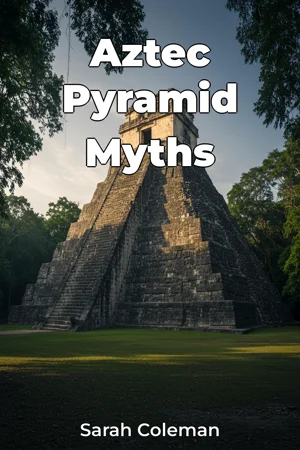
"Aztec Pyramid Myths" explores the profound religious significance of Aztec pyramids, revealing them as more than just temples. These monumental structures were central to Aztec society, serving as representations of their cosmos and facilitating communication with powerful gods like Huitzilopochtli, Tlaloc, and Quetzalcoatl. By examining the pyramids' construction, function, and symbolism, the book uncovers deep insights into Aztec theology, ritual practices, and worldview. The book uniquely combines archaeological evidence with mythological interpretations to provide a comprehensive understanding. Beginning with an overview of Aztec history and key deities, the narrative progresses to detailed analyses of pyramid architecture and rituals, focusing on sites like the Templo Mayor in Tenochtitlan. Finally, it delves into the mythological narratives associated with the pyramids, showcasing how these stories shaped the Aztec understanding of the world and their place within it. This approach sheds light on how the Aztecs used religious symbolism to maintain cosmic balance.
Book Details
ISBN
9788233992149
Publisher
Publifye AS
Your Licenses
You don't own any licenses for this book
Purchase a license below to unlock this book and download the EPUB.
Purchase License
Select a tier to unlock this book
Need bulk licensing?
Contact us for enterprise agreements.