
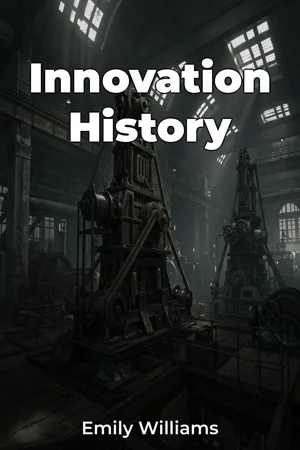
About This Book
What inventions have fundamentally reshaped the human experience, and what driving forces propelled their creation and adoption? "Innovation History" explores the transformative power of technological advancements, charting a course through the landmark inventions that have redefined how we live, work, and communicate. This book delves into the intricate interplay of historical context, societal needs, and individual ingenuity that fosters groundbreaking innovation. The core of this exploration focuses on three key pillars: communication technologies, energy innovations, and automation systems. Communication technologies, from the printing press to the internet, have exponentially accelerated the exchange of ideas and information, fostering collaboration and shaping public discourse. Energy innovations, encompassing the harnessing of fire to the development of nuclear power, have fueled industrial revolutions and redefined our relationship with the natural world. Automation systems, ranging from early textile looms to advanced robotics, have consistently redefined the nature of labor and productivity. Understanding the evolution and impact of these domains is crucial for comprehending the trajectory of human civilization. This book argues that technological innovation is not simply a linear progression of scientific discoveries, but rather a complex dance between societal needs, economic incentives, and the unpredictable sparks of human creativity. It is a thesis supported by meticulously researched historical accounts, patent records, and case studies of pivotal inventions and their inventors. The book unfolds in a structured narrative. First, the fundamental concepts of technological innovation, diffusion, and adoption are clearly defined. The succeeding sections delve into specific historical periods, examining the catalysts and consequences of major technological shifts. We explore the printing press and its revolutionary impact on literacy and knowledge dissemination, the steam engine and its central role in the Industrial Revolution, and the internet and its transformation of global communication and commerce. Each section offers a detailed analysis of the social, economic, and political contexts surrounding these innovations. The concluding chapters synthesize these historical narratives to identify recurring patterns and principles of innovation, culminating in a discussion of the ethical and societal challenges posed by emerging technologies like artificial intelligence and biotechnology. The evidence presented draws from diverse sources: primary source materials such as inventor notebooks and contemporary accounts, quantitative data illustrating technological adoption rates, and secondary analyses from leading historians and technology scholars. The book adopts an interdisciplinary approach, drawing connections between history, technology, economics, and sociology. For example, the societal impact of automation relates directly to economics and labor studies, while the evolution of communication technology informs our understanding of political science and media studies. What sets this book apart is its holistic perspective, viewing technology not in isolation but as an integral part of the human story. It avoids technological determinism, emphasizing the agency of individuals and societies in shaping the trajectory of innovation. The tone is informative and accessible, aiming to engage a broad audience interested in the history of technology and its impact on the world. The target audience includes students of history, technology, and business, as well as general readers with an interest in understanding the forces that have shaped our modern world. This book provides valuable insights for policymakers, entrepreneurs, and anyone seeking to navigate the complexities of a rapidly changing technological landscape. While the book aims to provide a comprehensive overview of major technological innovations, it acknowledges its limitations. It focuses primarily on innovations that have had a global impact, with a greater emphasis on Western technological development, while recognizing that innovations originating in other regions of the world also play a crucial role in the innovation ecosystem. The insights from "Innovation History" have practical applications for those seeking to understand and foster innovation in their own organizations and communities. By understanding the historical patterns and drivers of innovation, readers can gain a better understanding of how to identify opportunities, manage risk, and navigate the challenges of technological change. The book also touches upon debates surrounding the ethics of innovation, especially considering technologies that can have significant societal and economic impacts.
What inventions have fundamentally reshaped the human experience, and what driving forces propelled their creation and adoption? "Innovation History" explores the transformative power of technological advancements, charting a course through the landmark inventions that have redefined how we live, work, and communicate. This book delves into the intricate interplay of historical context, societal needs, and individual ingenuity that fosters groundbreaking innovation. The core of this exploration focuses on three key pillars: communication technologies, energy innovations, and automation systems. Communication technologies, from the printing press to the internet, have exponentially accelerated the exchange of ideas and information, fostering collaboration and shaping public discourse. Energy innovations, encompassing the harnessing of fire to the development of nuclear power, have fueled industrial revolutions and redefined our relationship with the natural world. Automation systems, ranging from early textile looms to advanced robotics, have consistently redefined the nature of labor and productivity. Understanding the evolution and impact of these domains is crucial for comprehending the trajectory of human civilization. This book argues that technological innovation is not simply a linear progression of scientific discoveries, but rather a complex dance between societal needs, economic incentives, and the unpredictable sparks of human creativity. It is a thesis supported by meticulously researched historical accounts, patent records, and case studies of pivotal inventions and their inventors. The book unfolds in a structured narrative. First, the fundamental concepts of technological innovation, diffusion, and adoption are clearly defined. The succeeding sections delve into specific historical periods, examining the catalysts and consequences of major technological shifts. We explore the printing press and its revolutionary impact on literacy and knowledge dissemination, the steam engine and its central role in the Industrial Revolution, and the internet and its transformation of global communication and commerce. Each section offers a detailed analysis of the social, economic, and political contexts surrounding these innovations. The concluding chapters synthesize these historical narratives to identify recurring patterns and principles of innovation, culminating in a discussion of the ethical and societal challenges posed by emerging technologies like artificial intelligence and biotechnology. The evidence presented draws from diverse sources: primary source materials such as inventor notebooks and contemporary accounts, quantitative data illustrating technological adoption rates, and secondary analyses from leading historians and technology scholars. The book adopts an interdisciplinary approach, drawing connections between history, technology, economics, and sociology. For example, the societal impact of automation relates directly to economics and labor studies, while the evolution of communication technology informs our understanding of political science and media studies. What sets this book apart is its holistic perspective, viewing technology not in isolation but as an integral part of the human story. It avoids technological determinism, emphasizing the agency of individuals and societies in shaping the trajectory of innovation. The tone is informative and accessible, aiming to engage a broad audience interested in the history of technology and its impact on the world. The target audience includes students of history, technology, and business, as well as general readers with an interest in understanding the forces that have shaped our modern world. This book provides valuable insights for policymakers, entrepreneurs, and anyone seeking to navigate the complexities of a rapidly changing technological landscape. While the book aims to provide a comprehensive overview of major technological innovations, it acknowledges its limitations. It focuses primarily on innovations that have had a global impact, with a greater emphasis on Western technological development, while recognizing that innovations originating in other regions of the world also play a crucial role in the innovation ecosystem. The insights from "Innovation History" have practical applications for those seeking to understand and foster innovation in their own organizations and communities. By understanding the historical patterns and drivers of innovation, readers can gain a better understanding of how to identify opportunities, manage risk, and navigate the challenges of technological change. The book also touches upon debates surrounding the ethics of innovation, especially considering technologies that can have significant societal and economic impacts.
"Innovation History" explores the pivotal technological advancements that have reshaped human civilization. The book focuses on the driving forces behind landmark inventions, examining how historical context, societal needs, and human ingenuity converge to spark innovation. It highlights the transformative power of communication technologies, energy innovations, and automation systems, illustrating how these areas have redefined how we live, work, and communicate. For example, the development of the printing press revolutionized literacy and knowledge dissemination, while advancements in automation, from early textile looms to modern robotics, have continually redefined labor and productivity. The book progresses through a structured narrative, beginning with fundamental concepts of technological innovation and then delving into specific historical periods. Examining the catalysts and consequences of major technological shifts, such as the Industrial Revolution fueled by the steam engine and the modern era shaped by the internet, it reveals recurring patterns and principles of innovation. What sets this book apart is its holistic perspective, viewing technology as an integral part of the human story, showing how societal needs and economic incentives intertwine with human creativity. Through meticulously researched historical accounts and case studies, "Innovation History" provides valuable insights for anyone seeking to understand the forces that have shaped our modern world.
Book Details
ISBN
9788233990305
Publisher
Publifye AS
Your Licenses
You don't own any licenses for this book
Purchase a license below to unlock this book and download the EPUB.
Purchase License
Select a tier to unlock this book
Need bulk licensing?
Contact us for enterprise agreements.