
About This Book
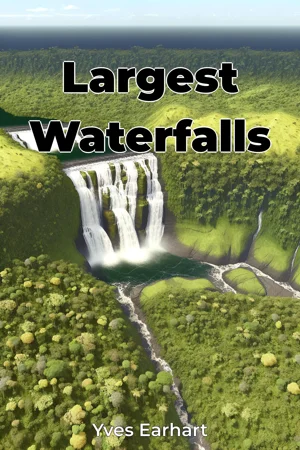
Have you ever wondered which waterfall truly reigns supreme, not just by height, but by sheer power and volume? "Largest Waterfalls" delves into the captivating world of these natural wonders, exploring the mightiest cascades on Earth based on their water flow and physical breadth, while examining their stunning visual impact and crucial ecological roles. This book will guide you through a meticulously researched exploration of these geological marvels. We will primarily focus on two crucial concepts: volume and width. Volume, measured in cubic meters per second, indicates the raw power of a waterfall, its ability to sculpt landscapes and drive ecosystems. Width, on the other hand, showcases the waterfall's grandeur, its sweeping presence across the terrain. Understanding both metrics provides a balanced perspective, moving beyond simple height measurements to consider the full scale of these natural phenomena. Why is this important? Because the scale and the nature of waterfalls significantly impact their surrounding environment, influencing biodiversity, erosion patterns, and even local climate. To fully appreciate the magnitude of these waterfalls, we will provide a geological and hydrological context. You will gain insights into the formation processes that create these breathtaking formations, the types of rock formations involved, and the climatic conditions that sustain them. Basic knowledge of geography and hydrology will be helpful, but not required, as we progressively build understanding of the processes involved.. The central argument of this book is that the true measure of a waterfall's significance lies not just in its height, but in a holistic evaluation incorporating its volume, width, ecological impact, and the geological forces that shaped it. By moving beyond simple rankings based on height, we can gain a deeper appreciation for the diverse roles these natural wonders play in our world. The book is structured into three major sections. Following an introduction to the fundamental concepts of waterfall formation and measurement, we will devote individual chapters to detailed analyses of several representative waterfalls, including those with the highest recorded volumes, such as the Boyoma Falls (formerly Stanley Falls), and the widest, like Khone Falls, as well as some notable large waterfalls in different regions. Each case study will include comprehensive data, photographs, and discussions of their unique ecological roles. Finally, in the concluding section, we will explore the practical implications of understanding these massive waterfalls, including their impact on regional water resources, tourism, and conservation efforts. The evidence presented will be drawn from a wide range of sources, including hydrological surveys, geological reports, satellite imagery, and on-the-ground observations. We will use publicly available data from governmental agencies, academic research papers, and reputable scientific organizations to support our analysis. "Largest Waterfalls" connects to several other fields of study. Ecology is crucial, as waterfalls often create unique habitats and dispersal barriers. Geology is essential to understanding the processes of erosion and landscape formation. Finally, hydrology provides the framework for analyzing water flow and its impact on the surrounding environment. These connections enhance the book's argument by demonstrating the multifaceted nature of waterfalls and their significance in a broader environmental context. "Largest Waterfalls" offers a comprehensive analysis of the world's greatest waterfalls, moving beyond simplistic measures like height to consider the full range of factors that define their significance. The tone is informative and accessible, aiming to engage a broad audience while maintaining scientific rigor. This book is intended for nature enthusiasts, geography students, environmental scientists, and anyone curious about the power and beauty of our planet's largest waterfalls. It would be valuable for anyone seeking a deeper understanding of these formations and their ecological roles. As a work of non-fiction, "Largest Waterfalls" strives for accuracy, objectivity, and clarity. It adheres to the conventions of scientific writing by citing sources and presenting evidence in a transparent manner. While this book strives to present a comprehensive global view, geographical constraints and data availability mean that some regions may be better represented than others. We will primarily focus on well-documented waterfalls, acknowledging that there may be other significant cascades that lack sufficient data for a complete analysis. The information included in this book will be helpful to those who work in conservation projects, as understanding the dynamics of large waterfalls can aid in sustainable practices. While precise measurement data exists for many prominent waterfalls, estimations and some degree of uncertainty persists, particularly for those in remote or inaccessible areas. The book will address these uncertainties openly and honestly, acknowledging the limitations of current knowledge.
Have you ever wondered which waterfall truly reigns supreme, not just by height, but by sheer power and volume? "Largest Waterfalls" delves into the captivating world of these natural wonders, exploring the mightiest cascades on Earth based on their water flow and physical breadth, while examining their stunning visual impact and crucial ecological roles. This book will guide you through a meticulously researched exploration of these geological marvels. We will primarily focus on two crucial concepts: volume and width. Volume, measured in cubic meters per second, indicates the raw power of a waterfall, its ability to sculpt landscapes and drive ecosystems. Width, on the other hand, showcases the waterfall's grandeur, its sweeping presence across the terrain. Understanding both metrics provides a balanced perspective, moving beyond simple height measurements to consider the full scale of these natural phenomena. Why is this important? Because the scale and the nature of waterfalls significantly impact their surrounding environment, influencing biodiversity, erosion patterns, and even local climate. To fully appreciate the magnitude of these waterfalls, we will provide a geological and hydrological context. You will gain insights into the formation processes that create these breathtaking formations, the types of rock formations involved, and the climatic conditions that sustain them. Basic knowledge of geography and hydrology will be helpful, but not required, as we progressively build understanding of the processes involved.. The central argument of this book is that the true measure of a waterfall's significance lies not just in its height, but in a holistic evaluation incorporating its volume, width, ecological impact, and the geological forces that shaped it. By moving beyond simple rankings based on height, we can gain a deeper appreciation for the diverse roles these natural wonders play in our world. The book is structured into three major sections. Following an introduction to the fundamental concepts of waterfall formation and measurement, we will devote individual chapters to detailed analyses of several representative waterfalls, including those with the highest recorded volumes, such as the Boyoma Falls (formerly Stanley Falls), and the widest, like Khone Falls, as well as some notable large waterfalls in different regions. Each case study will include comprehensive data, photographs, and discussions of their unique ecological roles. Finally, in the concluding section, we will explore the practical implications of understanding these massive waterfalls, including their impact on regional water resources, tourism, and conservation efforts. The evidence presented will be drawn from a wide range of sources, including hydrological surveys, geological reports, satellite imagery, and on-the-ground observations. We will use publicly available data from governmental agencies, academic research papers, and reputable scientific organizations to support our analysis. "Largest Waterfalls" connects to several other fields of study. Ecology is crucial, as waterfalls often create unique habitats and dispersal barriers. Geology is essential to understanding the processes of erosion and landscape formation. Finally, hydrology provides the framework for analyzing water flow and its impact on the surrounding environment. These connections enhance the book's argument by demonstrating the multifaceted nature of waterfalls and their significance in a broader environmental context. "Largest Waterfalls" offers a comprehensive analysis of the world's greatest waterfalls, moving beyond simplistic measures like height to consider the full range of factors that define their significance. The tone is informative and accessible, aiming to engage a broad audience while maintaining scientific rigor. This book is intended for nature enthusiasts, geography students, environmental scientists, and anyone curious about the power and beauty of our planet's largest waterfalls. It would be valuable for anyone seeking a deeper understanding of these formations and their ecological roles. As a work of non-fiction, "Largest Waterfalls" strives for accuracy, objectivity, and clarity. It adheres to the conventions of scientific writing by citing sources and presenting evidence in a transparent manner. While this book strives to present a comprehensive global view, geographical constraints and data availability mean that some regions may be better represented than others. We will primarily focus on well-documented waterfalls, acknowledging that there may be other significant cascades that lack sufficient data for a complete analysis. The information included in this book will be helpful to those who work in conservation projects, as understanding the dynamics of large waterfalls can aid in sustainable practices. While precise measurement data exists for many prominent waterfalls, estimations and some degree of uncertainty persists, particularly for those in remote or inaccessible areas. The book will address these uncertainties openly and honestly, acknowledging the limitations of current knowledge.
"Largest Waterfalls" explores the mightiest cascades on Earth, moving beyond simple height measurements to examine water flow and width as key indicators of their true power. The book emphasizes that volume, the amount of water surging over the edge, and width, the span of the falls, are crucial for understanding a waterfall's ecological impact and geological significance. For example, Boyoma Falls demonstrates immense volume, showcasing nature's raw strength, while Khone Falls extends impressively across the landscape, revealing a different kind of grandeur. The book delves into the geological formations and hydrological processes that create these natural wonders, providing context for understanding their scale and influence. It progresses from introducing fundamental concepts to detailed case studies of representative waterfalls. "Largest Waterfalls" connects Earth sciences, geography, and nature, offering a holistic perspective on these dynamic features and their importance in conservation and regional water resources.
Book Details
ISBN
9788233989255
Publisher
Publifye AS
Your Licenses
You don't own any licenses for this book
Purchase a license below to unlock this book and download the EPUB.
Purchase License
Select a tier to unlock this book
Need bulk licensing?
Contact us for enterprise agreements.