
About This Book
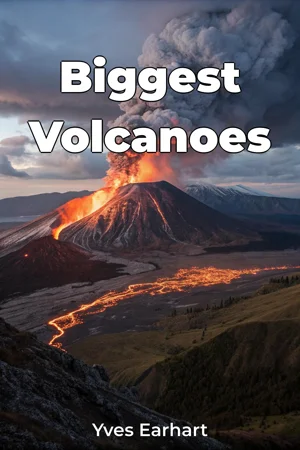
Have you ever wondered what forces shape the very ground beneath our feet? This book, *Biggest Volcanoes*, delves into the colossal world of volcanism, exploring the largest volcanoes on Earth, their violent eruptions, and their profound influence on the planet’s landscape and atmosphere. This is not merely a catalog of mountain-like structures; it is an examination of geological power and its lasting consequences. This book will cover three principal areas: the identification and classification of the largest volcanoes, a detailed analysis of their eruption histories and associated hazards, and an examination of the volcanoes' role in shaping Earth's climate and geological formations. Understanding these topics is crucial because volcanic activity, in its most extreme forms, poses significant risks to human populations and ecosystems, while also playing a vital part in the long-term evolution of our planet. To fully appreciate the magnitude and impact of these volcanic giants, we will explore the relevant geological context, including plate tectonics, magma formation, and different types of volcanic eruptions. The reader needs no prior expert knowledge, as the necessary scientific principles will be clearly explained. The central argument of this book is that the largest volcanoes represent some of the most powerful forces on Earth, capable of both destruction and creation. By understanding their formation, eruption patterns, and long-term effects, we can gain valuable insights into the dynamic processes that have sculpted our planet and continue to shape its future. The book is structured into three distinct sections. First, we introduce the concept of "largest volcanoes," categorizing them based on size, eruption style, and geological setting. Second, we present case studies of specific volcanoes like Mauna Loa, and other supervolcanoes, exploring their eruption histories, the hazards they pose, and their impact on surrounding environments. Finally, we synthesize this information to discuss the broader implications of large-scale volcanism for climate change, geological evolution, and planetary habitability. The evidence presented in this book is drawn from a wide range of sources, including geological surveys, satellite imagery, geochemical analyses of volcanic rocks, and historical records of volcanic eruptions. We will also draw from recent research in volcanology, seismology, and climatology to provide the most up-to-date understanding of these complex systems. The study of volcanoes links directly to several other fields. Climate science is crucial. The book explores the influence of major eruptions on global temperatures and atmospheric composition. Earth sciences are also important, specifically considering the impact on land formation. Finally, the book examines connections to environmental science, addressing the ecological consequences of volcanic activity. *Biggest Volcanoes* distinguishes itself by taking a comprehensive, multidisciplinary approach to understanding these geological giants. It blends established knowledge with recent research, incorporating diverse perspectives to provide a holistic view of large-scale volcanism. The tone of the book is professional and informative, while remaining accessible to a broad audience. The writing style emphasizes clarity and precision, ensuring that complex scientific concepts are presented in a clear and engaging manner. The primary audience is anyone with an interest in Earth sciences, geography, or nature. It would be valuable to students, educators, and general readers. The book offers a broad understanding of volcanism and its impact. As a work in Earth Sciences, it includes detailed descriptions of geological processes, maps, and diagrams to illustrate key concepts. The scope of the book focuses solely on the largest volcanoes and their impact. We intentionally limit our discussion of smaller volcanic features or specific regional volcanic fields unless they provide necessary context for understanding the larger phenomena. Beyond academic interest, the information in this book has real-world applications for hazard assessment, land-use planning, and climate modeling. By understanding the potential risks associated with large volcanoes, we can better prepare for future eruptions and mitigate their impact on human populations and the environment. While the basic mechanisms of volcanism are well established, there are still ongoing debates about the triggers of super-eruptions and the long-term effects of volcanic activity on climate. This book addresses these controversies by presenting different perspectives and evaluating the available evidence.
Have you ever wondered what forces shape the very ground beneath our feet? This book, *Biggest Volcanoes*, delves into the colossal world of volcanism, exploring the largest volcanoes on Earth, their violent eruptions, and their profound influence on the planet’s landscape and atmosphere. This is not merely a catalog of mountain-like structures; it is an examination of geological power and its lasting consequences. This book will cover three principal areas: the identification and classification of the largest volcanoes, a detailed analysis of their eruption histories and associated hazards, and an examination of the volcanoes' role in shaping Earth's climate and geological formations. Understanding these topics is crucial because volcanic activity, in its most extreme forms, poses significant risks to human populations and ecosystems, while also playing a vital part in the long-term evolution of our planet. To fully appreciate the magnitude and impact of these volcanic giants, we will explore the relevant geological context, including plate tectonics, magma formation, and different types of volcanic eruptions. The reader needs no prior expert knowledge, as the necessary scientific principles will be clearly explained. The central argument of this book is that the largest volcanoes represent some of the most powerful forces on Earth, capable of both destruction and creation. By understanding their formation, eruption patterns, and long-term effects, we can gain valuable insights into the dynamic processes that have sculpted our planet and continue to shape its future. The book is structured into three distinct sections. First, we introduce the concept of "largest volcanoes," categorizing them based on size, eruption style, and geological setting. Second, we present case studies of specific volcanoes like Mauna Loa, and other supervolcanoes, exploring their eruption histories, the hazards they pose, and their impact on surrounding environments. Finally, we synthesize this information to discuss the broader implications of large-scale volcanism for climate change, geological evolution, and planetary habitability. The evidence presented in this book is drawn from a wide range of sources, including geological surveys, satellite imagery, geochemical analyses of volcanic rocks, and historical records of volcanic eruptions. We will also draw from recent research in volcanology, seismology, and climatology to provide the most up-to-date understanding of these complex systems. The study of volcanoes links directly to several other fields. Climate science is crucial. The book explores the influence of major eruptions on global temperatures and atmospheric composition. Earth sciences are also important, specifically considering the impact on land formation. Finally, the book examines connections to environmental science, addressing the ecological consequences of volcanic activity. *Biggest Volcanoes* distinguishes itself by taking a comprehensive, multidisciplinary approach to understanding these geological giants. It blends established knowledge with recent research, incorporating diverse perspectives to provide a holistic view of large-scale volcanism. The tone of the book is professional and informative, while remaining accessible to a broad audience. The writing style emphasizes clarity and precision, ensuring that complex scientific concepts are presented in a clear and engaging manner. The primary audience is anyone with an interest in Earth sciences, geography, or nature. It would be valuable to students, educators, and general readers. The book offers a broad understanding of volcanism and its impact. As a work in Earth Sciences, it includes detailed descriptions of geological processes, maps, and diagrams to illustrate key concepts. The scope of the book focuses solely on the largest volcanoes and their impact. We intentionally limit our discussion of smaller volcanic features or specific regional volcanic fields unless they provide necessary context for understanding the larger phenomena. Beyond academic interest, the information in this book has real-world applications for hazard assessment, land-use planning, and climate modeling. By understanding the potential risks associated with large volcanoes, we can better prepare for future eruptions and mitigate their impact on human populations and the environment. While the basic mechanisms of volcanism are well established, there are still ongoing debates about the triggers of super-eruptions and the long-term effects of volcanic activity on climate. This book addresses these controversies by presenting different perspectives and evaluating the available evidence.
"Biggest Volcanoes" explores the dramatic world of volcanism, focusing on Earth's largest volcanoes and their profound effects. The book examines not just the physical structures but also the geological forces behind these formations. One intriguing insight is how massive eruptions can influence global climate patterns, sometimes leading to temporary cooling. The book also delves into the science behind magma formation and plate tectonics, explaining how these processes contribute to the creation and behavior of volcanoes like Mauna Loa and other supervolcanoes. The book progresses systematically, starting with the classification of the largest volcanoes based on size and eruption style. It then presents case studies, detailing eruption histories, hazards, and environmental impacts. Finally, it synthesizes this information to discuss broader implications for climate change and planetary evolution, highlighting the importance of understanding these geological giants for hazard assessment and land-use planning. By blending established knowledge with recent research, "Biggest Volcanoes" offers a comprehensive view of large-scale volcanism.
Book Details
ISBN
9788233988661
Publisher
Publifye AS
Your Licenses
You don't own any licenses for this book
Purchase a license below to unlock this book and download the EPUB.
Purchase License
Select a tier to unlock this book
Need bulk licensing?
Contact us for enterprise agreements.