
About This Book
Are the world's longest glaciers silent witnesses to climate change, or active agents reshaping our planet? This book, 'Longest Glaciers,' delves into these icy titans, exploring their formation, movement, and critical role in Earth's climate system. We will investigate the concerning rate at which these glaciers are melting, examining the profound consequences for global sea levels and ecosystems. These massive ice rivers are not merely frozen landscapes; they are dynamic systems profoundly intertwined with our planet's future. This book focuses on three key aspects: the physical characteristics and dynamics of the longest glaciers, their impact on global and local climate, and the accelerating glacial melt and its ramifications. Understanding these topics is crucial as glacial melt contributes significantly to sea-level rise, threatens coastal communities, and disrupts delicate ecosystems. Geographically, we examine glaciers on every continent that has them, with a particular emphasis on Greenland, Antarctica, and major mountain ranges like the Himalayas and Andes. We also explore the scientific methods used to study these glaciers, from satellite imagery and remote sensing to on-site measurements of ice thickness and flow rates. The central argument of 'Longest Glaciers' is that the rapid melting of these glaciers serves as a stark indicator of anthropogenic climate change, demanding immediate attention and informed action. This argument is vital because it contextualizes climate change not as an abstract concept, but as a tangible phenomenon with measurable and potentially irreversible consequences. The book unfolds in a structured manner. Initially, we introduce the formation and types of glaciers. Following this foundation, we dedicate chapters to detailing the mechanics of glacial movement focusing on the longest glaciers like Lambert-Fisher Glacier and Antarctica and others in Greenland. We will then explore the impact of these glaciers on climate patterns and sea levels. The final section presents a detailed analysis of the evidence for accelerated melting, its environmental consequences, and potential mitigation strategies. The arguments presented are substantiated with data from peer-reviewed scientific studies, including reports from the Intergovernmental Panel on Climate Change (IPCC), NASA's Earth Observatory, and various glaciological research institutions. We analyze data related to ice mass balance, sea-level rise projections, and changes in ocean temperatures, all meticulously cited and explained. 'Longest Glaciers' draws connections to several fields including climatology, oceanography, and environmental policy. The understanding of glacial melt requires insights into atmospheric processes, ocean currents, and the policies designed to combat climate change. These interdisciplinary links enrich our analysis and provide a holistic perspective on the issue. A unique aspect of this book is its focus on the interplay between glacial dynamics and human activities. We incorporate recent research that directly links human-induced warming to the accelerating melt rates of these glaciers. This perspective highlights the urgent need for sustainable practices and informed policy decisions. The book's tone is factual and analytical, aiming to present complex scientific information in an accessible manner. We avoid sensationalism, focusing instead on presenting data and analysis in a clear and concise style. This book is aimed at students, researchers, policymakers, and anyone interested in climate change and environmental science. It provides a comprehensive overview of a critical element of our planet's climate system, equipping readers with the knowledge necessary to understand and address one of the most pressing environmental challenges of our time. As a work of non-fiction, 'Longest Glaciers' adheres to the rigorous standards of scientific accuracy, clarity, and objectivity. We aim to present a balanced view, acknowledging uncertainties where they exist and carefully distinguishing between established facts and ongoing research. The book's scope is limited to the longest glaciers and their relationship to climate change, with a focus on the scientific evidence and its implications. While we touch on policy and potential solutions, our primary goal is to provide a comprehensive understanding of the science behind glacial melt. The information presented has practical applications for policymakers involved in climate change mitigation and adaptation planning, as well as for environmental organizations working to protect vulnerable ecosystems. Individuals can also use this knowledge to make informed decisions about their own environmental impact. The book engages with ongoing debates within the scientific community regarding the precise rate and extent of future sea-level rise. We present these differing viewpoints fairly, providing readers with a nuanced understanding of the uncertainties involved in climate modeling.
Are the world's longest glaciers silent witnesses to climate change, or active agents reshaping our planet? This book, 'Longest Glaciers,' delves into these icy titans, exploring their formation, movement, and critical role in Earth's climate system. We will investigate the concerning rate at which these glaciers are melting, examining the profound consequences for global sea levels and ecosystems. These massive ice rivers are not merely frozen landscapes; they are dynamic systems profoundly intertwined with our planet's future. This book focuses on three key aspects: the physical characteristics and dynamics of the longest glaciers, their impact on global and local climate, and the accelerating glacial melt and its ramifications. Understanding these topics is crucial as glacial melt contributes significantly to sea-level rise, threatens coastal communities, and disrupts delicate ecosystems. Geographically, we examine glaciers on every continent that has them, with a particular emphasis on Greenland, Antarctica, and major mountain ranges like the Himalayas and Andes. We also explore the scientific methods used to study these glaciers, from satellite imagery and remote sensing to on-site measurements of ice thickness and flow rates. The central argument of 'Longest Glaciers' is that the rapid melting of these glaciers serves as a stark indicator of anthropogenic climate change, demanding immediate attention and informed action. This argument is vital because it contextualizes climate change not as an abstract concept, but as a tangible phenomenon with measurable and potentially irreversible consequences. The book unfolds in a structured manner. Initially, we introduce the formation and types of glaciers. Following this foundation, we dedicate chapters to detailing the mechanics of glacial movement focusing on the longest glaciers like Lambert-Fisher Glacier and Antarctica and others in Greenland. We will then explore the impact of these glaciers on climate patterns and sea levels. The final section presents a detailed analysis of the evidence for accelerated melting, its environmental consequences, and potential mitigation strategies. The arguments presented are substantiated with data from peer-reviewed scientific studies, including reports from the Intergovernmental Panel on Climate Change (IPCC), NASA's Earth Observatory, and various glaciological research institutions. We analyze data related to ice mass balance, sea-level rise projections, and changes in ocean temperatures, all meticulously cited and explained. 'Longest Glaciers' draws connections to several fields including climatology, oceanography, and environmental policy. The understanding of glacial melt requires insights into atmospheric processes, ocean currents, and the policies designed to combat climate change. These interdisciplinary links enrich our analysis and provide a holistic perspective on the issue. A unique aspect of this book is its focus on the interplay between glacial dynamics and human activities. We incorporate recent research that directly links human-induced warming to the accelerating melt rates of these glaciers. This perspective highlights the urgent need for sustainable practices and informed policy decisions. The book's tone is factual and analytical, aiming to present complex scientific information in an accessible manner. We avoid sensationalism, focusing instead on presenting data and analysis in a clear and concise style. This book is aimed at students, researchers, policymakers, and anyone interested in climate change and environmental science. It provides a comprehensive overview of a critical element of our planet's climate system, equipping readers with the knowledge necessary to understand and address one of the most pressing environmental challenges of our time. As a work of non-fiction, 'Longest Glaciers' adheres to the rigorous standards of scientific accuracy, clarity, and objectivity. We aim to present a balanced view, acknowledging uncertainties where they exist and carefully distinguishing between established facts and ongoing research. The book's scope is limited to the longest glaciers and their relationship to climate change, with a focus on the scientific evidence and its implications. While we touch on policy and potential solutions, our primary goal is to provide a comprehensive understanding of the science behind glacial melt. The information presented has practical applications for policymakers involved in climate change mitigation and adaptation planning, as well as for environmental organizations working to protect vulnerable ecosystems. Individuals can also use this knowledge to make informed decisions about their own environmental impact. The book engages with ongoing debates within the scientific community regarding the precise rate and extent of future sea-level rise. We present these differing viewpoints fairly, providing readers with a nuanced understanding of the uncertainties involved in climate modeling.
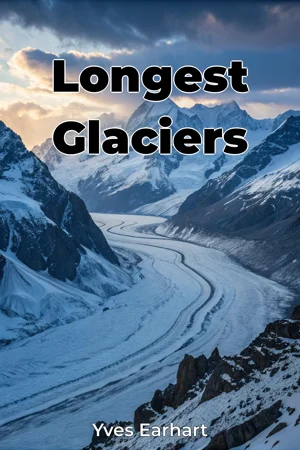
"Longest Glaciers" explores the crucial role of the world's largest glaciers in our planet's climate system, focusing on their dynamics, impact, and the alarming rate at which they are melting. It emphasizes how these icy giants are not just frozen relics but active agents in shaping global sea levels and ecosystems. The book investigates the intricate relationship between glacial melt and anthropogenic climate change, providing a tangible understanding of the consequences. The book uniquely examines glaciers across continents, with notable attention to Greenland, Antarctica, and the Himalayas. It presents scientific methods, from satellite imagery to on-site measurements, used to study these glaciers. Did you know that glacial melt significantly contributes to sea-level rise, threatening coastal communities? Or that these glaciers serve as stark indicators of human-induced warming? "Longest Glaciers" progresses logically. It begins with the formation and types of glaciers, moving to the mechanics of glacial movement, and culminating in an analysis of accelerated melting, its environmental consequences, and potential mitigation strategies. The book aims to present complex scientific information in an accessible manner.
Book Details
ISBN
9788233988623
Publisher
Publifye AS
Your Licenses
You don't own any licenses for this book
Purchase a license below to unlock this book and download the EPUB.
Purchase License
Select a tier to unlock this book
Need bulk licensing?
Contact us for enterprise agreements.