
About This Book
How has a relatively small body of water shaped global economics and international relations for centuries? "Persian Gulf History" delves into the multilayered story of this vital region, exploring its pivotal role as a trade nexus, the epicenter of oil production, and a crucial arena in Middle Eastern politics. This book illuminates the Persian Gulf’s historical trajectory, offering a comprehensive analysis of its economic, social, and political development from ancient times to the present day. The book focuses on three key pillars: its historical significance as a maritime trade route connecting East and West; its transformation into the world’s leading oil-producing region; and its enduring impact on the geopolitical landscape of the Middle East. These themes are critical for understanding the Gulf’s influence on global power dynamics, economic stability, and cultural exchange. To fully appreciate the Gulf's prominence, the book provides essential background on the region’s geography, pre-Islamic history, and the rise of Islam. It examines the impact of European colonialism, the formation of modern nation-states, and the complexities of tribal and sectarian identities. Readers will gain valuable insights into the Gulf’s unique cultural heritage and the factors shaping its contemporary challenges. The central argument is that the Persian Gulf’s strategic importance stems from its historical role as a valuable commercial artery and its subsequent transformation into the world's primary energy source. The book posits that the convergence of these factors has made the Gulf a focal point of international competition and conflict, influencing global economic trends and geopolitical strategies. The book is structured chronologically and thematically. It begins with an introduction to the Gulf's geographical setting and pre-Islamic history, followed by an examination of its role in the early Islamic world and the subsequent rise of regional empires. The core of the book analyzes the impact of European colonialism, the discovery of oil, and the emergence of independent Gulf states. The analysis culminates with an assessment of contemporary challenges, including political rivalries, economic diversification efforts, and the impact of globalization. The arguments will be supported by a wide range of primary and secondary sources, including archival documents, historical accounts, economic data, and political analyses. The book draws on original field research, including interviews with local experts and analysis of previously untapped Arabic-language sources. "Persian Gulf History" connects to several other fields of study, including international relations, energy economics, and Middle Eastern studies. It sheds light on the interplay between economic forces, political power, and cultural identities, thereby enriching our understanding of global affairs. It intersects with environmental studies by examining the ecological impact of the oil industry on the Gulf region. This history offers a unique interdisciplinary perspective, examining the region through the combined lenses of economics, history, and political science. It challenges conventional narratives by offering a nuanced analysis of the Gulf's internal dynamics and its complex relationship with the wider world. The writing style is designed to be accessible to a broad readership while maintaining scholarly rigor. It balances historical narrative with analytical insights, providing a thought-provoking and informative account of the Persian Gulf's history. The target audience includes students, researchers, policymakers, and anyone interested in understanding the complexities of the Middle East. This book will be valuable to those seeking a historically grounded and analytically rigorous examination of a region that continues to shape global events. As a work of non-fiction in the fields of economics and history, this book adheres to the genre's conventions of accuracy, objectivity, and evidence-based analysis. It presents a balanced and comprehensive account of the Persian Gulf’s history, avoiding partisan viewpoints and relying on verifiable sources. The scope of the book encompasses the entire history of the Persian Gulf region, from ancient times to the present day. However, it focuses primarily on the modern era, particularly the period after the discovery of oil. Some sub-regions may not be discussed in detail because the focus is on the broader context of the Persian Gulf. The information can be applied to understand current events in the Middle East, assess the impact of oil prices on the global economy, and develop informed policies toward the Gulf region. It will enable readers to critically evaluate media coverage of the region and make informed decisions about investments, international relations, and energy policy. The book addresses several ongoing debates in the field, including the role of external powers in shaping the Gulf’s destiny, the impact of sectarianism on regional stability, and the prospects for economic diversification. By presenting multiple perspectives and offering nuanced analyses, the book seeks to foster a more informed and constructive dialogue about these complex issues.
How has a relatively small body of water shaped global economics and international relations for centuries? "Persian Gulf History" delves into the multilayered story of this vital region, exploring its pivotal role as a trade nexus, the epicenter of oil production, and a crucial arena in Middle Eastern politics. This book illuminates the Persian Gulf’s historical trajectory, offering a comprehensive analysis of its economic, social, and political development from ancient times to the present day. The book focuses on three key pillars: its historical significance as a maritime trade route connecting East and West; its transformation into the world’s leading oil-producing region; and its enduring impact on the geopolitical landscape of the Middle East. These themes are critical for understanding the Gulf’s influence on global power dynamics, economic stability, and cultural exchange. To fully appreciate the Gulf's prominence, the book provides essential background on the region’s geography, pre-Islamic history, and the rise of Islam. It examines the impact of European colonialism, the formation of modern nation-states, and the complexities of tribal and sectarian identities. Readers will gain valuable insights into the Gulf’s unique cultural heritage and the factors shaping its contemporary challenges. The central argument is that the Persian Gulf’s strategic importance stems from its historical role as a valuable commercial artery and its subsequent transformation into the world's primary energy source. The book posits that the convergence of these factors has made the Gulf a focal point of international competition and conflict, influencing global economic trends and geopolitical strategies. The book is structured chronologically and thematically. It begins with an introduction to the Gulf's geographical setting and pre-Islamic history, followed by an examination of its role in the early Islamic world and the subsequent rise of regional empires. The core of the book analyzes the impact of European colonialism, the discovery of oil, and the emergence of independent Gulf states. The analysis culminates with an assessment of contemporary challenges, including political rivalries, economic diversification efforts, and the impact of globalization. The arguments will be supported by a wide range of primary and secondary sources, including archival documents, historical accounts, economic data, and political analyses. The book draws on original field research, including interviews with local experts and analysis of previously untapped Arabic-language sources. "Persian Gulf History" connects to several other fields of study, including international relations, energy economics, and Middle Eastern studies. It sheds light on the interplay between economic forces, political power, and cultural identities, thereby enriching our understanding of global affairs. It intersects with environmental studies by examining the ecological impact of the oil industry on the Gulf region. This history offers a unique interdisciplinary perspective, examining the region through the combined lenses of economics, history, and political science. It challenges conventional narratives by offering a nuanced analysis of the Gulf's internal dynamics and its complex relationship with the wider world. The writing style is designed to be accessible to a broad readership while maintaining scholarly rigor. It balances historical narrative with analytical insights, providing a thought-provoking and informative account of the Persian Gulf's history. The target audience includes students, researchers, policymakers, and anyone interested in understanding the complexities of the Middle East. This book will be valuable to those seeking a historically grounded and analytically rigorous examination of a region that continues to shape global events. As a work of non-fiction in the fields of economics and history, this book adheres to the genre's conventions of accuracy, objectivity, and evidence-based analysis. It presents a balanced and comprehensive account of the Persian Gulf’s history, avoiding partisan viewpoints and relying on verifiable sources. The scope of the book encompasses the entire history of the Persian Gulf region, from ancient times to the present day. However, it focuses primarily on the modern era, particularly the period after the discovery of oil. Some sub-regions may not be discussed in detail because the focus is on the broader context of the Persian Gulf. The information can be applied to understand current events in the Middle East, assess the impact of oil prices on the global economy, and develop informed policies toward the Gulf region. It will enable readers to critically evaluate media coverage of the region and make informed decisions about investments, international relations, and energy policy. The book addresses several ongoing debates in the field, including the role of external powers in shaping the Gulf’s destiny, the impact of sectarianism on regional stability, and the prospects for economic diversification. By presenting multiple perspectives and offering nuanced analyses, the book seeks to foster a more informed and constructive dialogue about these complex issues.
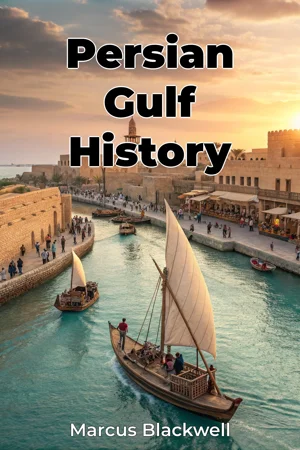
"Persian Gulf History" explores the multifaceted narrative of a region whose relatively small body of water has profoundly influenced global economics and international relations. This book meticulously examines the Persian Gulf's critical role as a historic maritime trade route, its transformation into a leading center for oil production, and its enduring impact on Middle Eastern geopolitics. It reveals how the Gulf's unique position has shaped not only regional dynamics but also global power structures, economic stability, and cultural exchange. The book progresses chronologically and thematically, beginning with the Gulf's ancient roots and moving through the rise of Islam, European colonialism, and the emergence of independent Gulf states. It demonstrates how the area's transformation into a primary energy source has made it a focal point for international competition and conflict. Readers gain insights into the complexities of tribal and sectarian identities, the impact of globalization, and the challenges of economic diversification. By examining the region through the combined lenses of economics, history, and political science, this book offers a unique interdisciplinary perspective, challenging conventional narratives and providing a nuanced analysis of the Gulf's internal dynamics and its relationship with the wider world.
Book Details
ISBN
9788233987916
Publisher
Publifye AS
Your Licenses
You don't own any licenses for this book
Purchase a license below to unlock this book and download the EPUB.
Purchase License
Select a tier to unlock this book
Need bulk licensing?
Contact us for enterprise agreements.