
About This Book
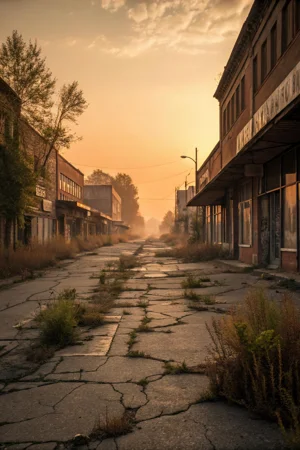
What compels an entire community to abandon their homes, leaving behind businesses, schools, and entire lifetimes of memories? "Streets Deserted" delves into the complex and often tragic phenomenon of urban abandonment, exploring the historical, geographical, and societal factors that transform thriving locales into desolate ghost towns. This book seeks to understand not just the 'what' and 'where' of urban decay, but the crucially important 'why', providing readers with a framework for analyzing and potentially mitigating such occurrences in the future. The core of our exploration rests on three intertwined themes: economic shifts, environmental disasters, and societal transformations. Economic downturns can decimate local industries, leaving populations without livelihoods and forcing mass migrations. Environmental catastrophes, from resource depletion to climate change-induced events, render previously habitable areas unsustainable. Societal changes, including demographic shifts, political instability, and even the rise of new technologies, can erode the social fabric of a community, leading to its eventual collapse. These themes are important because understanding the root causes of urban abandonment allows us to better predict and adapt to future challenges facing cities and towns worldwide. This book argues that urban abandonment is rarely a simple or singular event, but rather the culmination of a series of interconnected factors that erode a community's resilience. It's not just about economic hardship or natural disaster, but how these crises interact with existing social, political, and environmental vulnerabilities. By examining case studies from diverse geographical locations and historical periods, "Streets Deserted" will illuminate the common threads that connect seemingly disparate instances of urban decline. The book is structured in three parts. Part One introduces the core concepts and definitional parameters of urban abandonment, briefly outlining its historical prevalence and geographic distribution. Part Two explores the primary drivers of abandonment in detail: Chapters will focus on the impact of resource depletion and industrial decline, the role of natural disasters and environmental degradation, and the social and political factors that contribute to community disintegration. This section draws upon data from historical census records, geological surveys, and sociological studies. Part Three analyzes case studies of abandoned settlements, from post-industrial towns in the Rust Belt to communities displaced by environmental disasters, culminating in a discussion of strategies for preventing or mitigating urban decline and offering a framework for ensuring community sustainability. The book will be supported by a range of evidence, including demographic data, historical maps, geological surveys, and primary source accounts from former residents of abandoned areas. We will also incorporate satellite imagery and GIS mapping to visualize the spatial patterns of urban decay and document the environmental changes that have contributed to abandonment. "Streets Deserted" connects to several other fields of study, including economics, sociology, and environmental science. The economic aspects of deindustrialization and resource depletion are crucial to understanding community collapse. Sociological theories on social capital and community resilience offer insights into why some communities are better able to withstand hardship than others. Environmental science provides the framework for understanding the impact of climate change and resource scarcity on human settlements. Recognizing these interdisciplinary connections enriches the analysis and offers a nuanced perspective on the complex phenomenon of urban decline. This book offers a fresh perspective by integrating historical analysis with geographical and sociological insights. Rather than simply cataloging abandoned places, it seeks to understand the underlying processes that lead to abandonment and to identify potential interventions that could help communities avert such a fate. Written in a clear and accessible style, "Streets Deserted" is aimed at a broad audience, including students of history, geography, and urban planning, as well as general readers interested in the fate of communities facing economic and environmental challenges. The book provides valuable insights for policymakers and community leaders seeking to build more resilient and sustainable cities and towns. While "Streets Deserted" aims to provide a comprehensive overview of urban abandonment, its scope is limited to the study of human settlements that have experienced a significant decline in population and economic activity. It does not delve into the related but distinct phenomenon of rural depopulation. The practical applications of this book are numerous. By understanding the factors that contribute to urban abandonment, policymakers can develop strategies to promote economic diversification, invest in infrastructure improvements, and mitigate the impacts of climate change. Community leaders can use this knowledge to build social capital, strengthen community bonds, and develop adaptation plans for dealing with economic and environmental challenges. The field of urban studies is constantly evolving, with ongoing debates about the role of government intervention, the impact of globalization, and the best strategies for promoting sustainable development. "Streets Deserted" will engage with these debates by offering a historical and geographical perspective on the challenges facing communities in the 21st century.
What compels an entire community to abandon their homes, leaving behind businesses, schools, and entire lifetimes of memories? "Streets Deserted" delves into the complex and often tragic phenomenon of urban abandonment, exploring the historical, geographical, and societal factors that transform thriving locales into desolate ghost towns. This book seeks to understand not just the 'what' and 'where' of urban decay, but the crucially important 'why', providing readers with a framework for analyzing and potentially mitigating such occurrences in the future. The core of our exploration rests on three intertwined themes: economic shifts, environmental disasters, and societal transformations. Economic downturns can decimate local industries, leaving populations without livelihoods and forcing mass migrations. Environmental catastrophes, from resource depletion to climate change-induced events, render previously habitable areas unsustainable. Societal changes, including demographic shifts, political instability, and even the rise of new technologies, can erode the social fabric of a community, leading to its eventual collapse. These themes are important because understanding the root causes of urban abandonment allows us to better predict and adapt to future challenges facing cities and towns worldwide. This book argues that urban abandonment is rarely a simple or singular event, but rather the culmination of a series of interconnected factors that erode a community's resilience. It's not just about economic hardship or natural disaster, but how these crises interact with existing social, political, and environmental vulnerabilities. By examining case studies from diverse geographical locations and historical periods, "Streets Deserted" will illuminate the common threads that connect seemingly disparate instances of urban decline. The book is structured in three parts. Part One introduces the core concepts and definitional parameters of urban abandonment, briefly outlining its historical prevalence and geographic distribution. Part Two explores the primary drivers of abandonment in detail: Chapters will focus on the impact of resource depletion and industrial decline, the role of natural disasters and environmental degradation, and the social and political factors that contribute to community disintegration. This section draws upon data from historical census records, geological surveys, and sociological studies. Part Three analyzes case studies of abandoned settlements, from post-industrial towns in the Rust Belt to communities displaced by environmental disasters, culminating in a discussion of strategies for preventing or mitigating urban decline and offering a framework for ensuring community sustainability. The book will be supported by a range of evidence, including demographic data, historical maps, geological surveys, and primary source accounts from former residents of abandoned areas. We will also incorporate satellite imagery and GIS mapping to visualize the spatial patterns of urban decay and document the environmental changes that have contributed to abandonment. "Streets Deserted" connects to several other fields of study, including economics, sociology, and environmental science. The economic aspects of deindustrialization and resource depletion are crucial to understanding community collapse. Sociological theories on social capital and community resilience offer insights into why some communities are better able to withstand hardship than others. Environmental science provides the framework for understanding the impact of climate change and resource scarcity on human settlements. Recognizing these interdisciplinary connections enriches the analysis and offers a nuanced perspective on the complex phenomenon of urban decline. This book offers a fresh perspective by integrating historical analysis with geographical and sociological insights. Rather than simply cataloging abandoned places, it seeks to understand the underlying processes that lead to abandonment and to identify potential interventions that could help communities avert such a fate. Written in a clear and accessible style, "Streets Deserted" is aimed at a broad audience, including students of history, geography, and urban planning, as well as general readers interested in the fate of communities facing economic and environmental challenges. The book provides valuable insights for policymakers and community leaders seeking to build more resilient and sustainable cities and towns. While "Streets Deserted" aims to provide a comprehensive overview of urban abandonment, its scope is limited to the study of human settlements that have experienced a significant decline in population and economic activity. It does not delve into the related but distinct phenomenon of rural depopulation. The practical applications of this book are numerous. By understanding the factors that contribute to urban abandonment, policymakers can develop strategies to promote economic diversification, invest in infrastructure improvements, and mitigate the impacts of climate change. Community leaders can use this knowledge to build social capital, strengthen community bonds, and develop adaptation plans for dealing with economic and environmental challenges. The field of urban studies is constantly evolving, with ongoing debates about the role of government intervention, the impact of globalization, and the best strategies for promoting sustainable development. "Streets Deserted" will engage with these debates by offering a historical and geographical perspective on the challenges facing communities in the 21st century.
"Streets Deserted" explores the multifaceted phenomenon of urban abandonment, transforming vibrant areas into ghost towns through a blend of historical, geographical, and societal lenses. The book delves into the complex reasons behind why entire communities leave their homes, businesses, and memories behind. One key insight is that urban decay isn't a sudden occurrence but the culmination of interconnected factors eroding a community's resilience. Factors range from economic shifts, like deindustrialization leading to mass migrations, to environmental disasters, such as resource depletion making areas unsustainable. The book examines how societal transformations, including demographic changes and political instability, can further disintegrate community bonds. It argues that understanding these root causes allows for better prediction and adaptation to future challenges. Using case studies from diverse locations and periods, the book will illuminate the common threads connecting seemingly disparate instances of urban decline. Structured in three parts, it introduces core concepts, explores primary drivers like environmental degradation and industrial decline, and analyzes abandoned settlements, culminating in strategies for community sustainability and economic diversification.
Book Details
ISBN
9788233987893
Publisher
Publifye AS
Your Licenses
You don't own any licenses for this book
Purchase a license below to unlock this book and download the EPUB.
Purchase License
Select a tier to unlock this book
Need bulk licensing?
Contact us for enterprise agreements.