
About This Book
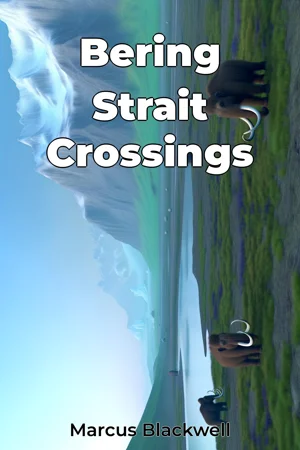
How did the first Americans arrive, and what secrets lie buried beneath the waves of the Bering Strait? "Bering Strait Crossings" delves into the complex story of early human migration from Asia to North America, exploring the geological and environmental factors that shaped this pivotal event in human history. This book examines the Bering Land Bridge, also known as Beringia, not merely as a geographical feature, but as a dynamic landscape that served as both a bridge and a filter for early human populations. Understanding the Bering Strait crossings is fundamental to comprehending the peopling of the Americas and the development of distinct indigenous cultures. The book’s central argument is that the Bering Land Bridge was not a single, uniform environment, but rather a complex and changing ecosystem that profoundly influenced the routes, timing, and genetic makeup of the earliest migrants. We challenge simplified narratives of a straightforward, linear migration, instead presenting a nuanced view of multiple waves of migration adapting to diverse environmental niches within Beringia. This understanding requires integrating evidence from multiple disciplines, offering a more complete picture than any single field can provide. "Bering Strait Crossings" begins by establishing the geological and climatological context of Beringia during the Late Pleistocene epoch. We explore the formation and disappearance of the land bridge due to fluctuating sea levels, driven by glacial cycles. Subsequently, the book examines the archaeological evidence for human presence in both Asia and North America, focusing on key sites that provide insights into the material culture and subsistence strategies of these early populations. A significant portion is dedicated to analyzing the genetic evidence, tracing the lineage of Native American populations back to their Asian origins and identifying distinct genetic markers associated with different migration waves. The book then synthesizes these diverse lines of evidence to reconstruct the potential routes and timelines of the Bering Strait crossings, considering factors such as resource availability, climate change, and technological capabilities. The final sections delve into the cultural adaptations and subsequent dispersal of these early migrants across the Americas, exploring how their initial experiences in Beringia shaped their later trajectories. The evidence presented in this book is drawn from a wide range of sources, including archaeological excavations, paleoenvironmental reconstructions, and genetic analyses. We incorporate data from both published research and original fieldwork, emphasizing the importance of interdisciplinary collaboration. Particular attention is given to newly emerging data from ancient DNA studies, which are revolutionizing our understanding of human population history. This book bridges the disciplines of archaeology, genetics, and earth sciences, offering a holistic perspective on the Bering Strait crossings. By integrating these fields, we aim to provide a more comprehensive and accurate account of this crucial chapter in human history. "Bering Strait Crossings" adopts an academic, yet accessible tone, making it suitable for students, researchers, and general readers with an interest in human origins, migration patterns, and the intersection of environment and culture. The intended audience includes scholars and students in anthropology, archaeology, genetics, and geography, as well as anyone curious about the early history of the Americas. While the book focuses primarily on the initial peopling of the Americas via the Bering Land Bridge, it acknowledges the ongoing debates surrounding alternative migration routes, such as the coastal migration theory. However, it deliberately limits its scope to the terrestrial Beringian route to provide a more in-depth analysis of the available evidence. The findings presented in "Bering Strait Crossings" have practical implications for understanding the genetic diversity and cultural heritage of Native American populations. This knowledge can inform contemporary discussions about indigenous rights, cultural preservation, and environmental stewardship. The book recognizes the sensitivities surrounding this topic and strives to present the evidence in a respectful and culturally sensitive manner. By synthesizing current research and presenting a nuanced perspective, "Bering Strait Crossings" offers a fresh and insightful contribution to the ongoing discussion about the peopling of the Americas.
How did the first Americans arrive, and what secrets lie buried beneath the waves of the Bering Strait? "Bering Strait Crossings" delves into the complex story of early human migration from Asia to North America, exploring the geological and environmental factors that shaped this pivotal event in human history. This book examines the Bering Land Bridge, also known as Beringia, not merely as a geographical feature, but as a dynamic landscape that served as both a bridge and a filter for early human populations. Understanding the Bering Strait crossings is fundamental to comprehending the peopling of the Americas and the development of distinct indigenous cultures. The book’s central argument is that the Bering Land Bridge was not a single, uniform environment, but rather a complex and changing ecosystem that profoundly influenced the routes, timing, and genetic makeup of the earliest migrants. We challenge simplified narratives of a straightforward, linear migration, instead presenting a nuanced view of multiple waves of migration adapting to diverse environmental niches within Beringia. This understanding requires integrating evidence from multiple disciplines, offering a more complete picture than any single field can provide. "Bering Strait Crossings" begins by establishing the geological and climatological context of Beringia during the Late Pleistocene epoch. We explore the formation and disappearance of the land bridge due to fluctuating sea levels, driven by glacial cycles. Subsequently, the book examines the archaeological evidence for human presence in both Asia and North America, focusing on key sites that provide insights into the material culture and subsistence strategies of these early populations. A significant portion is dedicated to analyzing the genetic evidence, tracing the lineage of Native American populations back to their Asian origins and identifying distinct genetic markers associated with different migration waves. The book then synthesizes these diverse lines of evidence to reconstruct the potential routes and timelines of the Bering Strait crossings, considering factors such as resource availability, climate change, and technological capabilities. The final sections delve into the cultural adaptations and subsequent dispersal of these early migrants across the Americas, exploring how their initial experiences in Beringia shaped their later trajectories. The evidence presented in this book is drawn from a wide range of sources, including archaeological excavations, paleoenvironmental reconstructions, and genetic analyses. We incorporate data from both published research and original fieldwork, emphasizing the importance of interdisciplinary collaboration. Particular attention is given to newly emerging data from ancient DNA studies, which are revolutionizing our understanding of human population history. This book bridges the disciplines of archaeology, genetics, and earth sciences, offering a holistic perspective on the Bering Strait crossings. By integrating these fields, we aim to provide a more comprehensive and accurate account of this crucial chapter in human history. "Bering Strait Crossings" adopts an academic, yet accessible tone, making it suitable for students, researchers, and general readers with an interest in human origins, migration patterns, and the intersection of environment and culture. The intended audience includes scholars and students in anthropology, archaeology, genetics, and geography, as well as anyone curious about the early history of the Americas. While the book focuses primarily on the initial peopling of the Americas via the Bering Land Bridge, it acknowledges the ongoing debates surrounding alternative migration routes, such as the coastal migration theory. However, it deliberately limits its scope to the terrestrial Beringian route to provide a more in-depth analysis of the available evidence. The findings presented in "Bering Strait Crossings" have practical implications for understanding the genetic diversity and cultural heritage of Native American populations. This knowledge can inform contemporary discussions about indigenous rights, cultural preservation, and environmental stewardship. The book recognizes the sensitivities surrounding this topic and strives to present the evidence in a respectful and culturally sensitive manner. By synthesizing current research and presenting a nuanced perspective, "Bering Strait Crossings" offers a fresh and insightful contribution to the ongoing discussion about the peopling of the Americas.
"Bering Strait Crossings" explores the fascinating story of how early humans migrated from Asia to North America via the Bering Land Bridge, or Beringia. Challenging simple narratives, the book highlights Beringia's complex environment, which influenced migration routes and the genetic makeup of early populations. It discusses how fluctuating sea levels, driven by glacial cycles during the Late Pleistocene epoch, shaped the land bridge's formation and disappearance, impacting human movement. The book uniquely integrates archaeological evidence, paleoenvironmental reconstructions, and genetic analysis to provide a holistic view. The book examines archaeological sites in Asia and North America, revealing insights into early humans' material culture and survival strategies. Genetic analysis traces the lineage of Native American populations to their Asian origins, identifying genetic markers associated with different migration waves. "Bering Strait Crossings" progresses by establishing the geological context, examining archaeological evidence, analyzing genetic data, and reconstructing migration routes, culminating in an exploration of cultural adaptations across the Americas. The book offers a fresh perspective by bridging archaeology, genetics, and earth sciences, appealing to scholars, students, and anyone interested in human origins and the peopling of the Americas.
Book Details
ISBN
9788233987596
Publisher
Publifye AS
Your Licenses
You don't own any licenses for this book
Purchase a license below to unlock this book and download the EPUB.
Purchase License
Select a tier to unlock this book
Need bulk licensing?
Contact us for enterprise agreements.