
About This Book
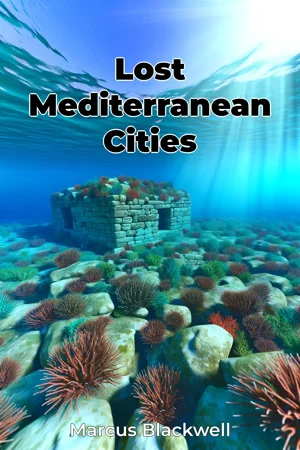
What secrets lie silently beneath the waves of the Mediterranean Sea, and what can they reveal about the ebb and flow of civilizations? "Lost Mediterranean Cities" delves into the submerged urban landscapes scattered across the Mediterranean, sites frozen in time that offer unprecedented insights into the past. This book explores the profound stories of these underwater metropolises and their enduring significance for our understanding of history, Earth sciences, and geography. We will examine the geological processes, such as sea-level changes and seismic activity, that caused these cities to sink, focusing on how these environmental shifts impacted human settlements. This geological perspective is crucial, providing the context for understanding the vulnerability of coastal civilizations throughout history. We will also investigate the archaeological evidence recovered from these sites, including architectural remains, artifacts, and biological samples, which shed light on the daily lives, economies, and cultural practices of the people who once inhabited these cities. The central argument of "Lost Mediterranean Cities" is that studying these submerged settlements provides a unique window into the complex interplay between human societies and their environment, revealing critical lessons about resilience, adaptation, and the long-term consequences of environmental change. This perspective challenges traditional historical narratives that often overlook the impact of natural forces on human development. The book begins by introducing the key concepts of marine archaeology, coastal geomorphology, and the history of Mediterranean civilizations. From there, we will delve into specific case studies, analyzing the sunken remains of cities like Pavlopetri in Greece, Atlit-Yam in Israel, and Baia in Italy. Each case study explores the city's history, the reasons for its submersion, and the archaeological discoveries made at the site. The book then examines the advanced technologies used to explore and document these underwater sites, including sonar, remotely operated vehicles (ROVs), and 3D modeling. We will also discuss the ethical considerations surrounding the excavation and preservation of underwater cultural heritage. The evidence presented in "Lost Mediterranean Cities" draws from a range of sources, including archaeological reports, geological surveys, historical texts, and cutting-edge scientific analyses. The book also incorporates original research conducted by leading marine archaeologists and geologists. "Lost Mediterranean Cities" connects to several other fields, including climate science (understanding sea-level rise), anthropology (studying human adaptation to environmental change), and maritime history (exploring the role of the sea in shaping civilizations). This interdisciplinary approach enriches the book's argument, demonstrating the interconnectedness of human history and natural processes. This book offers a unique perspective by combining archaeological data with geological and environmental analyses to provide a holistic understanding of submerged cities. Rather than simply recounting historical events, it examines the dynamic relationship between human societies and their environment. The tone of the book is informative, engaging, and accessible to a broad audience. While it is grounded in rigorous scientific research, it avoids technical jargon and presents complex information in a clear and concise manner. "Lost Mediterranean Cities" is intended for anyone interested in history, archaeology, Earth sciences, or the Mediterranean region. It will appeal to students, researchers, and general readers alike, offering new insights into the past and highlighting the importance of preserving our underwater cultural heritage. The scope of the book encompasses a wide range of submerged cities across the Mediterranean, but it focuses primarily on sites where significant archaeological research has been conducted. The limitations include the inherent challenges of underwater archaeology, such as limited visibility and the difficulty of accessing certain sites. The information presented in "Lost Mediterranean Cities" has practical applications for coastal management, heritage preservation, and understanding the impacts of climate change. By studying how past civilizations responded to environmental challenges, we can gain valuable insights into how to build more resilient communities today. While the interpretation of archaeological evidence is always subject to debate, "Lost Mediterranean Cities" presents a balanced and well-supported account of the available data, acknowledging alternative perspectives where appropriate.
What secrets lie silently beneath the waves of the Mediterranean Sea, and what can they reveal about the ebb and flow of civilizations? "Lost Mediterranean Cities" delves into the submerged urban landscapes scattered across the Mediterranean, sites frozen in time that offer unprecedented insights into the past. This book explores the profound stories of these underwater metropolises and their enduring significance for our understanding of history, Earth sciences, and geography. We will examine the geological processes, such as sea-level changes and seismic activity, that caused these cities to sink, focusing on how these environmental shifts impacted human settlements. This geological perspective is crucial, providing the context for understanding the vulnerability of coastal civilizations throughout history. We will also investigate the archaeological evidence recovered from these sites, including architectural remains, artifacts, and biological samples, which shed light on the daily lives, economies, and cultural practices of the people who once inhabited these cities. The central argument of "Lost Mediterranean Cities" is that studying these submerged settlements provides a unique window into the complex interplay between human societies and their environment, revealing critical lessons about resilience, adaptation, and the long-term consequences of environmental change. This perspective challenges traditional historical narratives that often overlook the impact of natural forces on human development. The book begins by introducing the key concepts of marine archaeology, coastal geomorphology, and the history of Mediterranean civilizations. From there, we will delve into specific case studies, analyzing the sunken remains of cities like Pavlopetri in Greece, Atlit-Yam in Israel, and Baia in Italy. Each case study explores the city's history, the reasons for its submersion, and the archaeological discoveries made at the site. The book then examines the advanced technologies used to explore and document these underwater sites, including sonar, remotely operated vehicles (ROVs), and 3D modeling. We will also discuss the ethical considerations surrounding the excavation and preservation of underwater cultural heritage. The evidence presented in "Lost Mediterranean Cities" draws from a range of sources, including archaeological reports, geological surveys, historical texts, and cutting-edge scientific analyses. The book also incorporates original research conducted by leading marine archaeologists and geologists. "Lost Mediterranean Cities" connects to several other fields, including climate science (understanding sea-level rise), anthropology (studying human adaptation to environmental change), and maritime history (exploring the role of the sea in shaping civilizations). This interdisciplinary approach enriches the book's argument, demonstrating the interconnectedness of human history and natural processes. This book offers a unique perspective by combining archaeological data with geological and environmental analyses to provide a holistic understanding of submerged cities. Rather than simply recounting historical events, it examines the dynamic relationship between human societies and their environment. The tone of the book is informative, engaging, and accessible to a broad audience. While it is grounded in rigorous scientific research, it avoids technical jargon and presents complex information in a clear and concise manner. "Lost Mediterranean Cities" is intended for anyone interested in history, archaeology, Earth sciences, or the Mediterranean region. It will appeal to students, researchers, and general readers alike, offering new insights into the past and highlighting the importance of preserving our underwater cultural heritage. The scope of the book encompasses a wide range of submerged cities across the Mediterranean, but it focuses primarily on sites where significant archaeological research has been conducted. The limitations include the inherent challenges of underwater archaeology, such as limited visibility and the difficulty of accessing certain sites. The information presented in "Lost Mediterranean Cities" has practical applications for coastal management, heritage preservation, and understanding the impacts of climate change. By studying how past civilizations responded to environmental challenges, we can gain valuable insights into how to build more resilient communities today. While the interpretation of archaeological evidence is always subject to debate, "Lost Mediterranean Cities" presents a balanced and well-supported account of the available data, acknowledging alternative perspectives where appropriate.
"Lost Mediterranean Cities" explores submerged urban landscapes in the Mediterranean, offering unique insights into history, Earth sciences, and geography. It reveals how geological events, such as sea-level changes and seismic activity, caused cities to sink, impacting human settlements. Marine archaeology uncovers architectural remains and artifacts, shedding light on daily life and cultural practices. These submerged sites provide critical lessons about resilience, adaptation, and environmental change, challenging traditional historical narratives. The book examines specific case studies like Pavlopetri, Atlit-Yam, and Baia, detailing their histories, submersion causes, and archaeological discoveries. Advanced technologies, including sonar and 3D modeling, aid exploration and documentation efforts to preserve underwater cultural heritage. By combining archaeological data with geological analyses, "Lost Mediterranean Cities" uncovers the interplay between human societies and their environment.
Book Details
ISBN
9788233987183
Publisher
Publifye AS
Your Licenses
You don't own any licenses for this book
Purchase a license below to unlock this book and download the EPUB.
Purchase License
Select a tier to unlock this book
Need bulk licensing?
Contact us for enterprise agreements.