
About This Book
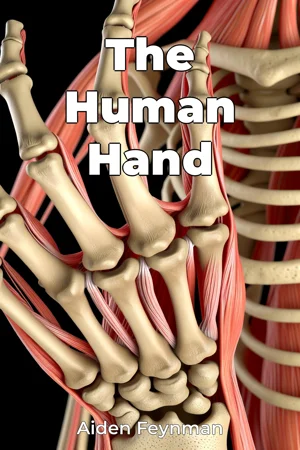
What if the key to understanding humanity lies not in our brains, but in our hands? This book, "The Human Hand," explores the intricate anatomy and mechanics of this remarkable appendage, revealing its profound influence on our evolution, our capacity for tool-making, and the development of fine motor skills that define our species. We will uncover how the hand became the physical manifestation of human intelligence and ingenuity. This exploration is vital because the hand is more than just a grasping tool; it is a sensory organ, a communication device, and a crucial interface between our minds and the external world. Understanding its structure and function provides critical insights into human evolution, cognitive development, and the very essence of what makes us human. We will also delve into the medical implications of hand injuries and disorders – highlighting the significance of preserving its capabilities. We will embark on a journey that begins with a detailed anatomical and biomechanical analysis of the hand, examining the bones, muscles, tendons, nerves, and blood vessels that work in concert to enable its complex movements. This foundation will be built upon with an exploration into its evolutionary history. We will trace the development of the hand from its earliest primate ancestors, analyzing the selective pressures that favored its unique dexterity and precision. We will then investigate the link between the hand and tool-making, demonstrating how the hand’s capabilities facilitated the creation and use of tools, which, in turn, spurred further cognitive and physical development. This section will present archeological evidence, biomechanical analyses, and cognitive studies illustrating this co-evolutionary relationship. The central argument of this book is that the human hand is not merely a product of evolution, but an active driver of it. Its capabilities have shaped our cognitive abilities, our technological advancements, and our very understanding of the world. We will examine how the precision grip, the opposable thumb, and the intricate neural pathways connecting the hand to the brain have enabled humans to manipulate objects with unparalleled skill, leading to innovations in art, science, and technology. The book unfolds in three major parts. First, it introduces the foundational concepts of hand anatomy, biomechanics, and evolutionary history. Second, it delves into the role of the hand in tool-making and the development of fine motor skills, exploring specific examples of how hand-craftsmanship has driven innovation across diverse fields and cultures. Third, it culminates with an analysis of the hand's impact on human cognition and culture, examining its role in language, art, and technology, and concludes with a discussion of the medical conditions and injuries that threaten hand function, and the rehabilitation techniques used to restore its function. The arguments presented are supported by a synthesis of anatomical studies, biomechanical analyses, paleontological evidence, and cognitive research. We will draw upon diverse data sources, including anatomical atlases, primate fossil records, experimental studies of hand motor control, and anthropological studies of tool use in different cultures. This book is not confined to the realm of biology alone. It also connects to fields such as anthropology, archeology, engineering, and medicine. Its insights can inform the design of prosthetic limbs, improve surgical techniques, and enhance our understanding of human cognitive development. It offers a novel perspective, viewing the hand as a central player in the human story rather than a mere appendage. This book is written in a clear and accessible style, suitable for a broad audience with an interest in science, biology, or human evolution. It assumes no prior expertise in anatomy or biomechanics, and technical concepts are explained in a user-friendly manner. The target audience includes students, educators, healthcare professionals, and anyone curious about the remarkable capabilities of the human hand. As a work of science non-fiction, the book adheres to the principles of factual accuracy, objectivity, and evidence-based reasoning. While comprehensive in its coverage, the book intentionally limits its scope to the biological, evolutionary, and cultural aspects of the hand, without delving into detailed medical or surgical procedures. The knowledge gained from this book can be practically applied in various settings. For example, it can inform the design of ergonomic tools and workplaces, improve rehabilitation strategies for hand injuries, and enhance educational programs focused on fine motor skill development. The book addresses ongoing discussions about the role of tool use in human evolution and the impact of technology on hand function. The book offers a comprehensive and insightful exploration of the human hand, revealing its pivotal role in shaping our species and our world.
What if the key to understanding humanity lies not in our brains, but in our hands? This book, "The Human Hand," explores the intricate anatomy and mechanics of this remarkable appendage, revealing its profound influence on our evolution, our capacity for tool-making, and the development of fine motor skills that define our species. We will uncover how the hand became the physical manifestation of human intelligence and ingenuity. This exploration is vital because the hand is more than just a grasping tool; it is a sensory organ, a communication device, and a crucial interface between our minds and the external world. Understanding its structure and function provides critical insights into human evolution, cognitive development, and the very essence of what makes us human. We will also delve into the medical implications of hand injuries and disorders – highlighting the significance of preserving its capabilities. We will embark on a journey that begins with a detailed anatomical and biomechanical analysis of the hand, examining the bones, muscles, tendons, nerves, and blood vessels that work in concert to enable its complex movements. This foundation will be built upon with an exploration into its evolutionary history. We will trace the development of the hand from its earliest primate ancestors, analyzing the selective pressures that favored its unique dexterity and precision. We will then investigate the link between the hand and tool-making, demonstrating how the hand’s capabilities facilitated the creation and use of tools, which, in turn, spurred further cognitive and physical development. This section will present archeological evidence, biomechanical analyses, and cognitive studies illustrating this co-evolutionary relationship. The central argument of this book is that the human hand is not merely a product of evolution, but an active driver of it. Its capabilities have shaped our cognitive abilities, our technological advancements, and our very understanding of the world. We will examine how the precision grip, the opposable thumb, and the intricate neural pathways connecting the hand to the brain have enabled humans to manipulate objects with unparalleled skill, leading to innovations in art, science, and technology. The book unfolds in three major parts. First, it introduces the foundational concepts of hand anatomy, biomechanics, and evolutionary history. Second, it delves into the role of the hand in tool-making and the development of fine motor skills, exploring specific examples of how hand-craftsmanship has driven innovation across diverse fields and cultures. Third, it culminates with an analysis of the hand's impact on human cognition and culture, examining its role in language, art, and technology, and concludes with a discussion of the medical conditions and injuries that threaten hand function, and the rehabilitation techniques used to restore its function. The arguments presented are supported by a synthesis of anatomical studies, biomechanical analyses, paleontological evidence, and cognitive research. We will draw upon diverse data sources, including anatomical atlases, primate fossil records, experimental studies of hand motor control, and anthropological studies of tool use in different cultures. This book is not confined to the realm of biology alone. It also connects to fields such as anthropology, archeology, engineering, and medicine. Its insights can inform the design of prosthetic limbs, improve surgical techniques, and enhance our understanding of human cognitive development. It offers a novel perspective, viewing the hand as a central player in the human story rather than a mere appendage. This book is written in a clear and accessible style, suitable for a broad audience with an interest in science, biology, or human evolution. It assumes no prior expertise in anatomy or biomechanics, and technical concepts are explained in a user-friendly manner. The target audience includes students, educators, healthcare professionals, and anyone curious about the remarkable capabilities of the human hand. As a work of science non-fiction, the book adheres to the principles of factual accuracy, objectivity, and evidence-based reasoning. While comprehensive in its coverage, the book intentionally limits its scope to the biological, evolutionary, and cultural aspects of the hand, without delving into detailed medical or surgical procedures. The knowledge gained from this book can be practically applied in various settings. For example, it can inform the design of ergonomic tools and workplaces, improve rehabilitation strategies for hand injuries, and enhance educational programs focused on fine motor skill development. The book addresses ongoing discussions about the role of tool use in human evolution and the impact of technology on hand function. The book offers a comprehensive and insightful exploration of the human hand, revealing its pivotal role in shaping our species and our world.
"The Human Hand" explores the hand's critical role in human evolution, tool-making, and cognitive development. It argues that the hand is not just a product of evolution but an active driver, shaping our intelligence and technological advancements. The book emphasizes the hand's intricate anatomy, revealing how its unique biomechanics enabled the creation and use of tools, which then spurred further cognitive and physical evolution. Consider the precision grip, a defining feature of the human hand, which allows for unparalleled object manipulation—a capability that has fueled innovation across art, science, and technology. The book begins with hand anatomy, biomechanics, and evolutionary history. It then investigates the hand's role in tool-making and fine motor skills, using examples of craftsmanship across cultures. Finally, it analyzes the hand's influence on human cognition and culture, covering language, art, and technology, and also addresses hand injuries and rehabilitation. By synthesizing anatomical studies, paleontological evidence, and cognitive research, the book demonstrates the hand's profound impact on what makes us human.
Book Details
ISBN
9788233986667
Publisher
Publifye AS
Your Licenses
You don't own any licenses for this book
Purchase a license below to unlock this book and download the EPUB.
Purchase License
Select a tier to unlock this book
Need bulk licensing?
Contact us for enterprise agreements.