
About This Book
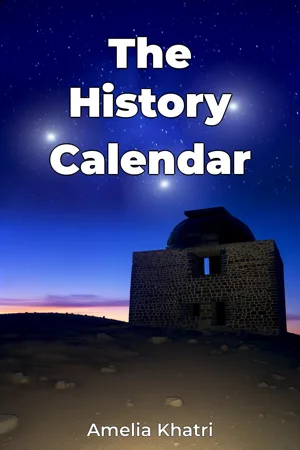
Have you ever stopped to consider how deeply our lives are governed by the simple act of measuring time? "The History Calendar" explores the fascinating story of how humanity has tracked, organized, and ultimately, been shaped by calendars, from the earliest lunar observations to the complex global timekeeping systems that dictate our modern world. This book delves into the evolution of calendars, revealing their profound impact on civilization, culture, and scientific development. At its core, "The History Calendar" examines three central themes: the origin of calendars in response to agricultural and societal needs, the development of increasingly sophisticated methods of timekeeping across different cultures, and the standardization of global time in the age of rapid communication and travel. These topics are vital because they illuminate the intricate relationship between human society and our understanding of time, demonstrating how calendars have both reflected and influenced our perception of the world. Understanding calendars requires a grasp of basic astronomy, mathematics, and a familiarity with ancient cultures. We will explore how early civilizations, lacking modern scientific tools, relied on careful observation of celestial bodies to predict seasons and regulate agricultural cycles. This book will examine calendars from across the globe, including the lunar calendars of Mesopotamia, the solar calendars of ancient Egypt, the complex Maya calendar, and the Gregorian calendar used worldwide today. The central argument of "The History Calendar" is that calendars are not merely neutral tools for measuring time, but actively shape the way we perceive and organize reality. By imposing a framework on the continuous flow of experience, calendars have influenced religious practices, social structures, and economic systems. The book begins with an introduction to the fundamental principles of timekeeping and the earliest attempts to create calendars based on lunar cycles. It then moves on to explore the diverse calendar systems developed by various cultures, highlighting their unique features and the astronomical knowledge that underpinned them. We will examine the Roman calendar and its various reforms, culminating in the Gregorian calendar. The latter half explores the challenges of synchronizing calendars across the globe, the impact of technology on timekeeping, and the ongoing debates about calendar reform. The book concludes by considering the philosophical implications of how we measure and experience time. The book's arguments are supported by a wide range of historical sources, including archaeological records, ancient texts, astronomical data, and scholarly analysis. It draws on research in astronomy, history, anthropology, and religious studies. "The History Calendar" connects to several other fields. Firstly, its exploration of astronomical observation links it to the history of science. Secondly, the analysis of different cultural calendars connects it to anthropology and religious studies. Finally, the book relates to sociology through its examination of how calendars influence social organization and communal activities. These interdisciplinary connections enrich the narrative and demonstrate the broad relevance of the topic. The book presents a unique perspective by emphasizing that calendars are more than just tools for time management; they are cultural artifacts that reflect deeply held beliefs about the nature of time and the universe. This perspective allows for a nuanced understanding of the diversity of calendrical systems and their profound impact on human societies. The tone is informative and accessible, aiming to engage a broad readership with clear explanations and compelling narratives. While grounded in academic research, the writing style avoids jargon and technical language, making the book accessible to anyone with an interest in history, science, or culture. This book is for anyone interested in history, astronomy, anthropology, or simply curious about the origins of our most basic ways of organizing our lives. It will be especially valuable to students, educators, and researchers seeking a comprehensive overview of the history of calendars. As a work of non-fiction, "The History Calendar" adheres to standards of accuracy, objectivity, and thorough research. All claims are backed by evidence, and different perspectives are considered. The scope of the book is broad, covering the history of calendars from ancient times to the present day. However, it focuses primarily on the major calendar systems that have had the most significant impact on human history, with less emphasis on more localized or obscure calendars. The book offers a deeper real-world application by allowing readers to better contextualize their own understanding of time and its effect on their lives. It provides a framework for understanding the cultural and historical forces that have shaped our modern world. Finally, the book will touch on ongoing debates about standardizing time, including the challenges of leap seconds and the potential benefits of alternative calendar systems. "The History Calendar" offers a compelling account of how we came to measure time, and how measuring time has shaped us.
Have you ever stopped to consider how deeply our lives are governed by the simple act of measuring time? "The History Calendar" explores the fascinating story of how humanity has tracked, organized, and ultimately, been shaped by calendars, from the earliest lunar observations to the complex global timekeeping systems that dictate our modern world. This book delves into the evolution of calendars, revealing their profound impact on civilization, culture, and scientific development. At its core, "The History Calendar" examines three central themes: the origin of calendars in response to agricultural and societal needs, the development of increasingly sophisticated methods of timekeeping across different cultures, and the standardization of global time in the age of rapid communication and travel. These topics are vital because they illuminate the intricate relationship between human society and our understanding of time, demonstrating how calendars have both reflected and influenced our perception of the world. Understanding calendars requires a grasp of basic astronomy, mathematics, and a familiarity with ancient cultures. We will explore how early civilizations, lacking modern scientific tools, relied on careful observation of celestial bodies to predict seasons and regulate agricultural cycles. This book will examine calendars from across the globe, including the lunar calendars of Mesopotamia, the solar calendars of ancient Egypt, the complex Maya calendar, and the Gregorian calendar used worldwide today. The central argument of "The History Calendar" is that calendars are not merely neutral tools for measuring time, but actively shape the way we perceive and organize reality. By imposing a framework on the continuous flow of experience, calendars have influenced religious practices, social structures, and economic systems. The book begins with an introduction to the fundamental principles of timekeeping and the earliest attempts to create calendars based on lunar cycles. It then moves on to explore the diverse calendar systems developed by various cultures, highlighting their unique features and the astronomical knowledge that underpinned them. We will examine the Roman calendar and its various reforms, culminating in the Gregorian calendar. The latter half explores the challenges of synchronizing calendars across the globe, the impact of technology on timekeeping, and the ongoing debates about calendar reform. The book concludes by considering the philosophical implications of how we measure and experience time. The book's arguments are supported by a wide range of historical sources, including archaeological records, ancient texts, astronomical data, and scholarly analysis. It draws on research in astronomy, history, anthropology, and religious studies. "The History Calendar" connects to several other fields. Firstly, its exploration of astronomical observation links it to the history of science. Secondly, the analysis of different cultural calendars connects it to anthropology and religious studies. Finally, the book relates to sociology through its examination of how calendars influence social organization and communal activities. These interdisciplinary connections enrich the narrative and demonstrate the broad relevance of the topic. The book presents a unique perspective by emphasizing that calendars are more than just tools for time management; they are cultural artifacts that reflect deeply held beliefs about the nature of time and the universe. This perspective allows for a nuanced understanding of the diversity of calendrical systems and their profound impact on human societies. The tone is informative and accessible, aiming to engage a broad readership with clear explanations and compelling narratives. While grounded in academic research, the writing style avoids jargon and technical language, making the book accessible to anyone with an interest in history, science, or culture. This book is for anyone interested in history, astronomy, anthropology, or simply curious about the origins of our most basic ways of organizing our lives. It will be especially valuable to students, educators, and researchers seeking a comprehensive overview of the history of calendars. As a work of non-fiction, "The History Calendar" adheres to standards of accuracy, objectivity, and thorough research. All claims are backed by evidence, and different perspectives are considered. The scope of the book is broad, covering the history of calendars from ancient times to the present day. However, it focuses primarily on the major calendar systems that have had the most significant impact on human history, with less emphasis on more localized or obscure calendars. The book offers a deeper real-world application by allowing readers to better contextualize their own understanding of time and its effect on their lives. It provides a framework for understanding the cultural and historical forces that have shaped our modern world. Finally, the book will touch on ongoing debates about standardizing time, including the challenges of leap seconds and the potential benefits of alternative calendar systems. "The History Calendar" offers a compelling account of how we came to measure time, and how measuring time has shaped us.
"The History Calendar" unveils the captivating story of how calendars have shaped human civilization. From early lunar observations driving agricultural practices to complex global timekeeping, the book explores how time measurement has influenced societies worldwide. Intriguingly, calendars aren't just neutral tools; they actively mold our perception of reality, impacting religious practices and social structures. Discover the evolution of calendars across cultures, from Mesopotamia's lunar systems to the sophisticated Maya calendar, and understand their astronomical underpinnings. The book examines the origins of calendars in response to societal needs, the development of sophisticated timekeeping methods, and the standardization of global time. It begins with the basics of timekeeping and early lunar calendars, progresses through diverse cultural systems, and culminates in the Gregorian calendar. The latter portion tackles synchronizing calendars globally, the impact of technology, and debates on calendar reform, offering readers a deep dive into the philosophical implications of time measurement. This unique perspective emphasizes calendars as cultural artifacts reflecting beliefs about time and the universe.
Book Details
ISBN
9788233986339
Publisher
Publifye AS
Your Licenses
You don't own any licenses for this book
Purchase a license below to unlock this book and download the EPUB.
Purchase License
Select a tier to unlock this book
Need bulk licensing?
Contact us for enterprise agreements.