
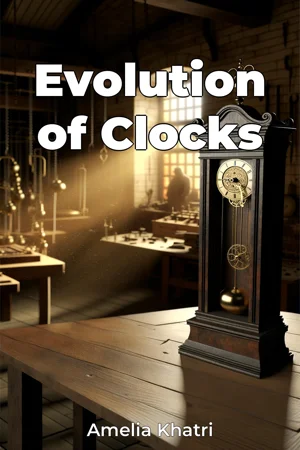
About This Book
Have you ever considered how profoundly our perception and measurement of time has shaped civilization? "Evolution of Clocks" explores the fascinating story of humanity’s quest to quantify time, from rudimentary ancient methods to the cutting-edge precision of atomic clocks, and how this journey has impacted our understanding of the universe and our place within it. This book delves into three main areas: the historical progression of timekeeping devices, the scientific principles underpinning these technologies, and the societal implications of increasingly accurate time measurement. Understanding these topics is critical because our ability to measure time has directly influenced everything from agricultural practices and religious observances to scientific discoveries and global communication networks. We begin by examining the earliest methods of timekeeping, born from observing natural cycles like the sun and stars. Sundials, water clocks (clepsydrae), and candle clocks represent early attempts to standardize time, each with its own limitations and cultural significance. As societies became more complex, the need for more accurate and portable timekeepers grew, leading to the invention of mechanical clocks in the medieval period. The pendulum clock, a revolutionary advancement, dramatically improved accuracy and paved the way for the intricate clockwork mechanisms of the Renaissance. The 19th and 20th centuries witness a burst of innovation, with the development of quartz clocks and, ultimately, atomic clocks, which harness the predictable oscillations of atoms to achieve unparalleled precision. The central argument of "Evolution of Clocks" is that the development of timekeeping technologies is not merely a story of scientific advancement but a reflection of humanity's evolving relationship with time itself. Our understanding of time has been refined, redefined, and ultimately revolutionized by our tools for measuring it. This evolution has not only shaped our daily lives but has also profoundly impacted scientific fields like physics, astronomy, and navigation. The book unfolds chronologically, starting with ancient timekeeping practices and progressing through the mechanical age to the era of atomic clocks. We will explore the underlying scientific principles of each type of clock, elucidating the physics and engineering that made these innovations possible. Major points include: the transition from natural observations to mechanical devices, the impact of scientific discoveries (like the pendulum and the piezoelectric effect) on clock accuracy, and the profound implications of atomic timekeeping for global synchronization and scientific research. The book culminates in a discussion of the current state of timekeeping and its potential future, including the ongoing quest for even greater precision and stability. "Evolution of Clocks" draws upon a diverse range of sources, including archaeological records, historical texts, scientific papers, and patent documents. Diagrams, illustrations, and photographs enhance the reader's understanding of the mechanisms and principles discussed. This book connects to various fields, including history, physics, and sociology. The historical context reveals how societal needs and cultural beliefs influenced the development of clocks. The physics explains the scientific principles upon which these devices function. The sociological perspective examines the impact of standardized time on social organization and global interconnectedness. This book provides a unique perspective by examining timekeeping not just as a technological endeavor but as a reflection of humanity’s evolving understanding of the universe and our place within it. The writing style is accessible and engaging, suitable for a general audience with an interest in history, science, or technology. The target audience includes anyone curious about the history of clocks, the science behind timekeeping, or the impact of time on society. The book's value lies in its comprehensive coverage of the subject, its clear explanations of complex concepts, and its engaging narrative style. As a work of non-fiction, "Evolution of Clocks" adheres to the principles of accuracy, objectivity, and thorough research. While the book strives to be comprehensive, it acknowledges the limitations of any single volume and focuses primarily on major developments and key innovations in timekeeping history. The information presented has real-world applications for understanding the importance of precision in navigation, communication, and scientific research. It also sheds light on the philosophical implications of how we perceive and measure time. While the book does not delve into current debates, it sets the stage for understanding potential issues related to the ongoing quest for even more accurate timekeeping.
Have you ever considered how profoundly our perception and measurement of time has shaped civilization? "Evolution of Clocks" explores the fascinating story of humanity’s quest to quantify time, from rudimentary ancient methods to the cutting-edge precision of atomic clocks, and how this journey has impacted our understanding of the universe and our place within it. This book delves into three main areas: the historical progression of timekeeping devices, the scientific principles underpinning these technologies, and the societal implications of increasingly accurate time measurement. Understanding these topics is critical because our ability to measure time has directly influenced everything from agricultural practices and religious observances to scientific discoveries and global communication networks. We begin by examining the earliest methods of timekeeping, born from observing natural cycles like the sun and stars. Sundials, water clocks (clepsydrae), and candle clocks represent early attempts to standardize time, each with its own limitations and cultural significance. As societies became more complex, the need for more accurate and portable timekeepers grew, leading to the invention of mechanical clocks in the medieval period. The pendulum clock, a revolutionary advancement, dramatically improved accuracy and paved the way for the intricate clockwork mechanisms of the Renaissance. The 19th and 20th centuries witness a burst of innovation, with the development of quartz clocks and, ultimately, atomic clocks, which harness the predictable oscillations of atoms to achieve unparalleled precision. The central argument of "Evolution of Clocks" is that the development of timekeeping technologies is not merely a story of scientific advancement but a reflection of humanity's evolving relationship with time itself. Our understanding of time has been refined, redefined, and ultimately revolutionized by our tools for measuring it. This evolution has not only shaped our daily lives but has also profoundly impacted scientific fields like physics, astronomy, and navigation. The book unfolds chronologically, starting with ancient timekeeping practices and progressing through the mechanical age to the era of atomic clocks. We will explore the underlying scientific principles of each type of clock, elucidating the physics and engineering that made these innovations possible. Major points include: the transition from natural observations to mechanical devices, the impact of scientific discoveries (like the pendulum and the piezoelectric effect) on clock accuracy, and the profound implications of atomic timekeeping for global synchronization and scientific research. The book culminates in a discussion of the current state of timekeeping and its potential future, including the ongoing quest for even greater precision and stability. "Evolution of Clocks" draws upon a diverse range of sources, including archaeological records, historical texts, scientific papers, and patent documents. Diagrams, illustrations, and photographs enhance the reader's understanding of the mechanisms and principles discussed. This book connects to various fields, including history, physics, and sociology. The historical context reveals how societal needs and cultural beliefs influenced the development of clocks. The physics explains the scientific principles upon which these devices function. The sociological perspective examines the impact of standardized time on social organization and global interconnectedness. This book provides a unique perspective by examining timekeeping not just as a technological endeavor but as a reflection of humanity’s evolving understanding of the universe and our place within it. The writing style is accessible and engaging, suitable for a general audience with an interest in history, science, or technology. The target audience includes anyone curious about the history of clocks, the science behind timekeeping, or the impact of time on society. The book's value lies in its comprehensive coverage of the subject, its clear explanations of complex concepts, and its engaging narrative style. As a work of non-fiction, "Evolution of Clocks" adheres to the principles of accuracy, objectivity, and thorough research. While the book strives to be comprehensive, it acknowledges the limitations of any single volume and focuses primarily on major developments and key innovations in timekeeping history. The information presented has real-world applications for understanding the importance of precision in navigation, communication, and scientific research. It also sheds light on the philosophical implications of how we perceive and measure time. While the book does not delve into current debates, it sets the stage for understanding potential issues related to the ongoing quest for even more accurate timekeeping.
"Evolution of Clocks" explores the captivating history of timekeeping, tracing humanity's efforts to measure time from ancient sundials to modern atomic clocks. It examines how these advancements have shaped our understanding of the universe and profoundly impacted society. The book highlights how the invention of the pendulum clock significantly improved accuracy, paving the way for intricate clockwork mechanisms. It also emphasizes that the development of timekeeping technologies reflects our evolving relationship with time itself, influencing fields like physics, astronomy, and navigation. The book unfolds chronologically, detailing the progression from natural observations to sophisticated mechanical and electronic devices. It presents the science behind each innovation, illustrating the physics and engineering principles that made these advancements possible. For instance, the transition from water clocks to mechanical clocks marked a significant leap in precision and portability. "Evolution of Clocks" uses diverse sources, including historical texts and scientific papers, to provide a comprehensive view of timekeeping's evolution.
Book Details
ISBN
9788233986018
Publisher
Publifye AS
Your Licenses
You don't own any licenses for this book
Purchase a license below to unlock this book and download the EPUB.
Purchase License
Select a tier to unlock this book
Need bulk licensing?
Contact us for enterprise agreements.