
About This Book
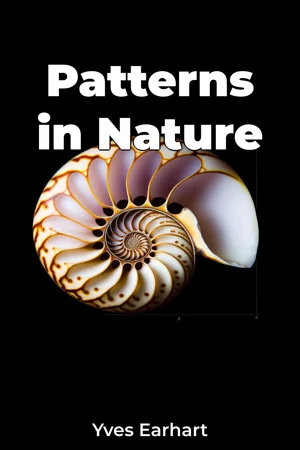
Have you ever paused to consider the hidden mathematical symphony orchestrating the natural world? "Patterns in Nature" unveils the recurring motifs woven throughout the universe, from the delicate spirals of seashells to the grand design of galaxies. This book explores how fundamental mathematical principles manifest in diverse natural phenomena, offering a fresh perspective on the interconnectedness of life, science, and the cosmos. We delve into three key areas: fractals, Fibonacci sequences, and symmetry. Fractals reveal how complex shapes can be generated from simple repeating patterns, demonstrating a powerful principle of self-similarity across scales. Fibonacci sequences, where each number is the sum of the two preceding ones, surprisingly appear in plant structures, animal proportions, and even population growth rates. Symmetry, in its various forms, dictates the arrangement of petals, the structure of crystals, and the bilateral designs of animal bodies. Understanding these patterns is important because they offer clues to the underlying processes that govern natural systems, allowing us to predict behaviors, model growth, and appreciate the inherent beauty of our world. This exploration doesn't exist in a vacuum. The history of pattern recognition is intertwined with the development of mathematics, physics, and biology. From ancient Greek geometers observing symmetries in nature to Renaissance artists employing the golden ratio, humans have long sought to understand the mathematical underpinnings of the world around them. Modern advancements in computer modeling and observational technologies have further revealed the prevalence of fractals and Fibonacci sequences in complex systems. The reader will benefit from a basic understanding of mathematical concepts such as ratios, proportions, and geometric shapes, but the book is designed to be accessible to a broad audience with an interest in science and nature. The central argument of "Patterns in Nature" is that mathematics is not merely a tool for describing the world, but a fundamental language in which nature expresses itself. This goes beyond superficial observations, revealing a deeper understanding of the physical laws and biological processes that shape our surroundings. The book begins by introducing the core concepts of fractals, Fibonacci sequences, and symmetry, providing clear definitions and illustrative examples. It then develops these ideas through chapters dedicated to specific natural phenomena. One section examines the presence of fractals in landscapes, coastlines, and river networks, using satellite imagery and computer simulations to illustrate the mathematical principles at play. Another chapter focuses on the prevalence of Fibonacci sequences in plant phyllotaxy (the arrangement of leaves on a stem), seed heads, and spiral galaxies, offering botanical and astronomical evidence. The third major section explores symmetry in the animal kingdom, analyzing body plans, camouflage patterns, and social behaviors. The book culminates by demonstrating how these patterns can inform practical applications in fields like biomimicry, materials science, and ecological modeling. The evidence presented throughout the book draws from diverse sources, including scientific literature, field observations, mathematical models, and visual representations. It will feature high-quality photographs and illustrations to showcase examples of patterns in nature. Statistical analyses and mathematical equations, presented clearly and understandably, will bolster the arguments. "Patterns in Nature" connects to various disciplines. Biology explores the evolutionary advantages of symmetrical body plans and the genetic mechanisms that control pattern formation. Physics provides the laws that drive the formation of fractals in non-equilibrium systems. Computer science offers the tools and algorithms to model complex patterns and simulate natural processes. These interdisciplinary connections enrich the book's argument by demonstrating the wide-ranging implications of mathematical patterns in understanding our world. This book offers a comprehensive yet accessible overview, bridging the gap between complex research and general readers. It presents information in a conversational and engaging style, making complex concepts understandable without sacrificing scientific rigor. The target audience includes students, educators, science enthusiasts, and anyone who wants to learn about the hidden mathematical order governing natural phenomena. The book is valuable to them because it offers a new lens through which to view the world and appreciate its inherent beauty. As a work of non-fiction, "Patterns in Nature" maintains a fact-based approach, relying on empirical evidence and scientific reasoning. While exploring complex topics, the book focuses on providing a clear and concise overview, explaining mathematical concepts in plain language. The scope is intentionally broad, covering diverse natural phenomena across multiple scales. However, the book is not an exhaustive mathematical treatise. It focuses on illustrating the key principles of fractals, Fibonacci sequences, and symmetry, rather than delving into advanced mathematical derivations. The knowledge shared in "Patterns in Nature" can have real-world applications. By understanding the patterns of nature, we can design more efficient structures, develop new materials, and create sustainable solutions to environmental problems. While there is general scientific agreement surrounding the mathematical foundations of these patterns, debates exist about the specific evolutionary pressures that drive their selection and the relative importance of these patterns in different systems. This book will touch upon such ongoing discussions within certain scientific communities.
Have you ever paused to consider the hidden mathematical symphony orchestrating the natural world? "Patterns in Nature" unveils the recurring motifs woven throughout the universe, from the delicate spirals of seashells to the grand design of galaxies. This book explores how fundamental mathematical principles manifest in diverse natural phenomena, offering a fresh perspective on the interconnectedness of life, science, and the cosmos. We delve into three key areas: fractals, Fibonacci sequences, and symmetry. Fractals reveal how complex shapes can be generated from simple repeating patterns, demonstrating a powerful principle of self-similarity across scales. Fibonacci sequences, where each number is the sum of the two preceding ones, surprisingly appear in plant structures, animal proportions, and even population growth rates. Symmetry, in its various forms, dictates the arrangement of petals, the structure of crystals, and the bilateral designs of animal bodies. Understanding these patterns is important because they offer clues to the underlying processes that govern natural systems, allowing us to predict behaviors, model growth, and appreciate the inherent beauty of our world. This exploration doesn't exist in a vacuum. The history of pattern recognition is intertwined with the development of mathematics, physics, and biology. From ancient Greek geometers observing symmetries in nature to Renaissance artists employing the golden ratio, humans have long sought to understand the mathematical underpinnings of the world around them. Modern advancements in computer modeling and observational technologies have further revealed the prevalence of fractals and Fibonacci sequences in complex systems. The reader will benefit from a basic understanding of mathematical concepts such as ratios, proportions, and geometric shapes, but the book is designed to be accessible to a broad audience with an interest in science and nature. The central argument of "Patterns in Nature" is that mathematics is not merely a tool for describing the world, but a fundamental language in which nature expresses itself. This goes beyond superficial observations, revealing a deeper understanding of the physical laws and biological processes that shape our surroundings. The book begins by introducing the core concepts of fractals, Fibonacci sequences, and symmetry, providing clear definitions and illustrative examples. It then develops these ideas through chapters dedicated to specific natural phenomena. One section examines the presence of fractals in landscapes, coastlines, and river networks, using satellite imagery and computer simulations to illustrate the mathematical principles at play. Another chapter focuses on the prevalence of Fibonacci sequences in plant phyllotaxy (the arrangement of leaves on a stem), seed heads, and spiral galaxies, offering botanical and astronomical evidence. The third major section explores symmetry in the animal kingdom, analyzing body plans, camouflage patterns, and social behaviors. The book culminates by demonstrating how these patterns can inform practical applications in fields like biomimicry, materials science, and ecological modeling. The evidence presented throughout the book draws from diverse sources, including scientific literature, field observations, mathematical models, and visual representations. It will feature high-quality photographs and illustrations to showcase examples of patterns in nature. Statistical analyses and mathematical equations, presented clearly and understandably, will bolster the arguments. "Patterns in Nature" connects to various disciplines. Biology explores the evolutionary advantages of symmetrical body plans and the genetic mechanisms that control pattern formation. Physics provides the laws that drive the formation of fractals in non-equilibrium systems. Computer science offers the tools and algorithms to model complex patterns and simulate natural processes. These interdisciplinary connections enrich the book's argument by demonstrating the wide-ranging implications of mathematical patterns in understanding our world. This book offers a comprehensive yet accessible overview, bridging the gap between complex research and general readers. It presents information in a conversational and engaging style, making complex concepts understandable without sacrificing scientific rigor. The target audience includes students, educators, science enthusiasts, and anyone who wants to learn about the hidden mathematical order governing natural phenomena. The book is valuable to them because it offers a new lens through which to view the world and appreciate its inherent beauty. As a work of non-fiction, "Patterns in Nature" maintains a fact-based approach, relying on empirical evidence and scientific reasoning. While exploring complex topics, the book focuses on providing a clear and concise overview, explaining mathematical concepts in plain language. The scope is intentionally broad, covering diverse natural phenomena across multiple scales. However, the book is not an exhaustive mathematical treatise. It focuses on illustrating the key principles of fractals, Fibonacci sequences, and symmetry, rather than delving into advanced mathematical derivations. The knowledge shared in "Patterns in Nature" can have real-world applications. By understanding the patterns of nature, we can design more efficient structures, develop new materials, and create sustainable solutions to environmental problems. While there is general scientific agreement surrounding the mathematical foundations of these patterns, debates exist about the specific evolutionary pressures that drive their selection and the relative importance of these patterns in different systems. This book will touch upon such ongoing discussions within certain scientific communities.
"Patterns in Nature" reveals the hidden mathematical order underlying the natural world. It explores recurring motifs like fractals, Fibonacci sequences, and symmetry in diverse phenomena, from seashells to galaxies. Did you know that fractals demonstrate self-similarity, meaning complex shapes are built from simple, repeating patterns at different scales? Or that the Fibonacci sequence, where each number is the sum of the two preceding ones, appears in plant structures and even spiral galaxies? The book progresses by first introducing these core concepts with clear examples. It then dedicates chapters to specific natural phenomena, such as fractals in landscapes and Fibonacci sequences in plant arrangements. Symmetry is explored in the animal kingdom. This approach makes complex ideas accessible, showing how mathematics is a fundamental language of nature, informing fields like biomimicry and ecological modeling.
Book Details
ISBN
9788233985998
Publisher
Publifye AS
Your Licenses
You don't own any licenses for this book
Purchase a license below to unlock this book and download the EPUB.
Purchase License
Select a tier to unlock this book
Need bulk licensing?
Contact us for enterprise agreements.