
About This Book
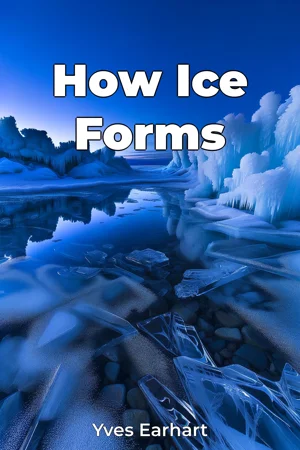
Did you know that the seemingly simple process of ice formation holds the key to understanding global weather patterns, climate change, and the delicate balance of ecosystems? "How Ice Forms" delves into the intricate molecular mechanisms that govern the creation of ice, revealing its profound influence on our planet. This book explores three primary areas: the fundamental physics and chemistry of ice nucleation and crystal growth, the critical role of ice in regulating Earth's climate system, and the multifaceted impacts of ice on diverse ecosystems and weather phenomena. These topics are crucial because ice governs processes from cloud formation and precipitation to ocean currents and the stability of polar regions. A basic understanding of chemistry and physics will be helpful, but no advanced scientific background is required. The central argument of "How Ice Forms" posits that a comprehensive understanding of ice formation at the molecular level is essential for accurately predicting future climate scenarios and mitigating the adverse effects of climate change. We maintain that current climate models often oversimplify the complexities of ice formation, leading to uncertainties in projections of sea-level rise, extreme weather events, and ecosystem changes. "How Ice Forms" is structured to provide a clear and logical progression of knowledge. It begins with an introduction to the molecular structure of water and the thermodynamics of phase transitions. The book then builds upon this foundation by examining the heterogeneous nucleation of ice in the atmosphere, focusing on the roles of aerosols, dust particles, and biological ice nucleators. Successive chapters investigate the impacts of ice on global albedo, ocean circulation patterns, and the stability of permafrost regions. The culmination of the book synthesizes these various threads to provide a holistic view of ice's influence, concluding with discussions of practical implications for climate modeling and geoengineering strategies. To support these arguments, this book draws upon a wide range of evidence, including laboratory experiments on ice nucleation, satellite observations of sea ice extent and snow cover, and climate model simulations. The book will present original analyses of datasets from polar expeditions and atmospheric monitoring stations. This book connects to several other fields of study, including atmospheric science, oceanography, and ecology. The processes of ice formation in clouds, for example, are linked to precipitation patterns and the global distribution of freshwater. The melting of glaciers affects sea levels, coastal erosion, and marine ecosystems. The book offers a unique perspective by emphasizing the importance of molecular-level processes in driving these large-scale phenomena. "How Ice Forms" takes an accessible approach, presenting complex scientific concepts in a clear and engaging manner without sacrificing scientific rigor. The writing style avoids jargon and uses real-world examples to illustrate key points. The target audience for this book includes students in earth sciences, geography, environmental science, and related fields, as well as researchers, policymakers, and anyone interested in learning more about the role of ice in our world. It is valuable for anyone seeking a deeper understanding of earth system science. As a work of non-fiction within the Earth Sciences, Geography, and Environment genres, "How Ice Forms" adheres to the standards of accuracy, objectivity, and evidence-based reasoning. The scope of this book is intentionally broad, covering a wide range of topics related to ice formation and its impacts. However, it does not delve into the engineering aspects of ice prevention or the specific details of glacier dynamics. Instead, it maintains the focus on the fundamental processes of ice formation and its role in global systems. The information in this book can be applied to many real-world problems. By understanding the factors that control ice formation, scientists can develop more accurate climate models, predict the impacts of climate change on water resources and ecosystems, and design effective strategies for mitigating these impacts. One of the ongoing debates in the field concerns the relative importance of different types of ice nucleating particles in the atmosphere. "How Ice Forms" addresses this debate by presenting a comprehensive review of the available evidence and offering new insights based on original research.
Did you know that the seemingly simple process of ice formation holds the key to understanding global weather patterns, climate change, and the delicate balance of ecosystems? "How Ice Forms" delves into the intricate molecular mechanisms that govern the creation of ice, revealing its profound influence on our planet. This book explores three primary areas: the fundamental physics and chemistry of ice nucleation and crystal growth, the critical role of ice in regulating Earth's climate system, and the multifaceted impacts of ice on diverse ecosystems and weather phenomena. These topics are crucial because ice governs processes from cloud formation and precipitation to ocean currents and the stability of polar regions. A basic understanding of chemistry and physics will be helpful, but no advanced scientific background is required. The central argument of "How Ice Forms" posits that a comprehensive understanding of ice formation at the molecular level is essential for accurately predicting future climate scenarios and mitigating the adverse effects of climate change. We maintain that current climate models often oversimplify the complexities of ice formation, leading to uncertainties in projections of sea-level rise, extreme weather events, and ecosystem changes. "How Ice Forms" is structured to provide a clear and logical progression of knowledge. It begins with an introduction to the molecular structure of water and the thermodynamics of phase transitions. The book then builds upon this foundation by examining the heterogeneous nucleation of ice in the atmosphere, focusing on the roles of aerosols, dust particles, and biological ice nucleators. Successive chapters investigate the impacts of ice on global albedo, ocean circulation patterns, and the stability of permafrost regions. The culmination of the book synthesizes these various threads to provide a holistic view of ice's influence, concluding with discussions of practical implications for climate modeling and geoengineering strategies. To support these arguments, this book draws upon a wide range of evidence, including laboratory experiments on ice nucleation, satellite observations of sea ice extent and snow cover, and climate model simulations. The book will present original analyses of datasets from polar expeditions and atmospheric monitoring stations. This book connects to several other fields of study, including atmospheric science, oceanography, and ecology. The processes of ice formation in clouds, for example, are linked to precipitation patterns and the global distribution of freshwater. The melting of glaciers affects sea levels, coastal erosion, and marine ecosystems. The book offers a unique perspective by emphasizing the importance of molecular-level processes in driving these large-scale phenomena. "How Ice Forms" takes an accessible approach, presenting complex scientific concepts in a clear and engaging manner without sacrificing scientific rigor. The writing style avoids jargon and uses real-world examples to illustrate key points. The target audience for this book includes students in earth sciences, geography, environmental science, and related fields, as well as researchers, policymakers, and anyone interested in learning more about the role of ice in our world. It is valuable for anyone seeking a deeper understanding of earth system science. As a work of non-fiction within the Earth Sciences, Geography, and Environment genres, "How Ice Forms" adheres to the standards of accuracy, objectivity, and evidence-based reasoning. The scope of this book is intentionally broad, covering a wide range of topics related to ice formation and its impacts. However, it does not delve into the engineering aspects of ice prevention or the specific details of glacier dynamics. Instead, it maintains the focus on the fundamental processes of ice formation and its role in global systems. The information in this book can be applied to many real-world problems. By understanding the factors that control ice formation, scientists can develop more accurate climate models, predict the impacts of climate change on water resources and ecosystems, and design effective strategies for mitigating these impacts. One of the ongoing debates in the field concerns the relative importance of different types of ice nucleating particles in the atmosphere. "How Ice Forms" addresses this debate by presenting a comprehensive review of the available evidence and offering new insights based on original research.
"How Ice Forms" explores the fascinating science behind something we often take for granted: ice. It reveals how the molecular processes of ice formation are crucial for understanding global weather patterns, climate change, and the health of our planet's ecosystems. The book emphasizes that current climate models, which often oversimplify these processes, may lead to inaccurate predictions about sea-level rise and extreme weather events. The book uniquely presents a comprehensive view of how ice impacts our world. It begins with the basics of water's molecular structure and gradually builds to cover complex topics like the role of aerosols in atmospheric ice nucleation, the impact of ice on ocean circulation, and the stability of permafrost regions. For instance, the book highlights that ice influences global albedo, affecting how much sunlight Earth reflects and, consequently, its temperature. It connects earth sciences with atmospheric science and oceanography. "How Ice Forms" adopts an accessible approach, making complex scientific concepts understandable through real-world examples. It progresses logically through the material, using laboratory experiments, satellite observations, and climate model simulations to support its arguments. The book concludes with discussions on the practical implications of ice formation for climate modeling and geoengineering, making it valuable for students, researchers, and anyone interested in environmental science.
Book Details
ISBN
9788233985981
Publisher
Publifye AS
Your Licenses
You don't own any licenses for this book
Purchase a license below to unlock this book and download the EPUB.
Purchase License
Select a tier to unlock this book
Need bulk licensing?
Contact us for enterprise agreements.