
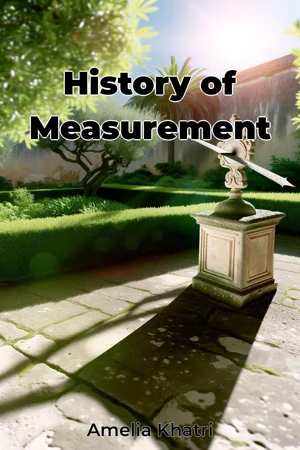
About This Book
Have you ever considered how deeply intertwined measurement is with the very fabric of civilization? This book, *History of Measurement*, explores the fascinating journey of how humans have quantified their world, from the earliest approximations to the sophisticated systems we rely on today. We delve into the evolution of measurement, demonstrating its central role in scientific advancement, technological innovation, and societal organization. This book examines three key themes: the origins of early measurement systems and their dependence on the human body and natural phenomena; the standardization efforts that emerged with burgeoning trade and scientific inquiry; and the quest for ever-greater precision, leading to the development of modern measurement technologies. Understanding these themes is crucial because measurement underpins nearly every aspect of modern life, from construction and manufacturing to scientific research and international commerce. Its history reveals how our understanding of the universe has been shaped by our ability to quantify it. We begin by examining the earliest measurement systems, such as the cubit in ancient Egypt and rudimentary timekeeping devices like sundials. These initial attempts at quantification were closely linked to human perception and local environments. We then trace the development of more standardized units, driven by the need for accurate trade and the burgeoning scientific revolution. The rise of the metric system in France marked a pivotal moment, offering a universal and coherent system based on decimal fractions. Finally, we explore the cutting-edge technologies of modern measurement, including atomic clocks and laser interferometry, illustrating the ongoing pursuit of ultimate precision. The central argument of *History of Measurement* is that the evolution of measurement systems is inextricably linked to the progress of human civilization. As our understanding of the world has grown, so too has our ability to measure it with increasing accuracy and sophistication. This iterative process has driven scientific discovery, technological advancement, and economic development. The book is structured to guide the reader through this historical progression. Part one introduces the fundamental concepts of measurement and their early applications in various cultures. Part two chronicles the development of standardized systems, focusing on the challenges of achieving uniformity and promoting international collaboration. Part three examines the scientific revolution's impact on measurement, highlighting innovations such as the development of accurate timekeeping and the establishment of fundamental physical constants. The culmination of our exploration lies in an examination of modern metrology and its impact on advanced technologies. A final chapter explores the philosophical implications of precise measurement and its role in our understanding of the universe. To support its arguments, the book draws on a wide range of historical sources, including ancient texts, archaeological findings, scientific papers, and museum artifacts. It incorporates case studies of specific measurement systems and technologies to illustrate key concepts and demonstrate their practical applications. *History of Measurement* connects to various fields of study, including history, science, engineering, and economics. The book offers a unique perspective by integrating historical context with scientific principles, demonstrating how cultural and societal factors have shaped the development of measurement standards. It is written in a clear and accessible style, avoiding technical jargon and complex mathematical equations, making it suitable for a broad audience. The book is intended for general readers with an interest in science, history, or technology, as well as students and professionals in fields related to measurement and instrumentation. While this book aims to provide a comprehensive overview of the history of measurement, certain limitations apply. The focus is primarily on Western scientific developments, with less emphasis on the contributions of other cultures. Furthermore, the book does not delve into the intricate mathematical details of specific measurement techniques. The knowledge gained from this book can be applied in various real-world contexts. Understanding the history of measurement can provide valuable insights into the origins of our modern technological infrastructure and the importance of standardization in global commerce. Moreover, it can inspire a deeper appreciation for the scientific method and the ongoing quest for knowledge. The book acknowledges some ongoing debates within the field. For instance, discussions continue regarding the social and political impacts of standardization, particularly concerning its effects on different cultures and economies.
Have you ever considered how deeply intertwined measurement is with the very fabric of civilization? This book, *History of Measurement*, explores the fascinating journey of how humans have quantified their world, from the earliest approximations to the sophisticated systems we rely on today. We delve into the evolution of measurement, demonstrating its central role in scientific advancement, technological innovation, and societal organization. This book examines three key themes: the origins of early measurement systems and their dependence on the human body and natural phenomena; the standardization efforts that emerged with burgeoning trade and scientific inquiry; and the quest for ever-greater precision, leading to the development of modern measurement technologies. Understanding these themes is crucial because measurement underpins nearly every aspect of modern life, from construction and manufacturing to scientific research and international commerce. Its history reveals how our understanding of the universe has been shaped by our ability to quantify it. We begin by examining the earliest measurement systems, such as the cubit in ancient Egypt and rudimentary timekeeping devices like sundials. These initial attempts at quantification were closely linked to human perception and local environments. We then trace the development of more standardized units, driven by the need for accurate trade and the burgeoning scientific revolution. The rise of the metric system in France marked a pivotal moment, offering a universal and coherent system based on decimal fractions. Finally, we explore the cutting-edge technologies of modern measurement, including atomic clocks and laser interferometry, illustrating the ongoing pursuit of ultimate precision. The central argument of *History of Measurement* is that the evolution of measurement systems is inextricably linked to the progress of human civilization. As our understanding of the world has grown, so too has our ability to measure it with increasing accuracy and sophistication. This iterative process has driven scientific discovery, technological advancement, and economic development. The book is structured to guide the reader through this historical progression. Part one introduces the fundamental concepts of measurement and their early applications in various cultures. Part two chronicles the development of standardized systems, focusing on the challenges of achieving uniformity and promoting international collaboration. Part three examines the scientific revolution's impact on measurement, highlighting innovations such as the development of accurate timekeeping and the establishment of fundamental physical constants. The culmination of our exploration lies in an examination of modern metrology and its impact on advanced technologies. A final chapter explores the philosophical implications of precise measurement and its role in our understanding of the universe. To support its arguments, the book draws on a wide range of historical sources, including ancient texts, archaeological findings, scientific papers, and museum artifacts. It incorporates case studies of specific measurement systems and technologies to illustrate key concepts and demonstrate their practical applications. *History of Measurement* connects to various fields of study, including history, science, engineering, and economics. The book offers a unique perspective by integrating historical context with scientific principles, demonstrating how cultural and societal factors have shaped the development of measurement standards. It is written in a clear and accessible style, avoiding technical jargon and complex mathematical equations, making it suitable for a broad audience. The book is intended for general readers with an interest in science, history, or technology, as well as students and professionals in fields related to measurement and instrumentation. While this book aims to provide a comprehensive overview of the history of measurement, certain limitations apply. The focus is primarily on Western scientific developments, with less emphasis on the contributions of other cultures. Furthermore, the book does not delve into the intricate mathematical details of specific measurement techniques. The knowledge gained from this book can be applied in various real-world contexts. Understanding the history of measurement can provide valuable insights into the origins of our modern technological infrastructure and the importance of standardization in global commerce. Moreover, it can inspire a deeper appreciation for the scientific method and the ongoing quest for knowledge. The book acknowledges some ongoing debates within the field. For instance, discussions continue regarding the social and political impacts of standardization, particularly concerning its effects on different cultures and economies.
"History of Measurement" explores the captivating evolution of how humans have quantified the world, from ancient approximations to modern precision. It uncovers measurement's critical role in scientific advancement, highlighting how it underpins nearly every facet of modern life, from construction to international commerce. Intriguingly, early measurement systems relied heavily on the human body and natural phenomena, like the cubit in ancient Egypt. The book further emphasizes the standardization efforts that emerged alongside burgeoning trade and scientific inquiry. The narrative progresses chronologically, beginning with early measurement systems and their ties to human perception. It then traces the development of standardized units, propelled by trade and the scientific revolution, with the metric system as a pivotal moment. Finally, the text explores cutting-edge technologies in modern measurement, like atomic clocks, showcasing the ongoing pursuit of ultimate precision. The book makes use of historical sources, archaeological findings, scientific papers, and museum artifacts to support its arguments.
Book Details
ISBN
9788233985585
Publisher
Publifye AS
Your Licenses
You don't own any licenses for this book
Purchase a license below to unlock this book and download the EPUB.
Purchase License
Select a tier to unlock this book
Need bulk licensing?
Contact us for enterprise agreements.