
About This Book
Have you ever wondered what triggers a lightning strike, or considered its vital role in shaping our environment? "Lightning Explained" unravels the complex physics of lightning, explores its far-reaching impact on nature, and provides crucial safety guidelines to protect against its potentially devastating effects. This book examines lightning not just as a meteorological phenomenon, but as a fundamental process in the Earth's atmospheric system. The core of this book revolves around three central themes: the science behind lightning formation, lightning's ecological significance, and strategies for mitigating its risks. Understanding the physics of lightning—charge separation, stepped leaders, and return strokes—is critical for predicting and preparing for this powerful natural event. Furthermore, lightning plays an essential role in nitrogen fixation, influencing atmospheric chemistry and impacting plant life. Lastly, practical knowledge of lightning safety is paramount, offering guidance on how to minimize risks during thunderstorms. To fully appreciate these concepts, the book provides a historical context, tracing the scientific understanding of lightning from early mythological interpretations to modern-day research using advanced sensors and modeling. A basic understanding of electrical charge and atmospheric processes will enhance the reader's experience, though all concepts are clearly explained. The central argument of "Lightning Explained" is that a comprehensive understanding of lightning, encompassing its physics, ecological role, and potential hazards, is crucial for promoting both environmental stewardship and personal safety in an era of increasing climate variability and severe weather events. The book begins by introducing basic electrostatic principles and then details the processes behind charge separation within storm clouds. It advances into the formation and propagation of lightning channels, illustrated with detailed diagrams and real-world examples. The book includes dedicated chapters on the role of lightning in atmospheric chemistry, examining how it generates vital compounds and influences the global nitrogen cycle. The final section focuses on practical safety measures, providing guidelines for individuals, businesses, and communities to minimize the risk of lightning strikes. The book relies on a foundation of scientific data collected from lightning detection networks, atmospheric research laboratories, and field studies. It also integrates data from historical records and case studies, drawing upon documented lightning incidents to illustrate key concepts and safety protocols. "Lightning Explained" connects to diverse fields of study, including atmospheric science, environmental science, and electrical engineering. Its exploration of nitrogen fixation links it to ecology and agricultural science, while the chapter on safety integrates with risk management and public health. This book offers a unique perspective by integrating the physical mechanisms of lightning with its broader environmental implications and practical safety considerations. It emphasizes a systems-thinking approach, encouraging readers to consider lightning not in isolation, but as an integral part of Earth's interconnected systems. The writing style balances scientific accuracy with accessibility, making complex concepts understandable. The book avoids jargon and uses clear language to explain complex scientific concepts. The target audience includes science enthusiasts, students of environmental science and meteorology, and anyone seeking a comprehensive understanding of lightning. It will appeal to readers who want to learn more about the science behind natural phenomena and how to protect themselves and their communities from weather-related hazards. As a work of non-fiction science, "Lightning Explained" adheres to the genre's expectations of accuracy, objectivity, and evidence-based reasoning. It presents information in a clear and organized manner, supported by credible sources and expert analysis. The book's scope is limited to terrestrial lightning and does not cover lightning on other planets. It offers a comprehensive exploration of cloud-to-ground lightning, while also covering cloud-to-cloud lightning. The information in this book can be applied practically in various ways, from implementing personal safety protocols during thunderstorms to improving lightning protection systems for buildings and infrastructure. It provides a foundation for informed decision-making in lightning-prone areas. While the physics of lightning formation is well-established, ongoing debates center on the precise mechanisms of charge separation in clouds and the influence of climate change on lightning frequency and intensity. "Lightning Explained" addresses these controversies, presenting different viewpoints and highlighting areas for future research.
Have you ever wondered what triggers a lightning strike, or considered its vital role in shaping our environment? "Lightning Explained" unravels the complex physics of lightning, explores its far-reaching impact on nature, and provides crucial safety guidelines to protect against its potentially devastating effects. This book examines lightning not just as a meteorological phenomenon, but as a fundamental process in the Earth's atmospheric system. The core of this book revolves around three central themes: the science behind lightning formation, lightning's ecological significance, and strategies for mitigating its risks. Understanding the physics of lightning—charge separation, stepped leaders, and return strokes—is critical for predicting and preparing for this powerful natural event. Furthermore, lightning plays an essential role in nitrogen fixation, influencing atmospheric chemistry and impacting plant life. Lastly, practical knowledge of lightning safety is paramount, offering guidance on how to minimize risks during thunderstorms. To fully appreciate these concepts, the book provides a historical context, tracing the scientific understanding of lightning from early mythological interpretations to modern-day research using advanced sensors and modeling. A basic understanding of electrical charge and atmospheric processes will enhance the reader's experience, though all concepts are clearly explained. The central argument of "Lightning Explained" is that a comprehensive understanding of lightning, encompassing its physics, ecological role, and potential hazards, is crucial for promoting both environmental stewardship and personal safety in an era of increasing climate variability and severe weather events. The book begins by introducing basic electrostatic principles and then details the processes behind charge separation within storm clouds. It advances into the formation and propagation of lightning channels, illustrated with detailed diagrams and real-world examples. The book includes dedicated chapters on the role of lightning in atmospheric chemistry, examining how it generates vital compounds and influences the global nitrogen cycle. The final section focuses on practical safety measures, providing guidelines for individuals, businesses, and communities to minimize the risk of lightning strikes. The book relies on a foundation of scientific data collected from lightning detection networks, atmospheric research laboratories, and field studies. It also integrates data from historical records and case studies, drawing upon documented lightning incidents to illustrate key concepts and safety protocols. "Lightning Explained" connects to diverse fields of study, including atmospheric science, environmental science, and electrical engineering. Its exploration of nitrogen fixation links it to ecology and agricultural science, while the chapter on safety integrates with risk management and public health. This book offers a unique perspective by integrating the physical mechanisms of lightning with its broader environmental implications and practical safety considerations. It emphasizes a systems-thinking approach, encouraging readers to consider lightning not in isolation, but as an integral part of Earth's interconnected systems. The writing style balances scientific accuracy with accessibility, making complex concepts understandable. The book avoids jargon and uses clear language to explain complex scientific concepts. The target audience includes science enthusiasts, students of environmental science and meteorology, and anyone seeking a comprehensive understanding of lightning. It will appeal to readers who want to learn more about the science behind natural phenomena and how to protect themselves and their communities from weather-related hazards. As a work of non-fiction science, "Lightning Explained" adheres to the genre's expectations of accuracy, objectivity, and evidence-based reasoning. It presents information in a clear and organized manner, supported by credible sources and expert analysis. The book's scope is limited to terrestrial lightning and does not cover lightning on other planets. It offers a comprehensive exploration of cloud-to-ground lightning, while also covering cloud-to-cloud lightning. The information in this book can be applied practically in various ways, from implementing personal safety protocols during thunderstorms to improving lightning protection systems for buildings and infrastructure. It provides a foundation for informed decision-making in lightning-prone areas. While the physics of lightning formation is well-established, ongoing debates center on the precise mechanisms of charge separation in clouds and the influence of climate change on lightning frequency and intensity. "Lightning Explained" addresses these controversies, presenting different viewpoints and highlighting areas for future research.
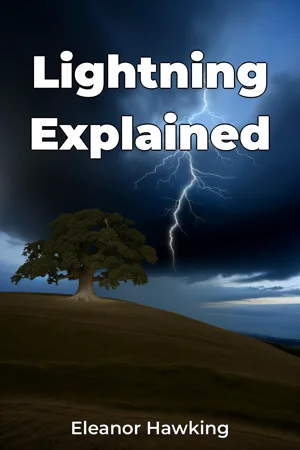
"Lightning Explained" offers a comprehensive look at this powerful natural phenomenon, spanning its science, environmental role, and safety considerations. It explores the physics of lightning formation, from initial charge separation in storm clouds to the dramatic flash of a return stroke. Did you know lightning plays a crucial role in nitrogen fixation, a process vital for plant growth and atmospheric chemistry? The book uniquely integrates these physical mechanisms with their broader ecological implications. The book progresses logically, beginning with basic electrostatic principles and advancing to detailed explanations of lightning channel formation and propagation. Dedicated chapters explore lightning’s impact on atmospheric chemistry and the global nitrogen cycle. It highlights the importance of understanding lightning not just as a weather event but as an integral part of Earth's interconnected systems. "Lightning Explained" also provides practical safety measures, offering guidelines for individuals and communities to minimize risk during thunderstorms, making it a valuable resource for science enthusiasts and anyone seeking to understand and mitigate the dangers of lightning.
Book Details
ISBN
9788233985486
Publisher
Publifye AS
Your Licenses
You don't own any licenses for this book
Purchase a license below to unlock this book and download the EPUB.
Purchase License
Select a tier to unlock this book
Need bulk licensing?
Contact us for enterprise agreements.