
About This Book
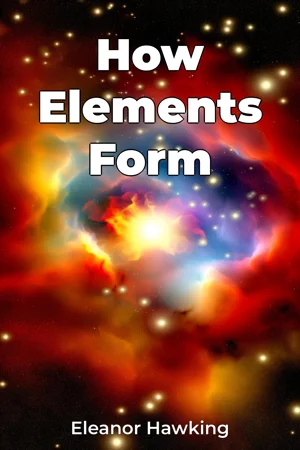
Where did the atoms that compose your body originate? This book, *How Elements Form*, unveils the captivating story of nucleosynthesis, the cosmic process responsible for forging every element in the universe, from the lightest hydrogen to the heaviest, like gold. The core of this exploration centers on three key areas: Big Bang nucleosynthesis, stellar nucleosynthesis, and explosive nucleosynthesis in supernovae. Understanding these processes provides insight into the universe's evolution, the life cycles of stars, and the origins of matter itself. This knowledge is paramount to fields like astrophysics, cosmology, and even chemistry. To fully appreciate the intricacies of element formation, we will first delve into the standard model of particle physics and the fundamental forces that govern interactions at the atomic level. A basic understanding of atomic structure and nuclear physics is helpful, but we will build concepts from the ground up. The central argument of *How Elements Form* is that the distribution of elements we observe today is a direct consequence of the interplay between gravity, nuclear physics, and thermodynamics across cosmic timescales. This distribution reveals crucial information about the universe’s age, density, and future trajectory, thus understanding nucleosynthesis is key to understanding the universe. The book starts by discussing the Big Bang and the creation of the lightest elements – hydrogen, helium, and trace amounts of lithium. We then shift our focus to stellar nucleosynthesis, exploring how stars, powered by nuclear fusion in their cores, synthesize heavier elements like carbon, oxygen, and iron. Subsequently, we investigate the cataclysmic events of supernovae, where the most massive stars meet their explosive demise, forging the heaviest elements, including gold and uranium, and scattering them across the cosmos. Finally, we examine how these elements become incorporated into new stars, planets, and ultimately, life. The narrative is supported by data from astronomical observations, nuclear physics experiments, and cosmological simulations. We present observational evidence of elemental abundances in stars of different ages and types, alongside experimental results from nuclear reaction rate measurements. The book also utilizes data from space-based telescopes and particle accelerators to build its arguments.. Beyond physics, *How Elements Form* connects directly to chemistry, informing our understanding of elemental properties and chemical reactions. Furthermore, geology benefits from the study of element distribution in the Earth's crust, providing clues about planetary formation and evolution. Finally, the book speaks to the field of astrobiology, as the elemental ingredients are the building blocks for life as we know it. This book offers a holistic view of nucleosynthesis, bridging the gap between theoretical physics and observational astronomy. It explains complex topics in a way that is accessible, avoiding excessive jargon and focusing on clear explanations and illustrative examples. The target audience includes anyone with a basic understanding of science who is curious about the origins of matter and the universe. High school and undergraduate students in physics, astronomy, and chemistry will find this book particularly valuable, along with science enthusiasts. As a work of science non-fiction, the book adheres to accuracy and presents conclusions grounded in evidence. While covering a vast topic, the discussion will center on the most well-established theories and observations, acknowledging areas of ongoing research and debate. The applications of nucleosynthesis extend to understanding the formation and evolution of galaxies, the search for exoplanets, and the ongoing quest to unravel the mysteries of dark matter and dark energy. While the book focuses on the standard model of cosmology and particle physics, alternative theories and unsolved problems in the field are acknowledged, such as the lithium problem in Big Bang nucleosynthesis and the precise mechanisms of r-process nucleosynthesis in supernovae. *How Elements Form* offers readers a journey through the universe's most fundamental and compelling processes, revealing the deep connections between the cosmos and ourselves.
Where did the atoms that compose your body originate? This book, *How Elements Form*, unveils the captivating story of nucleosynthesis, the cosmic process responsible for forging every element in the universe, from the lightest hydrogen to the heaviest, like gold. The core of this exploration centers on three key areas: Big Bang nucleosynthesis, stellar nucleosynthesis, and explosive nucleosynthesis in supernovae. Understanding these processes provides insight into the universe's evolution, the life cycles of stars, and the origins of matter itself. This knowledge is paramount to fields like astrophysics, cosmology, and even chemistry. To fully appreciate the intricacies of element formation, we will first delve into the standard model of particle physics and the fundamental forces that govern interactions at the atomic level. A basic understanding of atomic structure and nuclear physics is helpful, but we will build concepts from the ground up. The central argument of *How Elements Form* is that the distribution of elements we observe today is a direct consequence of the interplay between gravity, nuclear physics, and thermodynamics across cosmic timescales. This distribution reveals crucial information about the universe’s age, density, and future trajectory, thus understanding nucleosynthesis is key to understanding the universe. The book starts by discussing the Big Bang and the creation of the lightest elements – hydrogen, helium, and trace amounts of lithium. We then shift our focus to stellar nucleosynthesis, exploring how stars, powered by nuclear fusion in their cores, synthesize heavier elements like carbon, oxygen, and iron. Subsequently, we investigate the cataclysmic events of supernovae, where the most massive stars meet their explosive demise, forging the heaviest elements, including gold and uranium, and scattering them across the cosmos. Finally, we examine how these elements become incorporated into new stars, planets, and ultimately, life. The narrative is supported by data from astronomical observations, nuclear physics experiments, and cosmological simulations. We present observational evidence of elemental abundances in stars of different ages and types, alongside experimental results from nuclear reaction rate measurements. The book also utilizes data from space-based telescopes and particle accelerators to build its arguments.. Beyond physics, *How Elements Form* connects directly to chemistry, informing our understanding of elemental properties and chemical reactions. Furthermore, geology benefits from the study of element distribution in the Earth's crust, providing clues about planetary formation and evolution. Finally, the book speaks to the field of astrobiology, as the elemental ingredients are the building blocks for life as we know it. This book offers a holistic view of nucleosynthesis, bridging the gap between theoretical physics and observational astronomy. It explains complex topics in a way that is accessible, avoiding excessive jargon and focusing on clear explanations and illustrative examples. The target audience includes anyone with a basic understanding of science who is curious about the origins of matter and the universe. High school and undergraduate students in physics, astronomy, and chemistry will find this book particularly valuable, along with science enthusiasts. As a work of science non-fiction, the book adheres to accuracy and presents conclusions grounded in evidence. While covering a vast topic, the discussion will center on the most well-established theories and observations, acknowledging areas of ongoing research and debate. The applications of nucleosynthesis extend to understanding the formation and evolution of galaxies, the search for exoplanets, and the ongoing quest to unravel the mysteries of dark matter and dark energy. While the book focuses on the standard model of cosmology and particle physics, alternative theories and unsolved problems in the field are acknowledged, such as the lithium problem in Big Bang nucleosynthesis and the precise mechanisms of r-process nucleosynthesis in supernovae. *How Elements Form* offers readers a journey through the universe's most fundamental and compelling processes, revealing the deep connections between the cosmos and ourselves.
*How Elements Form* explores the fascinating process of nucleosynthesis, which explains the origin of all elements in the universe. From the hydrogen created in the Big Bang to the gold forged in supernovae, this book unveils how these elements came to be. It highlights the crucial roles of Big Bang nucleosynthesis, stellar nucleosynthesis, and explosive nucleosynthesis in supernovae, emphasizing how these processes shaped the universe's evolution and the life cycles of stars. Understanding element formation is key to unlocking mysteries in astrophysics, cosmology, and even chemistry. The book begins with the Big Bang and the creation of light elements, then progresses to stellar nucleosynthesis, explaining how stars fuse heavier elements in their cores. Finally, it delves into supernovae, where the heaviest elements are created and dispersed. A unique aspect of this book is its accessible approach to complex topics, providing clear explanations and examples while avoiding excessive jargon. Through astronomical observations, nuclear physics experiments, and cosmological simulations, *How Elements Form* offers a holistic view, connecting theoretical physics with observational astronomy.
Book Details
ISBN
9788233985257
Publisher
Publifye AS
Your Licenses
You don't own any licenses for this book
Purchase a license below to unlock this book and download the EPUB.
Purchase License
Select a tier to unlock this book
Need bulk licensing?
Contact us for enterprise agreements.