
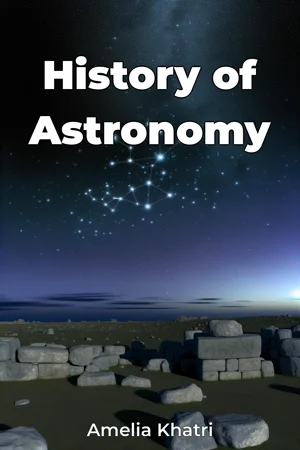
About This Book
Have you ever gazed at the night sky and wondered about the origins of our understanding of the cosmos? "History of Astronomy" traces humanity's relentless pursuit to decipher the universe, from rudimentary star charts etched millennia ago to the sophisticated space telescopes that now peer into the furthest reaches of space and time. This book delves into the pivotal moments and figures that shaped our knowledge of astronomy, revealing how cultural, technological, and scientific advancements intertwined to revolutionize our perception of our place in the universe. This exploration is crucial for several reasons. First, understanding the history of astronomy provides invaluable insight into the scientific method itself, illustrating how observation, experimentation, and theoretical modeling have gradually refined our understanding of celestial phenomena. Second, it unveils the profound impact of astronomical discoveries on human civilization, influencing everything from calendars and navigation to philosophy and religion. Finally, studying the history of astronomy equips us to critically assess current scientific advancements and appreciate the ongoing quest for knowledge that defines our species. This book offers a comprehensive journey through astronomical history, beginning with ancient civilizations and their earliest attempts to chart the stars and predict celestial events. We'll explore the contributions of the Babylonians, Egyptians, Greeks, and other early cultures, examining their cosmological models and the role of astronomy in their societies. Later, we will focus on the Copernican Revolution, detailing the shift from a geocentric to a heliocentric worldview and the subsequent debates and discoveries spurred by this paradigm shift. We will explore the lives and work of key figures such as Copernicus, Galileo, Kepler, and Newton, and investigate the scientific and social implications of their groundbreaking ideas. Lastly, it will explore the development of modern astrophysics, from the invention of the telescope to the era of space exploration. This section will examine how advancements in technology have enabled us to probe the universe in unprecedented detail, leading to discoveries such as galaxies, black holes, and dark matter. The central argument of this book is that our understanding of the cosmos is not a static body of knowledge but a continually evolving narrative, shaped by human curiosity, ingenuity, and the relentless pursuit of truth. This argument is important because it underscores the dynamic nature of science and highlights the importance of critical thinking and evidence-based reasoning in navigating the complex world around us. The core of this book relies on historical records, astronomical observations, and scientific publications spanning millennia. By examining these primary and secondary sources, we aim to provide a nuanced and accurate account of the development of astronomy, revealing both its triumphs and its challenges. Astronomy is inherently interdisciplinary, interfacing with physics, mathematics, and philosophy. This book will explore these connections, demonstrating how advances in one field have often spurred progress in others. For example, the development of calculus by Newton was crucial for formulating his laws of motion and gravity, which in turn revolutionized our understanding of celestial mechanics. Similarly, the rise of quantum mechanics in the 20th century has been essential for understanding the physics of stars and galaxies. This book is written with the general reader in mind, aiming to present complex concepts in an accessible and engaging manner. It avoids technical jargon and focuses on conveying the human stories behind the scientific discoveries, making it suitable for anyone with an interest in science, history, or the universe. The target audience includes students, educators, and anyone curious about the history of astronomy. In line with the conventions of historical and scientific writing, this book emphasizes accuracy, clarity, and objectivity. It strives to present a balanced and unbiased account of the development of astronomy, acknowledging the contributions of diverse cultures and individuals. While the book aims to provide a comprehensive overview of astronomical history, it acknowledges the limitations of its scope. It focuses primarily on the development of Western astronomy, while also recognizing the contributions of other cultures and traditions. The knowledge gained from this book can be applied practically by readers in a variety of ways. It can enhance their appreciation of the scientific method, improve their critical thinking skills, and foster a deeper understanding of our place in the universe. It can also inspire future generations of scientists and engineers to continue pushing the boundaries of human knowledge. Finally, the book touches upon some of the ongoing debates and controversies in the field, such as the nature of dark matter and dark energy, and the search for extraterrestrial life, illustrating the dynamic and evolving nature of astronomical research.
Have you ever gazed at the night sky and wondered about the origins of our understanding of the cosmos? "History of Astronomy" traces humanity's relentless pursuit to decipher the universe, from rudimentary star charts etched millennia ago to the sophisticated space telescopes that now peer into the furthest reaches of space and time. This book delves into the pivotal moments and figures that shaped our knowledge of astronomy, revealing how cultural, technological, and scientific advancements intertwined to revolutionize our perception of our place in the universe. This exploration is crucial for several reasons. First, understanding the history of astronomy provides invaluable insight into the scientific method itself, illustrating how observation, experimentation, and theoretical modeling have gradually refined our understanding of celestial phenomena. Second, it unveils the profound impact of astronomical discoveries on human civilization, influencing everything from calendars and navigation to philosophy and religion. Finally, studying the history of astronomy equips us to critically assess current scientific advancements and appreciate the ongoing quest for knowledge that defines our species. This book offers a comprehensive journey through astronomical history, beginning with ancient civilizations and their earliest attempts to chart the stars and predict celestial events. We'll explore the contributions of the Babylonians, Egyptians, Greeks, and other early cultures, examining their cosmological models and the role of astronomy in their societies. Later, we will focus on the Copernican Revolution, detailing the shift from a geocentric to a heliocentric worldview and the subsequent debates and discoveries spurred by this paradigm shift. We will explore the lives and work of key figures such as Copernicus, Galileo, Kepler, and Newton, and investigate the scientific and social implications of their groundbreaking ideas. Lastly, it will explore the development of modern astrophysics, from the invention of the telescope to the era of space exploration. This section will examine how advancements in technology have enabled us to probe the universe in unprecedented detail, leading to discoveries such as galaxies, black holes, and dark matter. The central argument of this book is that our understanding of the cosmos is not a static body of knowledge but a continually evolving narrative, shaped by human curiosity, ingenuity, and the relentless pursuit of truth. This argument is important because it underscores the dynamic nature of science and highlights the importance of critical thinking and evidence-based reasoning in navigating the complex world around us. The core of this book relies on historical records, astronomical observations, and scientific publications spanning millennia. By examining these primary and secondary sources, we aim to provide a nuanced and accurate account of the development of astronomy, revealing both its triumphs and its challenges. Astronomy is inherently interdisciplinary, interfacing with physics, mathematics, and philosophy. This book will explore these connections, demonstrating how advances in one field have often spurred progress in others. For example, the development of calculus by Newton was crucial for formulating his laws of motion and gravity, which in turn revolutionized our understanding of celestial mechanics. Similarly, the rise of quantum mechanics in the 20th century has been essential for understanding the physics of stars and galaxies. This book is written with the general reader in mind, aiming to present complex concepts in an accessible and engaging manner. It avoids technical jargon and focuses on conveying the human stories behind the scientific discoveries, making it suitable for anyone with an interest in science, history, or the universe. The target audience includes students, educators, and anyone curious about the history of astronomy. In line with the conventions of historical and scientific writing, this book emphasizes accuracy, clarity, and objectivity. It strives to present a balanced and unbiased account of the development of astronomy, acknowledging the contributions of diverse cultures and individuals. While the book aims to provide a comprehensive overview of astronomical history, it acknowledges the limitations of its scope. It focuses primarily on the development of Western astronomy, while also recognizing the contributions of other cultures and traditions. The knowledge gained from this book can be applied practically by readers in a variety of ways. It can enhance their appreciation of the scientific method, improve their critical thinking skills, and foster a deeper understanding of our place in the universe. It can also inspire future generations of scientists and engineers to continue pushing the boundaries of human knowledge. Finally, the book touches upon some of the ongoing debates and controversies in the field, such as the nature of dark matter and dark energy, and the search for extraterrestrial life, illustrating the dynamic and evolving nature of astronomical research.
"History of Astronomy" explores humanity's quest to understand the cosmos, tracing our knowledge from ancient star charts to modern space telescopes. It highlights pivotal moments and figures, revealing how cultural, technological, and scientific advancements have shaped our perception of the universe. The book emphasizes that our understanding of the cosmos is not static but evolves through human curiosity and ingenuity. It's intriguing to note how ancient civilizations used astronomy for calendars and navigation, and how the Copernican Revolution shifted our worldview from geocentric to heliocentric. The book journeys through astronomical history, starting with ancient civilizations like the Babylonians, Egyptians, and Greeks, examining their cosmological models. It then focuses on the Copernican Revolution and figures like Copernicus, Galileo, Kepler, and Newton, exploring the scientific and social implications of their ideas. Finally, it delves into modern astrophysics, the development of telescopes, and the era of space exploration, revealing discoveries like galaxies and black holes. The approach is accessible, avoiding technical jargon and focusing on the human stories behind scientific discoveries.
Book Details
ISBN
9788233985233
Publisher
Publifye AS
Your Licenses
You don't own any licenses for this book
Purchase a license below to unlock this book and download the EPUB.
Purchase License
Select a tier to unlock this book
Need bulk licensing?
Contact us for enterprise agreements.