
About This Book
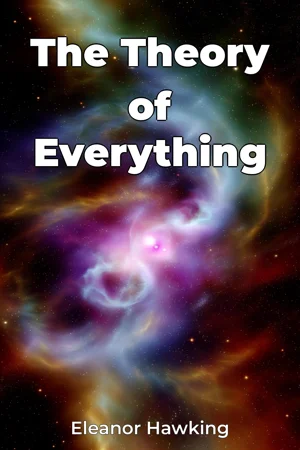
Is there a single equation that can explain everything in the universe, from the smallest subatomic particle to the largest cosmic structure? *The Theory of Everything* explores humanity's persistent quest to find this ultimate explanation, delving into the triumphs and tribulations of physicists who have dared to dream of a unified theory. This book navigates the complex landscape of theoretical physics, examining the historical context, current research, and philosophical implications of this ambitious endeavor. The book focuses on two central themes: Einstein's theory of general relativity, which describes gravity as a curvature of spacetime, and quantum mechanics, which governs the behavior of matter and energy at the atomic and subatomic levels. The core problem lies in reconciling these two incredibly successful yet seemingly incompatible descriptions of the universe. Understanding why these theories clash and the attempts to bridge the gap is crucial for a complete understanding of physics. Considerable background will be provided to ensure accessibility for a broad audience. This includes explanations of fundamental concepts like spacetime, quantum entanglement, and the Standard Model of particle physics. No prior expertise is required, only an interest in understanding the fundamental laws governing reality. *The Theory of Everything* argues that the search for unification is not merely an academic exercise, but a fundamental human drive to understand our place in the cosmos. The pursuit of this theory has driven major breakthroughs in physics and mathematics, and its potential implications for technology and our understanding of the universe are profound. The book unfolds in a logical progression. It begins by introducing the historical context, tracing the development of classical physics and the emergence of relativity and quantum mechanics. It then delves into the core incompatibilities between these theories, highlighting the challenges posed by quantum gravity. The book explores candidate theories, such as string theory and loop quantum gravity, examining their strengths, weaknesses, and the evidence supporting them. The book then explores the philosophical implications of unification, considering how a 'theory of everything' might reshape our understanding of reality, causality, and the nature of scientific explanation. Finally, it speculates on the potential technological applications of a unified theory, including advanced computing, energy production, and space travel. The arguments presented are supported by a wide range of evidence, including experimental data from particle accelerators, cosmological observations of the early universe, and mathematical models developed by leading theoretical physicists. It will scrutinize the assumptions and predictions of different candidate theories, examining the ongoing debates within the scientific community. The book also draws connections to other fields, such as cosmology, mathematics, and philosophy. Cosmology provides the observational context for testing theories of gravity and the early universe. Mathematics provides the language and tools for formulating these theories. Philosophy grapples with the conceptual and interpretational challenges posed by modern physics. *The Theory of Everything* distinguishes itself by providing a balanced and accessible overview of a complex and often esoteric field. It avoids sensationalism and instead focuses on presenting the scientific evidence and theoretical arguments in a clear and objective manner. The writing style is conversational but rigorous, aiming to engage both seasoned physicists and curious readers alike. The book is aimed at anyone with an interest in science, physics, or philosophy who wants to learn more about the quest to unify our understanding of the universe. It will appeal to students, science enthusiasts, and general readers. The book acknowledges that our understanding is incomplete. The scope is limited to well-established theories and promising areas of research. The theories discussed have real-world applications in areas such as quantum computing, materials science, and medical imaging. It addresses the ongoing debates about the interpretation of quantum mechanics and the viability of different approaches to quantum gravity.
Is there a single equation that can explain everything in the universe, from the smallest subatomic particle to the largest cosmic structure? *The Theory of Everything* explores humanity's persistent quest to find this ultimate explanation, delving into the triumphs and tribulations of physicists who have dared to dream of a unified theory. This book navigates the complex landscape of theoretical physics, examining the historical context, current research, and philosophical implications of this ambitious endeavor. The book focuses on two central themes: Einstein's theory of general relativity, which describes gravity as a curvature of spacetime, and quantum mechanics, which governs the behavior of matter and energy at the atomic and subatomic levels. The core problem lies in reconciling these two incredibly successful yet seemingly incompatible descriptions of the universe. Understanding why these theories clash and the attempts to bridge the gap is crucial for a complete understanding of physics. Considerable background will be provided to ensure accessibility for a broad audience. This includes explanations of fundamental concepts like spacetime, quantum entanglement, and the Standard Model of particle physics. No prior expertise is required, only an interest in understanding the fundamental laws governing reality. *The Theory of Everything* argues that the search for unification is not merely an academic exercise, but a fundamental human drive to understand our place in the cosmos. The pursuit of this theory has driven major breakthroughs in physics and mathematics, and its potential implications for technology and our understanding of the universe are profound. The book unfolds in a logical progression. It begins by introducing the historical context, tracing the development of classical physics and the emergence of relativity and quantum mechanics. It then delves into the core incompatibilities between these theories, highlighting the challenges posed by quantum gravity. The book explores candidate theories, such as string theory and loop quantum gravity, examining their strengths, weaknesses, and the evidence supporting them. The book then explores the philosophical implications of unification, considering how a 'theory of everything' might reshape our understanding of reality, causality, and the nature of scientific explanation. Finally, it speculates on the potential technological applications of a unified theory, including advanced computing, energy production, and space travel. The arguments presented are supported by a wide range of evidence, including experimental data from particle accelerators, cosmological observations of the early universe, and mathematical models developed by leading theoretical physicists. It will scrutinize the assumptions and predictions of different candidate theories, examining the ongoing debates within the scientific community. The book also draws connections to other fields, such as cosmology, mathematics, and philosophy. Cosmology provides the observational context for testing theories of gravity and the early universe. Mathematics provides the language and tools for formulating these theories. Philosophy grapples with the conceptual and interpretational challenges posed by modern physics. *The Theory of Everything* distinguishes itself by providing a balanced and accessible overview of a complex and often esoteric field. It avoids sensationalism and instead focuses on presenting the scientific evidence and theoretical arguments in a clear and objective manner. The writing style is conversational but rigorous, aiming to engage both seasoned physicists and curious readers alike. The book is aimed at anyone with an interest in science, physics, or philosophy who wants to learn more about the quest to unify our understanding of the universe. It will appeal to students, science enthusiasts, and general readers. The book acknowledges that our understanding is incomplete. The scope is limited to well-established theories and promising areas of research. The theories discussed have real-world applications in areas such as quantum computing, materials science, and medical imaging. It addresses the ongoing debates about the interpretation of quantum mechanics and the viability of different approaches to quantum gravity.
"The Theory of Everything" explores the ambitious quest to find a single, unified theory explaining all physical aspects of the universe. It delves into the historical context, current research, and philosophical implications of theoretical physics, focusing on reconciling Einstein's theory of general relativity (gravity as curved spacetime) with quantum mechanics (behavior of matter at atomic levels). The book emphasizes that this search isn't just academic; it's a fundamental human drive, which has led to major breakthroughs. The book navigates complex topics like spacetime and quantum entanglement, making them accessible to a broad audience without prior expertise. It examines candidate theories such as string theory and loop quantum gravity, presenting their strengths, weaknesses, and supporting evidence. Progressing through historical context, core incompatibilities, and philosophical implications, the book speculates on potential technological applications of a unified theory, like advanced computing and space travel, while scrutinizing assumptions and predictions with experimental data and mathematical models.
Book Details
ISBN
9788233985189
Publisher
Publifye AS
Your Licenses
You don't own any licenses for this book
Purchase a license below to unlock this book and download the EPUB.
Purchase License
Select a tier to unlock this book
Need bulk licensing?
Contact us for enterprise agreements.