
About This Book
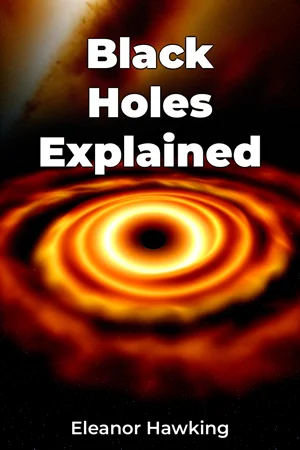
Have you ever wondered what happens when matter disappears from the Universe? 'Black Holes Explained' delves into the enigmatic realm of these cosmic vacuum cleaners, exploring their formation, the fundamental physics that govern them, and the profound mysteries they present. Understanding black holes is crucial because they challenge our current understanding of gravity, space, and time, pushing the boundaries of theoretical physics and astrophysics. Their influence extends from the evolution of galaxies to the very fabric of spacetime. This book provides a comprehensive exploration of black holes, beginning with their birth in the cataclysmic death throes of massive stars. We will dissect the physics of these collapsed objects, focusing on the event horizon – the point of no return – and the bizarre phenomenon of spacetime distortion near these singularities. The book then examines the perplexing concept of Hawking radiation, a theoretical process by which black holes slowly evaporate, challenging the classical understanding of black holes as inescapable traps. To understand the context of black hole research, we will briefly review the development of general relativity, tracing its origins and implications for our comprehension of gravity. No prior knowledge of advanced physics is necessary; the book is structured to gradually introduce relevant concepts, explaining complex equations and theoretical models through clear examples and analogies. The central argument of 'Black Holes Explained' is that while black holes represent extreme physical conditions that test the limits of our knowledge, studying them offers a unique window into understanding the fundamental laws of the Universe. This is vital for advancing theoretical physics and cosmology. The book unfolds systematically. First, it introduces the basic concepts of gravity, spacetime, and stellar evolution. Then, it delves into the formation of black holes, detailing the processes of stellar collapse and the creation of event horizons. The book dedicates a section to the physics within and around black holes, explaining concepts such as gravitational lensing, time dilation, and the behavior of matter under extreme gravitational forces. Finally, it explores the quantum mechanical aspects, presenting the theory of Hawking radiation and its implications for information loss and the nature of black hole entropy. The book concludes by discussing ongoing debates and future directions in black hole research, including their potential role in quantum gravity. The arguments presented are supported by observational data from telescopes, gravitational wave detectors, and theoretical models developed by leading physicists. The book analyzes data from sources like the Event Horizon Telescope, which captured the first direct image of a black hole's shadow, and results from gravitational wave observatories like LIGO and Virgo, which have detected the mergers of black holes. 'Black Holes Explained' connects to various areas of study, including astrophysics, cosmology, quantum mechanics, and even philosophy. The book explores the implications of black holes on our understanding of the universe's origins and destiny. Furthermore, their peculiar properties raise questions about the nature of information and causality, bridging the gap between physics and philosophy. This book offers a unique perspective by integrating theoretical physics with observational astronomy, providing a unified picture. The information is presented in a clear, informative style, aiming to be accessible to a broad audience while maintaining scientific rigor. The primary audience is comprised of science enthusiasts, undergraduate students, and anyone curious about the mysteries of the cosmos. This book will appeal to those seeking to expand their knowledge of cutting-edge physics and astrophysics. It aligns with the conventions of popular science writing, aiming to inform and engage without oversimplifying complex topics. The scope of the book is limited to the current theoretical and observational knowledge of black holes, intentionally excluding speculative or fringe theories. The real-world applications of black hole research lie primarily in advancing our fundamental understanding of physics and potentially informing future technologies related to energy and information storage. The book also addresses some ongoing debates in the field, such as the black hole information paradox – the apparent loss of information when matter falls into a black hole – and the validity of various quantum gravity theories.
Have you ever wondered what happens when matter disappears from the Universe? 'Black Holes Explained' delves into the enigmatic realm of these cosmic vacuum cleaners, exploring their formation, the fundamental physics that govern them, and the profound mysteries they present. Understanding black holes is crucial because they challenge our current understanding of gravity, space, and time, pushing the boundaries of theoretical physics and astrophysics. Their influence extends from the evolution of galaxies to the very fabric of spacetime. This book provides a comprehensive exploration of black holes, beginning with their birth in the cataclysmic death throes of massive stars. We will dissect the physics of these collapsed objects, focusing on the event horizon – the point of no return – and the bizarre phenomenon of spacetime distortion near these singularities. The book then examines the perplexing concept of Hawking radiation, a theoretical process by which black holes slowly evaporate, challenging the classical understanding of black holes as inescapable traps. To understand the context of black hole research, we will briefly review the development of general relativity, tracing its origins and implications for our comprehension of gravity. No prior knowledge of advanced physics is necessary; the book is structured to gradually introduce relevant concepts, explaining complex equations and theoretical models through clear examples and analogies. The central argument of 'Black Holes Explained' is that while black holes represent extreme physical conditions that test the limits of our knowledge, studying them offers a unique window into understanding the fundamental laws of the Universe. This is vital for advancing theoretical physics and cosmology. The book unfolds systematically. First, it introduces the basic concepts of gravity, spacetime, and stellar evolution. Then, it delves into the formation of black holes, detailing the processes of stellar collapse and the creation of event horizons. The book dedicates a section to the physics within and around black holes, explaining concepts such as gravitational lensing, time dilation, and the behavior of matter under extreme gravitational forces. Finally, it explores the quantum mechanical aspects, presenting the theory of Hawking radiation and its implications for information loss and the nature of black hole entropy. The book concludes by discussing ongoing debates and future directions in black hole research, including their potential role in quantum gravity. The arguments presented are supported by observational data from telescopes, gravitational wave detectors, and theoretical models developed by leading physicists. The book analyzes data from sources like the Event Horizon Telescope, which captured the first direct image of a black hole's shadow, and results from gravitational wave observatories like LIGO and Virgo, which have detected the mergers of black holes. 'Black Holes Explained' connects to various areas of study, including astrophysics, cosmology, quantum mechanics, and even philosophy. The book explores the implications of black holes on our understanding of the universe's origins and destiny. Furthermore, their peculiar properties raise questions about the nature of information and causality, bridging the gap between physics and philosophy. This book offers a unique perspective by integrating theoretical physics with observational astronomy, providing a unified picture. The information is presented in a clear, informative style, aiming to be accessible to a broad audience while maintaining scientific rigor. The primary audience is comprised of science enthusiasts, undergraduate students, and anyone curious about the mysteries of the cosmos. This book will appeal to those seeking to expand their knowledge of cutting-edge physics and astrophysics. It aligns with the conventions of popular science writing, aiming to inform and engage without oversimplifying complex topics. The scope of the book is limited to the current theoretical and observational knowledge of black holes, intentionally excluding speculative or fringe theories. The real-world applications of black hole research lie primarily in advancing our fundamental understanding of physics and potentially informing future technologies related to energy and information storage. The book also addresses some ongoing debates in the field, such as the black hole information paradox – the apparent loss of information when matter falls into a black hole – and the validity of various quantum gravity theories.
"Black Holes Explained" unravels the mysteries surrounding these cosmic entities, focusing on their formation, physics, and the challenges they pose to our understanding of the universe. Black holes, formed from the collapse of massive stars, present extreme conditions for testing general relativity and quantum mechanics. The book explores the event horizon, the boundary beyond which nothing can escape, and the mind-bending distortion of spacetime around these singularities. One intriguing aspect discussed is Hawking radiation, a theoretical process suggesting black holes aren't entirely inescapable, slowly "evaporating" over vast timescales. The book progresses systematically, introducing basic concepts like gravity and stellar evolution before delving into black hole formation and the physics within and around them. It explains complex concepts like gravitational lensing and time dilation using clear examples. By integrating theoretical physics with observational astronomy, "Black Holes Explained" provides a unified picture, supported by data from telescopes and gravitational wave detectors. This approach makes it valuable for science enthusiasts seeking to expand their knowledge of cutting-edge physics and astrophysics, offering a unique window into understanding the fundamental laws of the Universe.
Book Details
ISBN
9788233984809
Publisher
Publifye AS
Your Licenses
You don't own any licenses for this book
Purchase a license below to unlock this book and download the EPUB.
Purchase License
Select a tier to unlock this book
Need bulk licensing?
Contact us for enterprise agreements.