
About This Book
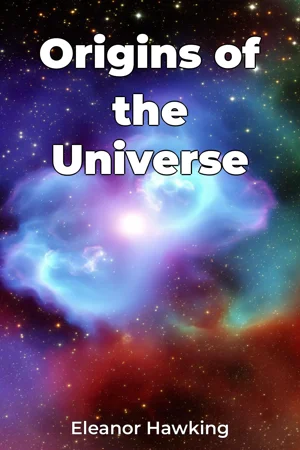
Have you ever gazed up at the night sky and wondered where it all came from? "Origins of the Universe" delves into this fundamental question, exploring the scientific theories and evidence surrounding the birth and evolution of everything. This book is not just a journey through space, but also a journey through time, tracing the universe's development from its earliest moments to the present day. Two central topics form the backbone of this exploration: the Big Bang theory and cosmic evolution. The Big Bang theory, the dominant cosmological model, proposes that the universe originated from an extremely hot, dense state and has been expanding and cooling ever since. Cosmic evolution examines the subsequent development of structures within the universe, from the formation of galaxies and stars to the emergence of planets and, potentially, life. These topics are important because they address our innate curiosity about existence and provide a framework for understanding our place in the cosmos. Understanding these concepts requires a grasp of basic physics, including gravity, electromagnetism, and the nature of matter and energy. We will build upon these fundamentals, introducing concepts such as redshift, cosmic microwave background radiation, and nucleosynthesis. The book's core argument is that the universe's history, while complex and still partially understood, can be deciphered through careful observation, theoretical modeling, and experimental verification. We will demonstrate how the scientific method, applied to cosmology, provides a robust and continuously refined understanding of our origins. "Origins of the Universe" is structured to guide the reader through a logical progression of ideas. We begin with an introduction to fundamental concepts in cosmology, defining key terms and outlining the history of our understanding of the universe. Following this, we will delve into comprehensive chapters dedicated to exploring the Big Bang theory, detailing the evidence supporting it, and examining its limitations and ongoing challenges. A further section explores cosmic evolution, tracing the formation of large-scale structures, galaxies, and stars, detailing key processes like gravitational collapse and nuclear fusion. Finally, we synthesize these concepts, discussing implications for the future of the universe and exploring open questions in cosmology. Throughout the book, we rely on a diverse range of evidence, including data from telescopes like Hubble and James Webb, observations of the cosmic microwave background, and results from particle physics experiments like the Large Hadron Collider. We will present data in an accessible manner, explaining the methodologies used to collect and interpret it. The study of the universe's origins draws connections to numerous fields, including particle physics, astrophysics, and even philosophy. The book also touches on mathematical modelling and computational analysis. By highlighting these interdisciplinary connections, we demonstrate the breadth and depth of cosmological research. "Origins of the Universe" stands out by offering a balanced view of accepted theories and ongoing debates. We address limitations and alternatives to the Big Bang model, presenting a nuanced perspective on the current state of cosmological research. Written in a clear and accessible style, devoid of jargon, this book targets anyone with an interest in science and the universe. The content is presented in a way that welcomes readers without extensive scientific training, and provides a deeper understanding of the universe around us. As a work of scientific non-fiction, "Origins of the Universe" adheres to the conventions of accuracy, objectivity, and evidence-based reasoning. We are committed to presenting the most up-to-date scientific understanding, while acknowledging the inherent uncertainties and ongoing research in the field. The scope of this book encompasses the observable universe and its entire history, but we will focus on established scientific theories and observational data. Speculative or fringe theories are mentioned briefly to provide context but are not the primary focus. While the book focuses on theoretical models and observational data, it touches on practical implications, such as developing new technologies for space exploration and understanding the fundamental laws of physics that govern our world. We acknowledge that the study of the universe's origins is an ongoing endeavor, with persistent debates and unanswered questions. We address some of these controversies, such as the nature of dark matter and dark energy, presenting different viewpoints and analyzing the evidence.
Have you ever gazed up at the night sky and wondered where it all came from? "Origins of the Universe" delves into this fundamental question, exploring the scientific theories and evidence surrounding the birth and evolution of everything. This book is not just a journey through space, but also a journey through time, tracing the universe's development from its earliest moments to the present day. Two central topics form the backbone of this exploration: the Big Bang theory and cosmic evolution. The Big Bang theory, the dominant cosmological model, proposes that the universe originated from an extremely hot, dense state and has been expanding and cooling ever since. Cosmic evolution examines the subsequent development of structures within the universe, from the formation of galaxies and stars to the emergence of planets and, potentially, life. These topics are important because they address our innate curiosity about existence and provide a framework for understanding our place in the cosmos. Understanding these concepts requires a grasp of basic physics, including gravity, electromagnetism, and the nature of matter and energy. We will build upon these fundamentals, introducing concepts such as redshift, cosmic microwave background radiation, and nucleosynthesis. The book's core argument is that the universe's history, while complex and still partially understood, can be deciphered through careful observation, theoretical modeling, and experimental verification. We will demonstrate how the scientific method, applied to cosmology, provides a robust and continuously refined understanding of our origins. "Origins of the Universe" is structured to guide the reader through a logical progression of ideas. We begin with an introduction to fundamental concepts in cosmology, defining key terms and outlining the history of our understanding of the universe. Following this, we will delve into comprehensive chapters dedicated to exploring the Big Bang theory, detailing the evidence supporting it, and examining its limitations and ongoing challenges. A further section explores cosmic evolution, tracing the formation of large-scale structures, galaxies, and stars, detailing key processes like gravitational collapse and nuclear fusion. Finally, we synthesize these concepts, discussing implications for the future of the universe and exploring open questions in cosmology. Throughout the book, we rely on a diverse range of evidence, including data from telescopes like Hubble and James Webb, observations of the cosmic microwave background, and results from particle physics experiments like the Large Hadron Collider. We will present data in an accessible manner, explaining the methodologies used to collect and interpret it. The study of the universe's origins draws connections to numerous fields, including particle physics, astrophysics, and even philosophy. The book also touches on mathematical modelling and computational analysis. By highlighting these interdisciplinary connections, we demonstrate the breadth and depth of cosmological research. "Origins of the Universe" stands out by offering a balanced view of accepted theories and ongoing debates. We address limitations and alternatives to the Big Bang model, presenting a nuanced perspective on the current state of cosmological research. Written in a clear and accessible style, devoid of jargon, this book targets anyone with an interest in science and the universe. The content is presented in a way that welcomes readers without extensive scientific training, and provides a deeper understanding of the universe around us. As a work of scientific non-fiction, "Origins of the Universe" adheres to the conventions of accuracy, objectivity, and evidence-based reasoning. We are committed to presenting the most up-to-date scientific understanding, while acknowledging the inherent uncertainties and ongoing research in the field. The scope of this book encompasses the observable universe and its entire history, but we will focus on established scientific theories and observational data. Speculative or fringe theories are mentioned briefly to provide context but are not the primary focus. While the book focuses on theoretical models and observational data, it touches on practical implications, such as developing new technologies for space exploration and understanding the fundamental laws of physics that govern our world. We acknowledge that the study of the universe's origins is an ongoing endeavor, with persistent debates and unanswered questions. We address some of these controversies, such as the nature of dark matter and dark energy, presenting different viewpoints and analyzing the evidence.
"Origins of the Universe" embarks on a comprehensive exploration of the cosmos, focusing on the Big Bang theory and cosmic evolution. The book explains our universe's development from its earliest moments through to the formation of galaxies and stars. It emphasizes how the scientific method, applied to cosmology and astrophysics, allows us to decipher cosmic history through observation and theoretical modeling. Intriguingly, the book reveals that the universe began from an extremely hot, dense state, and continues to expand and cool. The book guides readers through a logical progression, starting with fundamental concepts and key terms in cosmology. Later chapters delve into the Big Bang theory, detailing supporting evidence and limitations, and explore cosmic evolution, including gravitational collapse and nuclear fusion. Throughout, "Origins of the Universe" presents a balanced view of accepted theories and ongoing scientific debates, using data from telescopes and particle physics experiments to provide an accessible understanding suitable for anyone interested in science and the universe.
Book Details
ISBN
9788233984724
Publisher
Publifye AS
Your Licenses
You don't own any licenses for this book
Purchase a license below to unlock this book and download the EPUB.
Purchase License
Select a tier to unlock this book
Need bulk licensing?
Contact us for enterprise agreements.