
About This Book
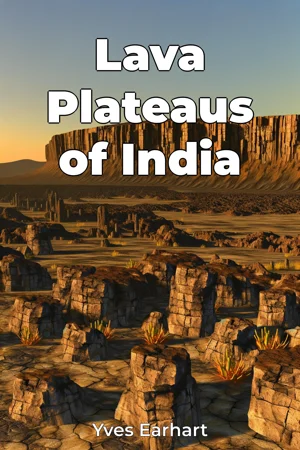
Have you ever wondered how the landscape of a region is dramatically shaped by forces deep within the Earth, creating both breathtaking beauty and fertile grounds? This book, "Lava Plateaus of India," delves into the geological history of the Indian subcontinent, specifically focusing on the formation and evolution of its extensive lava plateaus. We explore how immense volcanic activity sculpted the unique terrain and enriched the soil of the Deccan region, influencing its ecology, human settlements, and agricultural practices for millennia. This exploration is significant because understanding the Deccan Traps and similar geological formations worldwide provides crucial insights into past climate changes, mass extinction events, and the long-term evolution of our planet. Furthermore, the fertile soils derived from volcanic rock support large populations and significant agricultural output, making this understanding critical from a socio-economic perspective. The book will establish a solid foundation in geological principles related to volcanism and plate tectonics, as well as some basic knowledge of Indian history. We begin by exploring the geological context of the Indian subcontinent, examining its tectonic history and the processes that led to the formation of the Deccan Traps. We then turn our attention to the central argument: how massive volcanic eruptions, specifically flood basalt volcanism, shaped not only the physical landscape of India but also influenced its environmental conditions, biodiversity, and human history. The book is structured into three major sections. First, we introduce the reader to the fundamental concepts of plate tectonics, mantle plumes, and flood basalt volcanism, detailing the geological processes that created the Deccan Traps. Second, we examine the timing, intensity, and environmental consequences of the volcanic eruptions, providing a chronological account of the events that unfolded millions of years ago. This section includes detailed maps, geological surveys, and geochemical analyses of the lava flows. Third, the culmination of the argument connects the formation of the Deccan Traps to its present-day influence on Indian agriculture, ecology, and society. We will explore how the basaltic soil supports the cultivation of key crops and influenced settlement patterns. Our analysis relies on extensive geological surveys, geochemical analyses of rock samples, paleobotanical studies, and climate modeling. We will present data from isotopic dating techniques to accurately determine the age of the lava flows and reconstruct the sequence of volcanic events. This book also incorporates historical records and archaeological findings to investigate the impact of the Deccan Traps on human civilizations in the region. "Lava Plateaus of India" bridges earth sciences with history and geography. It delves into volcanology, geochemistry, sedimentology, and their effects on agricultural practices and patterns of human habitation. It also touches upon climatology, exploring possible links between the Deccan Traps formation and global climate change. The book offers a unique perspective by combining geological data with historical records and environmental analyses to provide a comprehensive understanding of the Deccan Traps. It is written in an accessible yet scientifically rigorous style, catering to a broad audience interested in earth sciences, Indian history, and environmental studies. The intended readership includes students, researchers, and anyone with a general interest in geology, geography, and Indian history. This book would be particularly valuable to students studying earth sciences, environmental science, and South Asian studies, providing them with a detailed case study of the interplay between geological processes and human society. As a work of non-fiction, this book adheres to the principles of accuracy, objectivity, and evidence-based reasoning. The scope of the book is limited to the Deccan Traps of India, although comparisons will be made to other large igneous provinces worldwide. While the book delves into the environmental and societal impacts of the Deccan Traps, it does not provide prescriptive solutions to current environmental challenges. The information presented in this book has practical applications in land management, resource assessment, and hazard mitigation in regions with similar geological formations. By understanding the geological history of the land, we can make more informed decisions about land use, agricultural practices, and infrastructure development. While the basic science of flood basalt volcanism is well-established, there are ongoing debates about the precise timing and duration of the Deccan Traps eruptions and their causal relationship with the Cretaceous-Paleogene extinction event. This book will present different viewpoints and critically evaluate the evidence supporting each hypothesis, striving for an unbiased presentation of the current state of knowledge.
Have you ever wondered how the landscape of a region is dramatically shaped by forces deep within the Earth, creating both breathtaking beauty and fertile grounds? This book, "Lava Plateaus of India," delves into the geological history of the Indian subcontinent, specifically focusing on the formation and evolution of its extensive lava plateaus. We explore how immense volcanic activity sculpted the unique terrain and enriched the soil of the Deccan region, influencing its ecology, human settlements, and agricultural practices for millennia. This exploration is significant because understanding the Deccan Traps and similar geological formations worldwide provides crucial insights into past climate changes, mass extinction events, and the long-term evolution of our planet. Furthermore, the fertile soils derived from volcanic rock support large populations and significant agricultural output, making this understanding critical from a socio-economic perspective. The book will establish a solid foundation in geological principles related to volcanism and plate tectonics, as well as some basic knowledge of Indian history. We begin by exploring the geological context of the Indian subcontinent, examining its tectonic history and the processes that led to the formation of the Deccan Traps. We then turn our attention to the central argument: how massive volcanic eruptions, specifically flood basalt volcanism, shaped not only the physical landscape of India but also influenced its environmental conditions, biodiversity, and human history. The book is structured into three major sections. First, we introduce the reader to the fundamental concepts of plate tectonics, mantle plumes, and flood basalt volcanism, detailing the geological processes that created the Deccan Traps. Second, we examine the timing, intensity, and environmental consequences of the volcanic eruptions, providing a chronological account of the events that unfolded millions of years ago. This section includes detailed maps, geological surveys, and geochemical analyses of the lava flows. Third, the culmination of the argument connects the formation of the Deccan Traps to its present-day influence on Indian agriculture, ecology, and society. We will explore how the basaltic soil supports the cultivation of key crops and influenced settlement patterns. Our analysis relies on extensive geological surveys, geochemical analyses of rock samples, paleobotanical studies, and climate modeling. We will present data from isotopic dating techniques to accurately determine the age of the lava flows and reconstruct the sequence of volcanic events. This book also incorporates historical records and archaeological findings to investigate the impact of the Deccan Traps on human civilizations in the region. "Lava Plateaus of India" bridges earth sciences with history and geography. It delves into volcanology, geochemistry, sedimentology, and their effects on agricultural practices and patterns of human habitation. It also touches upon climatology, exploring possible links between the Deccan Traps formation and global climate change. The book offers a unique perspective by combining geological data with historical records and environmental analyses to provide a comprehensive understanding of the Deccan Traps. It is written in an accessible yet scientifically rigorous style, catering to a broad audience interested in earth sciences, Indian history, and environmental studies. The intended readership includes students, researchers, and anyone with a general interest in geology, geography, and Indian history. This book would be particularly valuable to students studying earth sciences, environmental science, and South Asian studies, providing them with a detailed case study of the interplay between geological processes and human society. As a work of non-fiction, this book adheres to the principles of accuracy, objectivity, and evidence-based reasoning. The scope of the book is limited to the Deccan Traps of India, although comparisons will be made to other large igneous provinces worldwide. While the book delves into the environmental and societal impacts of the Deccan Traps, it does not provide prescriptive solutions to current environmental challenges. The information presented in this book has practical applications in land management, resource assessment, and hazard mitigation in regions with similar geological formations. By understanding the geological history of the land, we can make more informed decisions about land use, agricultural practices, and infrastructure development. While the basic science of flood basalt volcanism is well-established, there are ongoing debates about the precise timing and duration of the Deccan Traps eruptions and their causal relationship with the Cretaceous-Paleogene extinction event. This book will present different viewpoints and critically evaluate the evidence supporting each hypothesis, striving for an unbiased presentation of the current state of knowledge.
"Lava Plateaus of India" explores the geological history and formation of India's lava plateaus, particularly the Deccan Traps, offering a multidisciplinary approach that connects earth sciences with Indian history and geography. The book investigates how massive volcanic eruptions shaped the landscape, influenced environmental conditions, and affected human settlements and agricultural practices. Understanding these formations provides insights into past climate changes and the long-term evolution of the planet. The book presents a unique perspective by combining geological data with historical records to explore the Deccan Traps' influence on Indian agriculture, ecology, and society. The book is structured into three major sections, progressing from fundamental concepts of plate tectonics and volcanism to examining the timing and environmental consequences of the eruptions. It culminates by connecting the formation of the Deccan Traps to its present-day influence on Indian agriculture, ecology, and society. Through geological surveys, geochemical analyses, and historical records, the book unveils how the Deccan Traps have profoundly shaped the region.
Book Details
ISBN
9788233984717
Publisher
Publifye AS
Your Licenses
You don't own any licenses for this book
Purchase a license below to unlock this book and download the EPUB.
Purchase License
Select a tier to unlock this book
Need bulk licensing?
Contact us for enterprise agreements.