
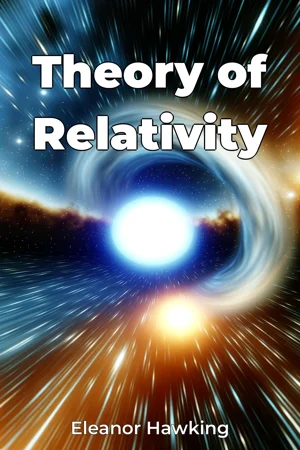
About This Book
Can the very fabric of space and time be warped and molded by gravity? This book, "Theory of Relativity," delves into Albert Einstein’s revolutionary theories that redefined our understanding of the universe, presenting a comprehensive exploration of his groundbreaking contributions to physics. We will meticulously examine the core concepts of special and general relativity, revealing their profound implications for our comprehension of space, time, gravity, and the cosmos. Understanding these theories is crucial, as they underpin many current technologies and continue to shape our exploration of the universe. This book provides a thorough explanation of relativity, beginning with the historical context of 19th-century physics, including the conflicts between Newtonian mechanics and Maxwell's electromagnetism, which set the stage for Einstein’s groundbreaking work. No prior knowledge of advanced mathematics is required, although a basic understanding of physics will be beneficial. The central argument of "Theory of Relativity" is that space and time are not absolute and independent entities, as previously believed, but rather are relative and intertwined, forming a single continuum called spacetime, and that gravity is not a force but a curvature of this spacetime caused by mass and energy. This paradigm shift has fundamentally altered our understanding of the universe and its behavior. The book is structured to guide the reader through the complexities of relativity in a clear and logical manner. First, we introduce the postulates of special relativity, examining its consequences, such as time dilation, length contraction, and the famous equation E=mc². Second, we transition to general relativity, exploring the principle of equivalence, the curvature of spacetime, and the effects of gravity on light and time. Third, we discuss experimental evidence supporting both theories, from the Michelson-Morley experiment to observations of gravitational lensing and the detection of gravitational waves. Finally, we explore the implications of relativity for cosmology, black holes, and the future of space exploration. The evidence presented relies on a combination of theoretical derivations, experimental data, and observational astronomy. We analyze the results of key experiments that confirmed Einstein’s predictions, and we examine astronomical observations that provide compelling evidence for general relativity, such as the bending of light around massive objects and the behavior of binary pulsars. "Theory of Relativity" connects to several other fields, including cosmology, astrophysics, and even philosophy. The book explores how relativity informs our understanding of the origin and evolution of the universe, the nature of black holes, and the philosophical implications of a universe where space and time are relative. The theory also has connections to technology, with the Global Positioning System (GPS) requiring relativistic corrections for accurate positioning. This book explains relativity with clear explanations and analogies to make these complex topics accessible to a broad audience. While maintaining scientific rigor, the writing style is designed to be approachable and engaging, making the book suitable for both students and general readers interested in learning about Einstein’s theories. The target audience includes science enthusiasts, students of physics and astronomy, and anyone curious about the fundamental laws governing the universe. This book offers a valuable resource for understanding one of the most significant scientific achievements of the 20th century. As a work of science, it is expected that claims are supported by verifiable experiments and observations, and the reasoning presented follows established scientific methods. The book focuses primarily on the theoretical framework of relativity and its experimental verification, with limited discussion of the mathematical formalism. The principles of relativity are not just abstract concepts; they have real-world applications, such as in the design of particle accelerators, the development of GPS technology, and the search for extraterrestrial life. While relativity has been extensively validated, some aspects, such as its compatibility with quantum mechanics, remain subjects of ongoing research and debate. This book outlines different proposed theories and provides a balanced view of their prospects.
Can the very fabric of space and time be warped and molded by gravity? This book, "Theory of Relativity," delves into Albert Einstein’s revolutionary theories that redefined our understanding of the universe, presenting a comprehensive exploration of his groundbreaking contributions to physics. We will meticulously examine the core concepts of special and general relativity, revealing their profound implications for our comprehension of space, time, gravity, and the cosmos. Understanding these theories is crucial, as they underpin many current technologies and continue to shape our exploration of the universe. This book provides a thorough explanation of relativity, beginning with the historical context of 19th-century physics, including the conflicts between Newtonian mechanics and Maxwell's electromagnetism, which set the stage for Einstein’s groundbreaking work. No prior knowledge of advanced mathematics is required, although a basic understanding of physics will be beneficial. The central argument of "Theory of Relativity" is that space and time are not absolute and independent entities, as previously believed, but rather are relative and intertwined, forming a single continuum called spacetime, and that gravity is not a force but a curvature of this spacetime caused by mass and energy. This paradigm shift has fundamentally altered our understanding of the universe and its behavior. The book is structured to guide the reader through the complexities of relativity in a clear and logical manner. First, we introduce the postulates of special relativity, examining its consequences, such as time dilation, length contraction, and the famous equation E=mc². Second, we transition to general relativity, exploring the principle of equivalence, the curvature of spacetime, and the effects of gravity on light and time. Third, we discuss experimental evidence supporting both theories, from the Michelson-Morley experiment to observations of gravitational lensing and the detection of gravitational waves. Finally, we explore the implications of relativity for cosmology, black holes, and the future of space exploration. The evidence presented relies on a combination of theoretical derivations, experimental data, and observational astronomy. We analyze the results of key experiments that confirmed Einstein’s predictions, and we examine astronomical observations that provide compelling evidence for general relativity, such as the bending of light around massive objects and the behavior of binary pulsars. "Theory of Relativity" connects to several other fields, including cosmology, astrophysics, and even philosophy. The book explores how relativity informs our understanding of the origin and evolution of the universe, the nature of black holes, and the philosophical implications of a universe where space and time are relative. The theory also has connections to technology, with the Global Positioning System (GPS) requiring relativistic corrections for accurate positioning. This book explains relativity with clear explanations and analogies to make these complex topics accessible to a broad audience. While maintaining scientific rigor, the writing style is designed to be approachable and engaging, making the book suitable for both students and general readers interested in learning about Einstein’s theories. The target audience includes science enthusiasts, students of physics and astronomy, and anyone curious about the fundamental laws governing the universe. This book offers a valuable resource for understanding one of the most significant scientific achievements of the 20th century. As a work of science, it is expected that claims are supported by verifiable experiments and observations, and the reasoning presented follows established scientific methods. The book focuses primarily on the theoretical framework of relativity and its experimental verification, with limited discussion of the mathematical formalism. The principles of relativity are not just abstract concepts; they have real-world applications, such as in the design of particle accelerators, the development of GPS technology, and the search for extraterrestrial life. While relativity has been extensively validated, some aspects, such as its compatibility with quantum mechanics, remain subjects of ongoing research and debate. This book outlines different proposed theories and provides a balanced view of their prospects.
"Theory of Relativity" explores Albert Einstein's groundbreaking theories, which revolutionized our understanding of physics, space, and time. The book delves into both special and general relativity, explaining how these concepts reshaped our comprehension of gravity and the cosmos. It highlights how, contrary to previous beliefs, space and time are not absolute but are intertwined as a single continuum called spacetime. A key insight is Einstein's famous equation, E=mc², demonstrating the equivalence of mass and energy. The book progresses logically, beginning with the historical context that led to Einstein's work. It then introduces the postulates of special relativity, followed by an exploration of general relativity, including the principle of equivalence and the curvature of spacetime. Experimental evidence supporting these theories, such as gravitational lensing, is examined. Making complex ideas approachable, the book uses clear explanations and analogies. This approach ensures that readers gain a solid grasp of relativity's profound implications for cosmology, astrophysics, and our ongoing exploration of the universe.
Book Details
ISBN
9788233984670
Publisher
Publifye AS
Your Licenses
You don't own any licenses for this book
Purchase a license below to unlock this book and download the EPUB.
Purchase License
Select a tier to unlock this book
Need bulk licensing?
Contact us for enterprise agreements.