
About This Book
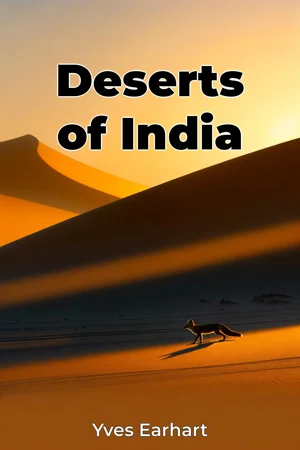
Have you ever wondered how life persists against all odds in the seemingly barren landscapes of India's deserts? This book, "Deserts of India," delves into the captivating world of these arid regions, exploring their formation, the climatic conditions that define them, and the remarkable adaptations that enable life to flourish in these harsh environments. Understanding these deserts is crucial not only for appreciating India's diverse geography but also for addressing contemporary challenges related to climate change, land degradation, and sustainable resource management. This book examines two key aspects of India's deserts: first, how they were formed through complex geological and climatic processes over millennia. Second, how the flora, fauna, and human populations have adapted to survive and even thrive in these challenging conditions. We aim to provide the reader with a deep understanding of the desert ecosystems and the intricate relationships that exist within them. The narrative begins with a foundational understanding of desert formation, exploring the roles of the Aravalli Range, rain shadow effects, and prevailing wind patterns in shaping the Thar Desert, India’s largest. We'll then examine the climatic conditions that characterize these regions, detailing the extreme temperatures, erratic rainfall, and high evaporation rates that define their aridity. This section draws upon meteorological data, geological surveys, and climate models to provide a factual basis for understanding these environments. Our central argument is that India's deserts are not simply wastelands but dynamic ecosystems with a rich biodiversity and cultural heritage that are uniquely adapted to their environment. These fragile ecosystems are under increasing pressure from human activities and climate change, making their study and conservation ever more vital. The book's structure mirrors this argument, beginning with an introduction to desert environments globally and specifically in India (Part 1). Part 2 explores the geological history and climatic factors that have shaped India's deserts, relying on paleoclimatic data and geological surveys. Part 3 examines the plant and animal life of these regions, focusing on their physiological and behavioral adaptations, drawing upon field studies and ecological research. Part 4 investigates the human populations that inhabit these deserts, their traditional livelihoods, and the challenges they face in a changing world, using ethnographic studies and socio-economic data. The book culminates with a discussion of the conservation efforts and sustainable development strategies that are crucial to ensuring the long-term health of these unique ecosystems (Part 5). The evidence presented throughout the book is based on a wide range of sources, including geological surveys of India, meteorological data from the Indian Meteorological Department, ecological studies conducted by various research institutions, and ethnographic research focusing on the cultural adaptations of desert-dwelling communities. This multifaceted approach incorporates both quantitative and qualitative data, providing a comprehensive understanding of the subject matter. "Deserts of India" also connects to other fields of study, including climatology, botany, zoology, anthropology, and environmental science. By integrating these perspectives, the book offers a holistic and interdisciplinary understanding of desert ecosystems. Our approach stands out by combining detailed scientific analysis with insights into the cultural and social dimensions of desert life. The tone of the book is informative and engaging, aiming to make complex scientific concepts accessible to a broad audience. The writing style blends scientific rigor with a narrative approach, bringing the deserts of India to life through vivid descriptions and compelling stories. The target audience includes students and researchers in environmental science, geography, and related fields, as well as anyone with an interest in the natural history and cultural heritage of India. This book would be valuable to readers by offering a comprehensive and up-to-date understanding of India's desert ecosystems, highlighting the challenges they face, and exploring potential solutions for their conservation. As a work of non-fiction, "Deserts of India" adheres to the conventions of accuracy, objectivity, and evidence-based analysis. The scope of the book is limited to the deserts within India, primarily focusing on the Thar Desert but also considering other arid and semi-arid regions. This focus allows for an in-depth exploration of the unique characteristics of these ecosystems. The information presented in this book has practical applications for policymakers, conservationists, and local communities. By understanding the ecological and social dynamics of desert ecosystems, we can develop more effective strategies for sustainable development and climate change adaptation. Finally, the book addresses some of the ongoing debates surrounding desertification, land use practices, and the impact of climate change on desert ecosystems. By presenting different perspectives and analyzing the available evidence, we aim to contribute to a more nuanced understanding of these complex issues.
Have you ever wondered how life persists against all odds in the seemingly barren landscapes of India's deserts? This book, "Deserts of India," delves into the captivating world of these arid regions, exploring their formation, the climatic conditions that define them, and the remarkable adaptations that enable life to flourish in these harsh environments. Understanding these deserts is crucial not only for appreciating India's diverse geography but also for addressing contemporary challenges related to climate change, land degradation, and sustainable resource management. This book examines two key aspects of India's deserts: first, how they were formed through complex geological and climatic processes over millennia. Second, how the flora, fauna, and human populations have adapted to survive and even thrive in these challenging conditions. We aim to provide the reader with a deep understanding of the desert ecosystems and the intricate relationships that exist within them. The narrative begins with a foundational understanding of desert formation, exploring the roles of the Aravalli Range, rain shadow effects, and prevailing wind patterns in shaping the Thar Desert, India’s largest. We'll then examine the climatic conditions that characterize these regions, detailing the extreme temperatures, erratic rainfall, and high evaporation rates that define their aridity. This section draws upon meteorological data, geological surveys, and climate models to provide a factual basis for understanding these environments. Our central argument is that India's deserts are not simply wastelands but dynamic ecosystems with a rich biodiversity and cultural heritage that are uniquely adapted to their environment. These fragile ecosystems are under increasing pressure from human activities and climate change, making their study and conservation ever more vital. The book's structure mirrors this argument, beginning with an introduction to desert environments globally and specifically in India (Part 1). Part 2 explores the geological history and climatic factors that have shaped India's deserts, relying on paleoclimatic data and geological surveys. Part 3 examines the plant and animal life of these regions, focusing on their physiological and behavioral adaptations, drawing upon field studies and ecological research. Part 4 investigates the human populations that inhabit these deserts, their traditional livelihoods, and the challenges they face in a changing world, using ethnographic studies and socio-economic data. The book culminates with a discussion of the conservation efforts and sustainable development strategies that are crucial to ensuring the long-term health of these unique ecosystems (Part 5). The evidence presented throughout the book is based on a wide range of sources, including geological surveys of India, meteorological data from the Indian Meteorological Department, ecological studies conducted by various research institutions, and ethnographic research focusing on the cultural adaptations of desert-dwelling communities. This multifaceted approach incorporates both quantitative and qualitative data, providing a comprehensive understanding of the subject matter. "Deserts of India" also connects to other fields of study, including climatology, botany, zoology, anthropology, and environmental science. By integrating these perspectives, the book offers a holistic and interdisciplinary understanding of desert ecosystems. Our approach stands out by combining detailed scientific analysis with insights into the cultural and social dimensions of desert life. The tone of the book is informative and engaging, aiming to make complex scientific concepts accessible to a broad audience. The writing style blends scientific rigor with a narrative approach, bringing the deserts of India to life through vivid descriptions and compelling stories. The target audience includes students and researchers in environmental science, geography, and related fields, as well as anyone with an interest in the natural history and cultural heritage of India. This book would be valuable to readers by offering a comprehensive and up-to-date understanding of India's desert ecosystems, highlighting the challenges they face, and exploring potential solutions for their conservation. As a work of non-fiction, "Deserts of India" adheres to the conventions of accuracy, objectivity, and evidence-based analysis. The scope of the book is limited to the deserts within India, primarily focusing on the Thar Desert but also considering other arid and semi-arid regions. This focus allows for an in-depth exploration of the unique characteristics of these ecosystems. The information presented in this book has practical applications for policymakers, conservationists, and local communities. By understanding the ecological and social dynamics of desert ecosystems, we can develop more effective strategies for sustainable development and climate change adaptation. Finally, the book addresses some of the ongoing debates surrounding desertification, land use practices, and the impact of climate change on desert ecosystems. By presenting different perspectives and analyzing the available evidence, we aim to contribute to a more nuanced understanding of these complex issues.
"Deserts of India" explores the captivating reality of India's arid landscapes, emphasizing that these regions are far from barren. The book investigates how unique geological and climatic processes shaped these deserts over millennia, and how flora, fauna, and human populations have remarkably adapted to thrive in such challenging conditions. One intriguing fact is the role of the Aravalli Range in creating a rain shadow effect, significantly influencing the formation of the Thar Desert. Another key insight is the delicate balance within these desert ecosystems, highlighting the interdependence of various species and their environment. The book offers a comprehensive understanding of desert ecosystems, starting with an overview of desert formation and climatic conditions. It progresses to examine the geological history, plant and animal life, and the human populations inhabiting these regions. The approach blends scientific rigor with engaging narratives, making complex concepts accessible. Ultimately, the book underscores the urgent need for conservation and sustainable resource management to protect these fragile environments.
Book Details
ISBN
9788233984397
Publisher
Publifye AS
Your Licenses
You don't own any licenses for this book
Purchase a license below to unlock this book and download the EPUB.
Purchase License
Select a tier to unlock this book
Need bulk licensing?
Contact us for enterprise agreements.