
About This Book
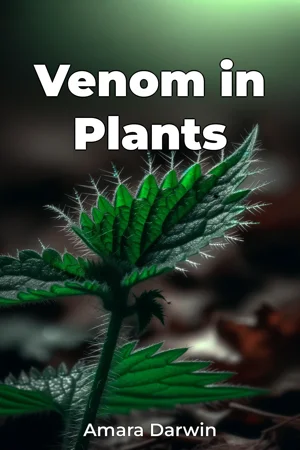
Have you ever considered the silent arsenal of the plant kingdom? This book, "Venom in Plants," delves into the fascinating and often overlooked world of poisonous and venomous flora, exploring the diverse strategies plants employ to defend themselves and influence their environment. We examine the multifaceted nature of plant toxins, moving beyond simple definitions to understand the complex chemistry and delivery mechanisms involved. The significance of this topic lies in its implications for understanding plant evolution, ecological interactions, and even human health. We provide essential context by briefly discussing the historical uses of plant toxins in medicine and warfare, while clarifying the basic botanical and chemical concepts necessary to comprehend the intricacies of plant venom. The central argument of "Venom in Plants" is that plant toxins are not merely passive defenses but rather active agents of ecological influence, shaping plant communities and driving evolutionary arms races between plants and herbivores. We show how plant toxins play a pivotal role in shaping the structure and dynamics of ecosystems. The book is structured to guide the reader through a comprehensive exploration of the subject. Beginning with an introduction to the fundamental principles of plant toxicology, we define key terms and explore the biochemical pathways responsible for producing various toxins. We then move into detailed surveys of different classes of venomous plants, highlighting specific examples such as stinging nettles (Urtica species) and giant hogweed (Heracleum mantegazzianum), analyzing their unique venom delivery systems, and detailing the physiological effects of their toxins. We dedicate substantial attention to species that deploy sophisticated mechanisms to inflict pain or harm, providing a detailed assessment of the toxins involved, and the evolutionary pressures that may have led to their development. The book culminates offering a comprehensive overview of the ecological consequences of plant venom, including its role in plant-herbivore interactions, community dynamics, and even broader ecosystem processes. The evidence presented draws from a wide range of sources, including original scientific research, field studies, and detailed chemical analyses of plant toxins. We incorporate data from botanical surveys, ecological experiments, and biochemical assays to support our arguments. The book highlights recent research using advanced analytical techniques, such as mass spectrometry and genomics, to identify and characterize novel plant toxins. "Venom in Plants" intersects with several other fields of study. There are connections to pharmacology, as plant toxins often serve as the basis for drug development. There are also connections to ecology, given the role of toxins in shaping plant-herbivore interactions. Additionally, evolutionary biology plays a key role, informing our understanding of how and why plants have developed these venomous defense mechanisms. These connections enhance our understanding of the subject by providing diverse perspectives on plant toxicity. This book adopts a rigorous yet accessible approach, aiming to bridge the gap between technical scientific literature and general interest in the natural world. The tone is informative and engaging, balancing scientific accuracy with clear and concise explanations suitable for a broad audience. The target audience includes students and researchers in botany, ecology, and related fields, as well as anyone with a general interest in plant biology and natural history. It will be valuable to readers seeking a deeper understanding of the hidden chemical defenses of plants and their ecological significance. As a work of science non-fiction, the book emphasizes factual accuracy, clear presentation of evidence, and a balanced perspective on existing scientific knowledge. The scope of the book is limited to the study of plant toxins that cause immediate and measurable harm to animals and humans. While we acknowledge the broader role of plant secondary metabolites in plant defense, we focus on the specific examples of plants with venomous properties. The information presented has real-world applications in areas such as plant identification, risk assessment, and the development of new pest management strategies. It can also inform our understanding of the potential dangers posed by invasive plant species and the importance of responsible plant handling. While the ecological significance of herbivore resistance to plant toxins is generally accepted, specific aspects of the co-evolutionary dynamics between plants and herbivores remain an active area of discussion. We address these debates by presenting different perspectives and evaluating the available evidence.
Have you ever considered the silent arsenal of the plant kingdom? This book, "Venom in Plants," delves into the fascinating and often overlooked world of poisonous and venomous flora, exploring the diverse strategies plants employ to defend themselves and influence their environment. We examine the multifaceted nature of plant toxins, moving beyond simple definitions to understand the complex chemistry and delivery mechanisms involved. The significance of this topic lies in its implications for understanding plant evolution, ecological interactions, and even human health. We provide essential context by briefly discussing the historical uses of plant toxins in medicine and warfare, while clarifying the basic botanical and chemical concepts necessary to comprehend the intricacies of plant venom. The central argument of "Venom in Plants" is that plant toxins are not merely passive defenses but rather active agents of ecological influence, shaping plant communities and driving evolutionary arms races between plants and herbivores. We show how plant toxins play a pivotal role in shaping the structure and dynamics of ecosystems. The book is structured to guide the reader through a comprehensive exploration of the subject. Beginning with an introduction to the fundamental principles of plant toxicology, we define key terms and explore the biochemical pathways responsible for producing various toxins. We then move into detailed surveys of different classes of venomous plants, highlighting specific examples such as stinging nettles (Urtica species) and giant hogweed (Heracleum mantegazzianum), analyzing their unique venom delivery systems, and detailing the physiological effects of their toxins. We dedicate substantial attention to species that deploy sophisticated mechanisms to inflict pain or harm, providing a detailed assessment of the toxins involved, and the evolutionary pressures that may have led to their development. The book culminates offering a comprehensive overview of the ecological consequences of plant venom, including its role in plant-herbivore interactions, community dynamics, and even broader ecosystem processes. The evidence presented draws from a wide range of sources, including original scientific research, field studies, and detailed chemical analyses of plant toxins. We incorporate data from botanical surveys, ecological experiments, and biochemical assays to support our arguments. The book highlights recent research using advanced analytical techniques, such as mass spectrometry and genomics, to identify and characterize novel plant toxins. "Venom in Plants" intersects with several other fields of study. There are connections to pharmacology, as plant toxins often serve as the basis for drug development. There are also connections to ecology, given the role of toxins in shaping plant-herbivore interactions. Additionally, evolutionary biology plays a key role, informing our understanding of how and why plants have developed these venomous defense mechanisms. These connections enhance our understanding of the subject by providing diverse perspectives on plant toxicity. This book adopts a rigorous yet accessible approach, aiming to bridge the gap between technical scientific literature and general interest in the natural world. The tone is informative and engaging, balancing scientific accuracy with clear and concise explanations suitable for a broad audience. The target audience includes students and researchers in botany, ecology, and related fields, as well as anyone with a general interest in plant biology and natural history. It will be valuable to readers seeking a deeper understanding of the hidden chemical defenses of plants and their ecological significance. As a work of science non-fiction, the book emphasizes factual accuracy, clear presentation of evidence, and a balanced perspective on existing scientific knowledge. The scope of the book is limited to the study of plant toxins that cause immediate and measurable harm to animals and humans. While we acknowledge the broader role of plant secondary metabolites in plant defense, we focus on the specific examples of plants with venomous properties. The information presented has real-world applications in areas such as plant identification, risk assessment, and the development of new pest management strategies. It can also inform our understanding of the potential dangers posed by invasive plant species and the importance of responsible plant handling. While the ecological significance of herbivore resistance to plant toxins is generally accepted, specific aspects of the co-evolutionary dynamics between plants and herbivores remain an active area of discussion. We address these debates by presenting different perspectives and evaluating the available evidence.
"Venom in Plants" explores the intriguing world of plant toxins, revealing how these chemical defenses shape plant-herbivore interactions and influence entire ecosystems. Plant toxins are not merely passive deterrents but active agents driving evolutionary arms races. For example, some plants use sophisticated mechanisms, such as stinging nettles, to inflict pain or harm, demonstrating the potent effects of their venom. The book begins with an introduction to plant toxicology, defining key terms and exploring the biochemical pathways behind toxin production. It then surveys various classes of venomous plants, detailing their venom delivery systems and physiological effects. A significant portion is dedicated to species with advanced defense mechanisms, analyzing their toxins and the evolutionary pressures that led to their development. The book progresses to a comprehensive overview of the ecological consequences of plant venom, highlighting its role in plant-herbivore dynamics and broader ecosystem processes. This book offers a unique and valuable perspective on the plant kingdom's silent arsenal. It adopts a rigorous yet accessible approach, bridging the gap between scientific literature and general interest. By examining the chemical defenses of plants, "Venom in Plants" enhances our understanding of plant biology, ecology, and the complex interactions that shape the natural world.
Book Details
ISBN
9788233984090
Publisher
Publifye AS
Your Licenses
You don't own any licenses for this book
Purchase a license below to unlock this book and download the EPUB.
Purchase License
Select a tier to unlock this book
Need bulk licensing?
Contact us for enterprise agreements.