
About This Book
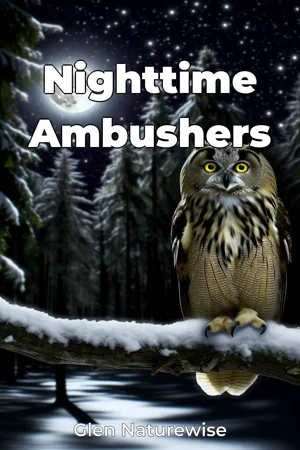
Have you ever wondered what goes bump in the night? Or how some creatures thrive in the darkness where we can barely see? "Nighttime Ambushers" plunges into the hidden world of nocturnal predators, revealing the specialized senses and hunting strategies that allow them to dominate the darkness. This book explores the fascinating adaptations of animals like owls, big cats, and other less familiar hunters, providing a comprehensive look at the science behind their nocturnal success. Our central argument is that the evolution of heightened sensory perception, combined with specific behavioral adaptations, is crucial for survival in low-light environments. We demonstrate how these predators have evolved to exploit the vulnerabilities of their prey during the night. This understanding is not only vital for appreciating the intricacies of the natural world but also for informing conservation efforts and understanding ecological balance. This book is structured to provide a thorough understanding of nocturnal predation. We begin by introducing the challenges of hunting at night, including limitations in visibility, the need for stealth, and the importance of alternative sensory inputs. We then delve into specific case studies, examining the unique adaptations of different predator groups. For example, we explore the exceptional hearing of owls, enabling them to pinpoint prey hidden beneath snow or vegetation. Similarly, we analyze the enhanced vision and camouflage of big cats, allowing them to stalk their prey undetected. We further examine less well-known nocturnal predators, showcasing the diversity of evolutionary solutions to the challenge of night hunting, such as the electroreception of certain fish. "Nighttime Ambushers" offers an in-depth look at the scientific evidence supporting our arguments. We draw on a range of sources, including field studies, laboratory experiments, and anatomical analyses. The book will present data on the sensitivity of nocturnal predators' sensory organs, the effectiveness of their hunting strategies, and the ecological impact of their presence. The book also explores the interdisciplinary connections between nocturnal predation and other fields, such as sensory biology, evolutionary ecology, and conservation science. By understanding the sensory capabilities of these animals, we gain insights into the limits of perception and the power of natural selection. Furthermore, by examining the ecological role of nocturnal predators, we can better understand the complex interactions within ecosystems and the importance of maintaining biodiversity. The information will allow us to see how the behavior of these animals affects the animals around them, including humans, and how protecting them is a vital task. "Nighttime Ambushers" is written in an accessible and engaging style, making it suitable for anyone with an interest in nature, biology, or wildlife. While the book is grounded in scientific research, we avoid jargon and technical language, ensuring that the content is understandable to a broad audience. Our target audience includes students, naturalists, wildlife enthusiasts, and anyone curious about the hidden world of nocturnal animals. This book is valuable because it provides a comprehensive and up-to-date overview of the science behind nocturnal predation, filling a gap in popular science literature. The scope of "Nighttime Ambushers" is intentionally limited to terrestrial and avian predators, focusing primarily on the sensory and behavioral adaptations that enable them to hunt successfully in the dark. While we acknowledge the existence of aquatic nocturnal predators, a full exploration of these creatures would require a separate volume. The information presented in "Nighttime Ambushers" has practical applications in the field of conservation. Understanding the specific needs of nocturnal predators is essential for developing effective conservation strategies. For example, protecting their habitats, reducing light pollution, and managing prey populations are all crucial steps in ensuring their long-term survival. "Nighttime Ambushers" offers a compelling and informative journey into the world of nocturnal predators, revealing the science behind their remarkable adaptations and highlighting the importance of their ecological role.
Have you ever wondered what goes bump in the night? Or how some creatures thrive in the darkness where we can barely see? "Nighttime Ambushers" plunges into the hidden world of nocturnal predators, revealing the specialized senses and hunting strategies that allow them to dominate the darkness. This book explores the fascinating adaptations of animals like owls, big cats, and other less familiar hunters, providing a comprehensive look at the science behind their nocturnal success. Our central argument is that the evolution of heightened sensory perception, combined with specific behavioral adaptations, is crucial for survival in low-light environments. We demonstrate how these predators have evolved to exploit the vulnerabilities of their prey during the night. This understanding is not only vital for appreciating the intricacies of the natural world but also for informing conservation efforts and understanding ecological balance. This book is structured to provide a thorough understanding of nocturnal predation. We begin by introducing the challenges of hunting at night, including limitations in visibility, the need for stealth, and the importance of alternative sensory inputs. We then delve into specific case studies, examining the unique adaptations of different predator groups. For example, we explore the exceptional hearing of owls, enabling them to pinpoint prey hidden beneath snow or vegetation. Similarly, we analyze the enhanced vision and camouflage of big cats, allowing them to stalk their prey undetected. We further examine less well-known nocturnal predators, showcasing the diversity of evolutionary solutions to the challenge of night hunting, such as the electroreception of certain fish. "Nighttime Ambushers" offers an in-depth look at the scientific evidence supporting our arguments. We draw on a range of sources, including field studies, laboratory experiments, and anatomical analyses. The book will present data on the sensitivity of nocturnal predators' sensory organs, the effectiveness of their hunting strategies, and the ecological impact of their presence. The book also explores the interdisciplinary connections between nocturnal predation and other fields, such as sensory biology, evolutionary ecology, and conservation science. By understanding the sensory capabilities of these animals, we gain insights into the limits of perception and the power of natural selection. Furthermore, by examining the ecological role of nocturnal predators, we can better understand the complex interactions within ecosystems and the importance of maintaining biodiversity. The information will allow us to see how the behavior of these animals affects the animals around them, including humans, and how protecting them is a vital task. "Nighttime Ambushers" is written in an accessible and engaging style, making it suitable for anyone with an interest in nature, biology, or wildlife. While the book is grounded in scientific research, we avoid jargon and technical language, ensuring that the content is understandable to a broad audience. Our target audience includes students, naturalists, wildlife enthusiasts, and anyone curious about the hidden world of nocturnal animals. This book is valuable because it provides a comprehensive and up-to-date overview of the science behind nocturnal predation, filling a gap in popular science literature. The scope of "Nighttime Ambushers" is intentionally limited to terrestrial and avian predators, focusing primarily on the sensory and behavioral adaptations that enable them to hunt successfully in the dark. While we acknowledge the existence of aquatic nocturnal predators, a full exploration of these creatures would require a separate volume. The information presented in "Nighttime Ambushers" has practical applications in the field of conservation. Understanding the specific needs of nocturnal predators is essential for developing effective conservation strategies. For example, protecting their habitats, reducing light pollution, and managing prey populations are all crucial steps in ensuring their long-term survival. "Nighttime Ambushers" offers a compelling and informative journey into the world of nocturnal predators, revealing the science behind their remarkable adaptations and highlighting the importance of their ecological role.
"Nighttime Ambushers" delves into the fascinating lives of nocturnal predators and their specialized adaptations for thriving in low-light environments. It explores how animals like owls and big cats have evolved unique sensory capabilities and hunting strategies to dominate the darkness. The book highlights how heightened sensory perception, combined with specific behavioral adaptations, is crucial for their survival. One intriguing example is the exceptional hearing of owls, which allows them to locate prey hidden beneath layers of snow. The book progresses systematically, beginning with the challenges of night hunting and then diving into specific case studies of different predator groups. It examines how these predators exploit the vulnerabilities of their prey at night, emphasizing the importance of understanding this for both appreciating nature and informing conservation efforts. By exploring the sensory capabilities and hunting techniques of these creatures, "Nighttime Ambushers" provides a comprehensive look at the science behind nocturnal predation and its impact on ecological balance.
Book Details
ISBN
9788233983925
Publisher
Publifye AS
Your Licenses
You don't own any licenses for this book
Purchase a license below to unlock this book and download the EPUB.
Purchase License
Select a tier to unlock this book
Need bulk licensing?
Contact us for enterprise agreements.