
About This Book
Did you know that some amphibians, often perceived as harmless creatures, possess sophisticated venom delivery systems? In "Venomous Amphibians," we delve into the under-explored world of these fascinating animals, revealing the surprising diversity and complexity of their venomous capabilities. This book explores the evolutionary origins, chemical compositions, and ecological roles of amphibian venoms, offering a comprehensive overview of a topic that bridges the gap between herpetology, toxicology, and evolutionary biology. We will address two key topics: the diverse mechanisms by which amphibians produce and deliver venom, and the ecological significance of venom in their survival and interactions within their ecosystems. These topics are important because they challenge conventional views of amphibians as passive organisms and highlight the crucial role of chemical defenses in their evolution. The understanding of amphibian venoms has historically been limited due to the small size and cryptic nature of many species, as well as the challenges in studying their toxins. However, advances in analytical techniques, such as mass spectrometry and genomics, have revolutionized our ability to characterize these complex chemical cocktails. No prior specialized knowledge is required to understand this book. The central argument of "Venomous Amphibians" is that venom production and delivery have played a more significant role in amphibian evolution and ecology than previously recognized. This argument is important because an appreciation for the diversity of amphibian venom systems will enhance conservation efforts and inspire new avenues of research in fields such as pharmacology and biomaterials. The book is structured as follows: following an introduction to the general characteristics of amphibians and an overview of venomous animals, we explore the different types of venom glands and delivery mechanisms found in frogs and salamanders. We then dedicate chapters to specific case studies, examining the venoms of poison dart frogs, the toxic skin secretions of certain salamander species, and the unique venom delivery systems of caecilians. This culminates in a discussion of the evolutionary origins and ecological consequences of amphibian venom, including its role in predator defense, prey capture, and intra-specific interactions. We conclude by examining potential applications of amphibian venoms in medicine and biotechnology, reflecting future research directions. The evidence presented in this book is drawn from a combination of scientific literature, including original research articles, reviews, and field studies. Data sources include chemical analyses of venom samples, phylogenetic analyses of venom-producing species, and ecological studies of amphibian behavior and interactions. Novel research and methodologies, such as advanced imaging techniques to visualize venom glands and delivery systems, are included. This book connects to several other fields, including pharmacology (exploring the potential medicinal uses of amphibian venoms), evolutionary biology (understanding the origins and diversification of venom systems), and conservation biology (assessing the impact of environmental changes on venomous amphibians). These connections enhance the book's argument by demonstrating the broad relevance and interdisciplinary nature of amphibian venom research. A unique aspect of "Venomous Amphibians" is its focus on the comparative biology of venom systems across different amphibian groups. By examining the similarities and differences in venom production, delivery, and function, we gain a deeper understanding of the evolutionary forces that have shaped these remarkable adaptations. The tone is scholarly, while remaining accessible to a broad audience. The writing style is clear, concise, and engaging, with ample use of illustrations and diagrams to enhance understanding. The target audience includes herpetologists, biologists, ecologists, toxicologists, and anyone with an interest in amphibians and venomous animals. This book would be valuable to them because it provides a comprehensive and up-to-date overview of a fascinating and understudied topic. As a work of scientific non-fiction, "Venomous Amphibians" adheres to standards of accuracy, objectivity, and evidence-based reasoning. The book's scope is limited to amphibians; it does not delve into the venoms of other animal groups in depth. The information in this book can be applied to real-world conservation efforts, informing strategies for protecting venomous amphibian species and their habitats. It can also inspire new research in drug discovery and biomaterials, leading to the development of novel therapeutic agents and technologies. There are ongoing debates regarding the classification of certain amphibian secretions as true venoms versus toxins and the evolutionary origins of venom systems. This book addresses these debates by presenting different perspectives and providing a balanced assessment of the available evidence.
Did you know that some amphibians, often perceived as harmless creatures, possess sophisticated venom delivery systems? In "Venomous Amphibians," we delve into the under-explored world of these fascinating animals, revealing the surprising diversity and complexity of their venomous capabilities. This book explores the evolutionary origins, chemical compositions, and ecological roles of amphibian venoms, offering a comprehensive overview of a topic that bridges the gap between herpetology, toxicology, and evolutionary biology. We will address two key topics: the diverse mechanisms by which amphibians produce and deliver venom, and the ecological significance of venom in their survival and interactions within their ecosystems. These topics are important because they challenge conventional views of amphibians as passive organisms and highlight the crucial role of chemical defenses in their evolution. The understanding of amphibian venoms has historically been limited due to the small size and cryptic nature of many species, as well as the challenges in studying their toxins. However, advances in analytical techniques, such as mass spectrometry and genomics, have revolutionized our ability to characterize these complex chemical cocktails. No prior specialized knowledge is required to understand this book. The central argument of "Venomous Amphibians" is that venom production and delivery have played a more significant role in amphibian evolution and ecology than previously recognized. This argument is important because an appreciation for the diversity of amphibian venom systems will enhance conservation efforts and inspire new avenues of research in fields such as pharmacology and biomaterials. The book is structured as follows: following an introduction to the general characteristics of amphibians and an overview of venomous animals, we explore the different types of venom glands and delivery mechanisms found in frogs and salamanders. We then dedicate chapters to specific case studies, examining the venoms of poison dart frogs, the toxic skin secretions of certain salamander species, and the unique venom delivery systems of caecilians. This culminates in a discussion of the evolutionary origins and ecological consequences of amphibian venom, including its role in predator defense, prey capture, and intra-specific interactions. We conclude by examining potential applications of amphibian venoms in medicine and biotechnology, reflecting future research directions. The evidence presented in this book is drawn from a combination of scientific literature, including original research articles, reviews, and field studies. Data sources include chemical analyses of venom samples, phylogenetic analyses of venom-producing species, and ecological studies of amphibian behavior and interactions. Novel research and methodologies, such as advanced imaging techniques to visualize venom glands and delivery systems, are included. This book connects to several other fields, including pharmacology (exploring the potential medicinal uses of amphibian venoms), evolutionary biology (understanding the origins and diversification of venom systems), and conservation biology (assessing the impact of environmental changes on venomous amphibians). These connections enhance the book's argument by demonstrating the broad relevance and interdisciplinary nature of amphibian venom research. A unique aspect of "Venomous Amphibians" is its focus on the comparative biology of venom systems across different amphibian groups. By examining the similarities and differences in venom production, delivery, and function, we gain a deeper understanding of the evolutionary forces that have shaped these remarkable adaptations. The tone is scholarly, while remaining accessible to a broad audience. The writing style is clear, concise, and engaging, with ample use of illustrations and diagrams to enhance understanding. The target audience includes herpetologists, biologists, ecologists, toxicologists, and anyone with an interest in amphibians and venomous animals. This book would be valuable to them because it provides a comprehensive and up-to-date overview of a fascinating and understudied topic. As a work of scientific non-fiction, "Venomous Amphibians" adheres to standards of accuracy, objectivity, and evidence-based reasoning. The book's scope is limited to amphibians; it does not delve into the venoms of other animal groups in depth. The information in this book can be applied to real-world conservation efforts, informing strategies for protecting venomous amphibian species and their habitats. It can also inspire new research in drug discovery and biomaterials, leading to the development of novel therapeutic agents and technologies. There are ongoing debates regarding the classification of certain amphibian secretions as true venoms versus toxins and the evolutionary origins of venom systems. This book addresses these debates by presenting different perspectives and providing a balanced assessment of the available evidence.
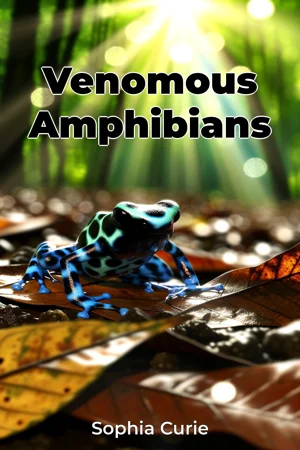
"Venomous Amphibians" explores the diverse and often overlooked world of venomous amphibians, revealing how these creatures utilize toxins for defense, predation, and communication. The book uncovers fascinating insights into the evolutionary origins and chemical compositions of amphibian venoms, highlighting their significance in ecology and evolutionary biology. These chemical defenses play a crucial role in their survival, challenging the conventional view of amphibians as passive organisms. The book examines venom delivery systems across various amphibian groups, from poison dart frogs to salamanders and caecilians, detailing the unique adaptations of each. Did you know that some salamanders secrete toxins through their skin as a defense mechanism? Or that caecilians possess specialized venom delivery systems? This book begins with an introduction to amphibians and venomous animals, progresses through different types of venom glands and mechanisms, and culminates in a discussion of evolutionary origins and ecological consequences, offering a comprehensive overview of this understudied topic. By bridging herpetology, toxicology, and evolutionary biology, "Venomous Amphibians" offers a valuable resource for researchers, students, and anyone fascinated by nature, biology, and the life sciences. The book's accessible approach makes complex scientific information understandable, showcasing the remarkable adaptations that enable these creatures to thrive in their environments.
Book Details
ISBN
9788233983598
Publisher
Publifye AS
Your Licenses
You don't own any licenses for this book
Purchase a license below to unlock this book and download the EPUB.
Purchase License
Select a tier to unlock this book
Need bulk licensing?
Contact us for enterprise agreements.