
About This Book
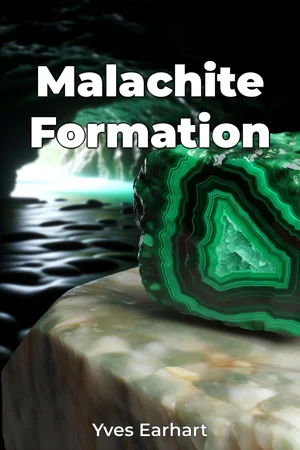
Have you ever wondered how the vibrant green patterns of malachite, a gemstone prized for its beauty and used in jewelry and carvings for millennia, come into existence? "Malachite Formation" delves into the fascinating geological processes that give rise to this captivating mineral, exploring its origins, the chemistry behind its creation, and its significance in both geological studies and human history. This book aims to unravel the mysteries surrounding malachite's development, offering a comprehensive understanding of its formation for both seasoned geologists and curious enthusiasts. This book focuses on two principal areas: the oxidation of copper deposits and the resulting creation of malachite, and the factors influencing malachite's unique banding and crystalline structures. Understanding these processes is crucial for interpreting geological history, as malachite serves as an indicator of past environmental conditions and copper mineralization. Furthermore, appreciation of malachite formation enhances our understanding of mineralogy and Earth's geochemical cycles. We begin by establishing the necessary geological and chemical background including an overview of copper ore deposits and defining relevant chemical principles. We then proceed to examine the oxidation process, detailing how copper sulfides and other copper-bearing minerals react with oxygen and water to form secondary minerals, focusing on the specific reactions that lead to the precipitation of malachite. This section will also discuss the role of various environmental factors, such as pH levels, temperature, and the presence of other ions, in influencing the formation of malachite rather than other copper carbonates such as azurite. The book then dedicates substantial attention to explaining the formation of malachite's characteristic banding patterns. This includes exploring the processes of rhythmic precipitation, diffusion, and Liesegang banding, and how these phenomena manifest in the unique visual textures of malachite. We also delve into the process of pseudomorphing, whereby malachite replaces other minerals, preserving their original forms in striking green detail. Further on, we present evidence gathered from field studies, laboratory experiments, and geochemical modeling. We analyze data from various malachite-rich locations around the world, including the Democratic Republic of Congo, Russia, and the southwestern United States, examining the geological settings, associated mineral assemblages, and geochemical conditions that promote malachite formation. The book also presents data from X-ray diffraction and electron microscopy, illustrating the microstructural features of malachite and how these features relate to its formation history. This exploration connects to the fields of environmental science, archaeology, and material science. The presence of malachite can indicate past mining activities and environmental contamination, informing remediation strategies. Archaeologically, malachite provides insights into ancient trade routes and the use of minerals in pigments and adornments. In material science, the study of malachite's structure contributes to our understanding of crystal growth and the synthesis of novel materials. Our approach combines geological fieldwork, laboratory analysis, and theoretical modeling to provide a holistic view of malachite formation. This book differentiates itself by integrating geochemical principles with detailed observations of malachite textures and occurrences, offering a more complete and nuanced understanding of the mineral's origins. Written in a clear, accessible style, "Malachite Formation" targets a broad audience including geology students, mineral collectors, environmental scientists, and anyone with an interest in Earth sciences and mineralogy. The book is designed to provide a comprehensive overview of malachite formation, while acknowledging that the field is constantly evolving with new discoveries and interpretations. We also limit our investigation to naturally occurring malachite, excluding synthetic variations and focusing on geological processes. The concepts discussed in this book find practical application in mineral exploration, environmental monitoring, and the conservation of geological heritage. Understanding the conditions that lead to malachite formation can aid in the discovery of new copper deposits, while also assisting in the assessment of environmental risks associated with copper mining. While the fundamental principles of malachite formation are well-established, ongoing debates persist regarding the precise mechanisms that control the development of its banding patterns and the role of microorganisms in its precipitation. This book addresses these controversies, presenting different perspectives and offering potential avenues for future research.
Have you ever wondered how the vibrant green patterns of malachite, a gemstone prized for its beauty and used in jewelry and carvings for millennia, come into existence? "Malachite Formation" delves into the fascinating geological processes that give rise to this captivating mineral, exploring its origins, the chemistry behind its creation, and its significance in both geological studies and human history. This book aims to unravel the mysteries surrounding malachite's development, offering a comprehensive understanding of its formation for both seasoned geologists and curious enthusiasts. This book focuses on two principal areas: the oxidation of copper deposits and the resulting creation of malachite, and the factors influencing malachite's unique banding and crystalline structures. Understanding these processes is crucial for interpreting geological history, as malachite serves as an indicator of past environmental conditions and copper mineralization. Furthermore, appreciation of malachite formation enhances our understanding of mineralogy and Earth's geochemical cycles. We begin by establishing the necessary geological and chemical background including an overview of copper ore deposits and defining relevant chemical principles. We then proceed to examine the oxidation process, detailing how copper sulfides and other copper-bearing minerals react with oxygen and water to form secondary minerals, focusing on the specific reactions that lead to the precipitation of malachite. This section will also discuss the role of various environmental factors, such as pH levels, temperature, and the presence of other ions, in influencing the formation of malachite rather than other copper carbonates such as azurite. The book then dedicates substantial attention to explaining the formation of malachite's characteristic banding patterns. This includes exploring the processes of rhythmic precipitation, diffusion, and Liesegang banding, and how these phenomena manifest in the unique visual textures of malachite. We also delve into the process of pseudomorphing, whereby malachite replaces other minerals, preserving their original forms in striking green detail. Further on, we present evidence gathered from field studies, laboratory experiments, and geochemical modeling. We analyze data from various malachite-rich locations around the world, including the Democratic Republic of Congo, Russia, and the southwestern United States, examining the geological settings, associated mineral assemblages, and geochemical conditions that promote malachite formation. The book also presents data from X-ray diffraction and electron microscopy, illustrating the microstructural features of malachite and how these features relate to its formation history. This exploration connects to the fields of environmental science, archaeology, and material science. The presence of malachite can indicate past mining activities and environmental contamination, informing remediation strategies. Archaeologically, malachite provides insights into ancient trade routes and the use of minerals in pigments and adornments. In material science, the study of malachite's structure contributes to our understanding of crystal growth and the synthesis of novel materials. Our approach combines geological fieldwork, laboratory analysis, and theoretical modeling to provide a holistic view of malachite formation. This book differentiates itself by integrating geochemical principles with detailed observations of malachite textures and occurrences, offering a more complete and nuanced understanding of the mineral's origins. Written in a clear, accessible style, "Malachite Formation" targets a broad audience including geology students, mineral collectors, environmental scientists, and anyone with an interest in Earth sciences and mineralogy. The book is designed to provide a comprehensive overview of malachite formation, while acknowledging that the field is constantly evolving with new discoveries and interpretations. We also limit our investigation to naturally occurring malachite, excluding synthetic variations and focusing on geological processes. The concepts discussed in this book find practical application in mineral exploration, environmental monitoring, and the conservation of geological heritage. Understanding the conditions that lead to malachite formation can aid in the discovery of new copper deposits, while also assisting in the assessment of environmental risks associated with copper mining. While the fundamental principles of malachite formation are well-established, ongoing debates persist regarding the precise mechanisms that control the development of its banding patterns and the role of microorganisms in its precipitation. This book addresses these controversies, presenting different perspectives and offering potential avenues for future research.
"Malachite Formation" explores the geological origins of malachite, a vibrant green mineral prized for its beauty and use as an indicator of environmental conditions. The book investigates the oxidation of copper deposits, detailing the chemical reactions that lead to malachite's creation. This process reveals how copper sulfides interact with oxygen and water to form this captivating mineral. Understanding the role of environmental factors, such as pH levels and temperature, is key to understanding why malachite forms instead of other copper carbonates. A unique aspect of malachite is its characteristic banding patterns. The book examines rhythmic precipitation, diffusion, and Liesegang banding to explain these textures. Through field studies, lab experiments, and geochemical modeling from sites like the Democratic Republic of Congo, Russia, and the southwestern United States, the text reveals how malachite forms. It also connects malachite formation to environmental science, archaeology, and material science, highlighting its importance in understanding past mining activities, ancient trade routes, and crystal growth. The book combines geochemical principles with detailed observations of malachite occurrences.
Book Details
ISBN
9788233983444
Publisher
Publifye AS
Your Licenses
You don't own any licenses for this book
Purchase a license below to unlock this book and download the EPUB.
Purchase License
Select a tier to unlock this book
Need bulk licensing?
Contact us for enterprise agreements.