
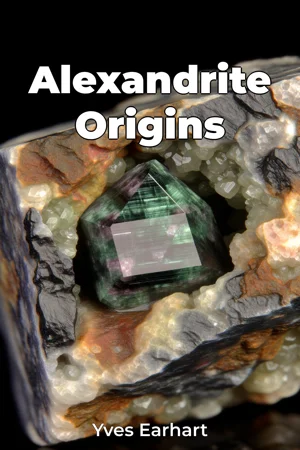
About This Book
Have you ever held a gemstone that appears to change its color depending on the light? This phenomenon, showcased most prominently by alexandrite, hints at a complex and fascinating origin story rooted in rare geological conditions. "Alexandrite Origins" delves into the very heart of alexandrite's formation, its unique optical properties, and its significance in both scientific and gemological communities. This book explores three key concepts: the geological conditions necessary for alexandrite to form, the physics behind its color-changing ability (pleochroism), and the historical and economic impact of alexandrite discoveries. These topics are important because understanding alexandrite reveals crucial insights into the Earth's geological processes and the interplay of trace elements in mineral formation. Furthermore, the stone's value and desirability are directly tied to its scientific rarity and optical characteristics. To fully appreciate alexandrite's story, some background in basic mineralogy and crystal chemistry is helpful, though the text is structured to be accessible to a broad audience. We begin by outlining the role of beryllium, chromium, and aluminum in chrysoberyl formation and how specific geological environments, involving the interaction of beryllium-rich and chromium-rich fluids, are vital for alexandrite's genesis, moving beyond traditional magmatic settings. The central argument of "Alexandrite Origins" is that alexandrite's existence is not merely a geological anomaly but a valuable marker of specific, rare geological events and conditions on Earth, providing insight into metamorphic processes and fluid dynamics within the Earth's crust. Understanding its formation provides insight into the potential formation of other rare minerals. The book is structured as follows: initially, we introduce the mineral chrysoberyl and its chemical composition. Then, we examine the geological environments required for alexandrite formation, focusing on the interaction of different rock types and fluid compositions. We discuss the metamorphic events that lead to the mobilization of beryllium and chromium, essential elements in alexandrite. Next, we explore the physics of alexandrite's pleochroism, explaining the absorption spectra of chromium ions in the chrysoberyl structure and how these interactions result in a color change under different lighting conditions. Finally, we consider the historical discoveries of alexandrite in Russia, Brazil, and other locations and how the stone's rarity has driven its economic and cultural value. The evidence presented in the book draws from diverse sources, including geological survey reports, mineralogical databases, spectroscopic analyses of alexandrite samples, and fluid inclusion studies. A unique aspect of the research involves comparing the geological settings of various alexandrite deposits worldwide to identify common factors and refine our understanding of its formation conditions. "Alexandrite Origins" connects to several other fields, including geochemistry, through the analysis of trace elements in alexandrite and its host rocks; materials science, by examining the optical properties of the gemstone; and economic geology, by studying the formation of ore deposits and the distribution of valuable minerals. These interdisciplinary connections enrich our understanding of alexandrite's complex story. This book takes a unique perspective by emphasizing the geological rarity and specific formation conditions required for alexandrite, distinguishing it from other gemstone formation stories. The writing style is factual and analytical, aiming to present complex scientific information in a clear and accessible manner for both specialists and interested general readers. The target audience includes geology students, gemologists, mineral collectors, and anyone interested in the Earth sciences and the origins of gemstones. The book's value lies in its comprehensive treatment of alexandrite's formation, optical properties, and significance. As a work in Earth Sciences Geography, this book follows the conventions of scholarly research, providing citations, diagrams, and detailed explanations of geological processes. The scope of the book is limited to alexandrite's formation, properties, and history, without delving extensively into the broader field of gemstone cutting or jewelry design. The information presented here can be applied practically in mineral exploration, gemstone identification, and geological research, providing insights into the conditions required for rare mineral formation. While the basic mechanism of alexandrite's color change is well-established, debates persist regarding the relative importance of different geological processes in creating alexandrite deposits. The book will address these ongoing debates, presenting different viewpoints and evidence.
Have you ever held a gemstone that appears to change its color depending on the light? This phenomenon, showcased most prominently by alexandrite, hints at a complex and fascinating origin story rooted in rare geological conditions. "Alexandrite Origins" delves into the very heart of alexandrite's formation, its unique optical properties, and its significance in both scientific and gemological communities. This book explores three key concepts: the geological conditions necessary for alexandrite to form, the physics behind its color-changing ability (pleochroism), and the historical and economic impact of alexandrite discoveries. These topics are important because understanding alexandrite reveals crucial insights into the Earth's geological processes and the interplay of trace elements in mineral formation. Furthermore, the stone's value and desirability are directly tied to its scientific rarity and optical characteristics. To fully appreciate alexandrite's story, some background in basic mineralogy and crystal chemistry is helpful, though the text is structured to be accessible to a broad audience. We begin by outlining the role of beryllium, chromium, and aluminum in chrysoberyl formation and how specific geological environments, involving the interaction of beryllium-rich and chromium-rich fluids, are vital for alexandrite's genesis, moving beyond traditional magmatic settings. The central argument of "Alexandrite Origins" is that alexandrite's existence is not merely a geological anomaly but a valuable marker of specific, rare geological events and conditions on Earth, providing insight into metamorphic processes and fluid dynamics within the Earth's crust. Understanding its formation provides insight into the potential formation of other rare minerals. The book is structured as follows: initially, we introduce the mineral chrysoberyl and its chemical composition. Then, we examine the geological environments required for alexandrite formation, focusing on the interaction of different rock types and fluid compositions. We discuss the metamorphic events that lead to the mobilization of beryllium and chromium, essential elements in alexandrite. Next, we explore the physics of alexandrite's pleochroism, explaining the absorption spectra of chromium ions in the chrysoberyl structure and how these interactions result in a color change under different lighting conditions. Finally, we consider the historical discoveries of alexandrite in Russia, Brazil, and other locations and how the stone's rarity has driven its economic and cultural value. The evidence presented in the book draws from diverse sources, including geological survey reports, mineralogical databases, spectroscopic analyses of alexandrite samples, and fluid inclusion studies. A unique aspect of the research involves comparing the geological settings of various alexandrite deposits worldwide to identify common factors and refine our understanding of its formation conditions. "Alexandrite Origins" connects to several other fields, including geochemistry, through the analysis of trace elements in alexandrite and its host rocks; materials science, by examining the optical properties of the gemstone; and economic geology, by studying the formation of ore deposits and the distribution of valuable minerals. These interdisciplinary connections enrich our understanding of alexandrite's complex story. This book takes a unique perspective by emphasizing the geological rarity and specific formation conditions required for alexandrite, distinguishing it from other gemstone formation stories. The writing style is factual and analytical, aiming to present complex scientific information in a clear and accessible manner for both specialists and interested general readers. The target audience includes geology students, gemologists, mineral collectors, and anyone interested in the Earth sciences and the origins of gemstones. The book's value lies in its comprehensive treatment of alexandrite's formation, optical properties, and significance. As a work in Earth Sciences Geography, this book follows the conventions of scholarly research, providing citations, diagrams, and detailed explanations of geological processes. The scope of the book is limited to alexandrite's formation, properties, and history, without delving extensively into the broader field of gemstone cutting or jewelry design. The information presented here can be applied practically in mineral exploration, gemstone identification, and geological research, providing insights into the conditions required for rare mineral formation. While the basic mechanism of alexandrite's color change is well-established, debates persist regarding the relative importance of different geological processes in creating alexandrite deposits. The book will address these ongoing debates, presenting different viewpoints and evidence.
"Alexandrite Origins" explores the fascinating story behind this color-changing gemstone, revealing how rare geological circumstances give rise to its unique properties. The book delves into the specific conditions needed for alexandrite to form, emphasizing the interplay of elements like beryllium and chromium. One intriguing aspect highlighted is how alexandrite's existence serves as a marker for unusual geological events, offering insights into the Earth's metamorphic processes. The book also explains the physics behind alexandrite's pleochroism, the phenomenon that causes it to appear green in daylight and red in incandescent light. This color change is due to the way chromium ions absorb light within the crystal structure. Furthermore, it examines the historical and economic significance of alexandrite discoveries, noting how its rarity contributes to its value. The book progresses from introducing chrysoberyl's composition to exploring geological environments and metamorphic events to discussing pleochroism and historical discoveries. This book uniquely emphasizes the geological rarity and specific formation conditions of alexandrite. By presenting complex scientific information in an accessible manner, "Alexandrite Origins" caters to a broad audience, including geology students, gemologists, and anyone interested in Earth sciences and the origins of gemstones.
Book Details
ISBN
9788233983345
Publisher
Publifye AS
Your Licenses
You don't own any licenses for this book
Purchase a license below to unlock this book and download the EPUB.
Purchase License
Select a tier to unlock this book
Need bulk licensing?
Contact us for enterprise agreements.