
About This Book
Have you ever wondered what transforms ordinary quartz into the captivating purple gemstone we know as amethyst? "Amethyst Growth" delves into the fascinating story of this beautiful mineral, exploring the geological processes, chemical reactions, and environmental conditions that contribute to its formation and vibrant color. This book illuminates two main topics: the intricate geological processes responsible for amethyst formation and the science behind its distinctive purple hue. Understanding these processes is crucial because it provides insights into larger earth systems, mineral formation, and the interplay of chemistry and geology. Amethyst has been prized by civilizations for millennia, adorning royal collections and religious artifacts. Its significance extends beyond mere aesthetics, serving as a valuable indicator of geological history and the presence of specific elements within the Earth’s crust. To fully appreciate the formation of amethyst, a basic understanding of mineralogy, crystal structures, and the rock cycle is helpful, all of which will be clarified progressively. The central argument posits that amethyst is not simply a type of quartz but a unique geological product resulting from a specific sequence of events involving iron impurities and natural irradiation within particular geological environments. This argument is important because it challenges simplistic explanations and highlights the complex interplay of factors involved in the creation of this gemstone. The book is structured in four parts. First, detailed mineralogical properties of quartz and the chemical composition of amethyst are introduced laying the groundwork for understanding its subsequent development. Second, the book examines the geological environments conducive to amethyst growth, focusing on the volcanic and hydrothermal systems where these gemstones typically form. Third, the crucial role of iron impurities in the quartz crystal lattice and the impact of natural radiation on iron, which creates the defining purple color, will be explained. Finally, the implications of amethyst formation are explored, looking at the potential for using amethyst deposits as indicators of past geological activity and environmental conditions. The arguments presented in this book are supported by a thorough review of geological literature, geochemical analyses of amethyst samples from various locations, and experimental data on the effects of radiation on quartz. Where possible, the book integrates original data from recent field studies and laboratory experiments. The study of amethyst inherently connects to diverse fields such as geochemistry, radiation physics, and art history. The geochemical composition of amethyst can provide clues about the Earth’s past environments and the chemical processes that shaped them. The effects of radiation on mineral structures tie the book into the realm of nuclear physics. The history of amethyst in art and culture reveals fascinating aspects of human civilization and trade. The unique approach of “Amethyst Growth” lies in its synthesis of geological, chemical, and physical concepts to provide a comprehensive understanding of amethyst formation. The book avoids jargon, presenting complex information in an accessible manner suitable for both students and professionals. The tone is factual and informative, maintaining a professional yet engaging style suited for a non-fiction science book. The intended audience includes geology students, mineral enthusiasts, gemologists, and anyone curious about the natural processes that create gemstones. This book provides value by offering a detailed, scientifically grounded explanation of a fascinating natural phenomenon. As a work of earth sciences, the book adheres to the conventions of scientific accuracy, thorough referencing, and objective analysis. While this book strives to provide a comprehensive overview of amethyst formation, it focuses primarily on geological and geochemical aspects, with only limited discussion of the gemological properties influencing the perceived value of different amethyst varieties. The information presented in 'Amethyst Growth' has real-world applications in areas like mineral exploration and environmental monitoring. By understanding how amethyst forms and where it is likely to be found, geologists can improve mineral exploration strategies. Furthermore, the presence of amethyst can be an indicator of past geological activity, such as volcanic eruptions or hydrothermal events, which can inform risk assessments in certain regions. Discussions surrounding irradiation treatment to enhance amethyst color will be addressed, with consideration of the ethical implications and impacts on the gemstone market. "Amethyst Growth" invites you to uncover the secrets behind this captivating gemstone.
Have you ever wondered what transforms ordinary quartz into the captivating purple gemstone we know as amethyst? "Amethyst Growth" delves into the fascinating story of this beautiful mineral, exploring the geological processes, chemical reactions, and environmental conditions that contribute to its formation and vibrant color. This book illuminates two main topics: the intricate geological processes responsible for amethyst formation and the science behind its distinctive purple hue. Understanding these processes is crucial because it provides insights into larger earth systems, mineral formation, and the interplay of chemistry and geology. Amethyst has been prized by civilizations for millennia, adorning royal collections and religious artifacts. Its significance extends beyond mere aesthetics, serving as a valuable indicator of geological history and the presence of specific elements within the Earth’s crust. To fully appreciate the formation of amethyst, a basic understanding of mineralogy, crystal structures, and the rock cycle is helpful, all of which will be clarified progressively. The central argument posits that amethyst is not simply a type of quartz but a unique geological product resulting from a specific sequence of events involving iron impurities and natural irradiation within particular geological environments. This argument is important because it challenges simplistic explanations and highlights the complex interplay of factors involved in the creation of this gemstone. The book is structured in four parts. First, detailed mineralogical properties of quartz and the chemical composition of amethyst are introduced laying the groundwork for understanding its subsequent development. Second, the book examines the geological environments conducive to amethyst growth, focusing on the volcanic and hydrothermal systems where these gemstones typically form. Third, the crucial role of iron impurities in the quartz crystal lattice and the impact of natural radiation on iron, which creates the defining purple color, will be explained. Finally, the implications of amethyst formation are explored, looking at the potential for using amethyst deposits as indicators of past geological activity and environmental conditions. The arguments presented in this book are supported by a thorough review of geological literature, geochemical analyses of amethyst samples from various locations, and experimental data on the effects of radiation on quartz. Where possible, the book integrates original data from recent field studies and laboratory experiments. The study of amethyst inherently connects to diverse fields such as geochemistry, radiation physics, and art history. The geochemical composition of amethyst can provide clues about the Earth’s past environments and the chemical processes that shaped them. The effects of radiation on mineral structures tie the book into the realm of nuclear physics. The history of amethyst in art and culture reveals fascinating aspects of human civilization and trade. The unique approach of “Amethyst Growth” lies in its synthesis of geological, chemical, and physical concepts to provide a comprehensive understanding of amethyst formation. The book avoids jargon, presenting complex information in an accessible manner suitable for both students and professionals. The tone is factual and informative, maintaining a professional yet engaging style suited for a non-fiction science book. The intended audience includes geology students, mineral enthusiasts, gemologists, and anyone curious about the natural processes that create gemstones. This book provides value by offering a detailed, scientifically grounded explanation of a fascinating natural phenomenon. As a work of earth sciences, the book adheres to the conventions of scientific accuracy, thorough referencing, and objective analysis. While this book strives to provide a comprehensive overview of amethyst formation, it focuses primarily on geological and geochemical aspects, with only limited discussion of the gemological properties influencing the perceived value of different amethyst varieties. The information presented in 'Amethyst Growth' has real-world applications in areas like mineral exploration and environmental monitoring. By understanding how amethyst forms and where it is likely to be found, geologists can improve mineral exploration strategies. Furthermore, the presence of amethyst can be an indicator of past geological activity, such as volcanic eruptions or hydrothermal events, which can inform risk assessments in certain regions. Discussions surrounding irradiation treatment to enhance amethyst color will be addressed, with consideration of the ethical implications and impacts on the gemstone market. "Amethyst Growth" invites you to uncover the secrets behind this captivating gemstone.
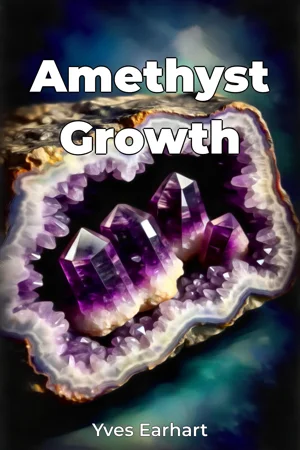
"Amethyst Growth" explores the fascinating journey of how ordinary quartz transforms into the captivating purple gemstone, amethyst. It delves into the geological processes and chemical conditions required for its formation, highlighting the interplay between mineralogy, geochemistry, and radiation physics. This book argues that amethyst is a unique geological product, not just a type of quartz, resulting from specific conditions involving iron impurities and natural irradiation. One intriguing aspect is how amethyst formation relates to volcanic and hydrothermal systems, providing insights into Earth's deep processes. The book progresses systematically, beginning with the mineralogical properties of quartz and the chemical composition of amethyst. It then examines geological environments conducive to amethyst growth, the role of iron impurities and irradiation in creating its color, and the broader implications for understanding geological history. "Amethyst Growth" integrates geological literature, geochemical analyses, and experimental data, offering a comprehensive understanding of amethyst formation. Its accessible approach avoids jargon, making complex information understandable for students, professionals, and anyone curious about the natural processes behind gemstones.
Book Details
ISBN
9788233983284
Publisher
Publifye AS
Your Licenses
You don't own any licenses for this book
Purchase a license below to unlock this book and download the EPUB.
Purchase License
Select a tier to unlock this book
Need bulk licensing?
Contact us for enterprise agreements.