
About This Book
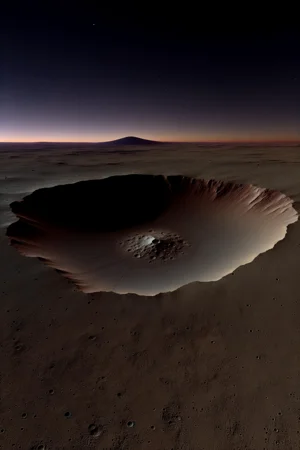
Have you ever looked at the Moon and wondered how those countless craters came to exist? "Crater Formation" delves into the fascinating and complex processes behind these ubiquitous geological features, exploring their origins from both extraterrestrial impacts and terrestrial volcanic activity. This book offers a comprehensive examination of crater formation, presenting a cohesive understanding of their significance in shaping planetary surfaces throughout the solar system. We address two primary topics: impact cratering and volcanic cratering. Impact craters, formed by the collision of meteorites and other celestial bodies, provide a window into the early solar system and the bombardment history of planets. Volcanic craters, on the other hand, reveal the dynamic internal processes of planets and their role in shaping landscapes through eruptions and collapses. Understanding both types of craters is crucial for interpreting planetary geology and comprehending the forces that mold our world and others. The book provides a necessary grounding in basic geology, physics, and astronomy, ensuring accessibility for readers with varying backgrounds. Concepts like kinetic energy transfer, shockwave propagation, and magma dynamics are explained clearly. The central argument of "Crater Formation" is that craters are not just static landforms but rather dynamic records of planetary history and internal activity. Their study allows scientists to reconstruct past events, understand the composition of planetary surfaces, and even assess the potential hazards of future impacts or volcanic eruptions. The book is structured logically, beginning with an introduction to the fundamental concepts of crater formation, including the physics of impact and eruption processes. It proceeds to examine impact cratering in detail, covering topics such as impactor characteristics, crater morphology, and the ejecta blanket. We then turn to volcanic cratering, exploring different types of volcanoes, eruption styles, and the formation of calderas. We will also discuss some specific, well-studied craters on Earth, the Moon, and Mars, using these examples to illustrate the principles discussed. The book culminates in a discussion of the implications of cratering for understanding planetary evolution, resource exploration, and hazard assessment. The evidence presented in "Crater Formation" comes from a variety of sources, including satellite imagery, geophysical data, laboratory experiments, and numerical modeling. We draw upon findings from NASA and ESA missions, ground-based observations, and peer-reviewed scientific literature. Interdisciplinary connections are emphasized throughout the book. We explore the links between geology and astronomy, physics and volcanology, and planetary science and resource management. For example, the study of impact craters has implications for understanding the delivery of water and organic materials to early Earth, while the study of volcanic craters can inform geothermal energy exploration. A unique aspect of this book is its integrated approach, treating impact and volcanic cratering as complementary processes that reveal different aspects of planetary evolution. Rather than focusing solely on one type of crater, we demonstrate how comparing and contrasting these features can lead to a more complete understanding of planetary surfaces. "Crater Formation" is written in a clear and accessible style, avoiding jargon and technical details where possible. The tone is informative but engaging, aiming to capture the reader's curiosity and inspire further exploration of planetary science. The target audience includes students, amateur astronomers, science enthusiasts, and anyone interested in learning more about planetary geology and the forces that shape our world and others. The book is valuable for its comprehensive coverage, its integrated approach, and its real-world applications. As a work of non-fiction, this book aims to provide accurate and up-to-date information about crater formation, adhering to the standards of scientific rigor and objectivity. The scope of the book is limited to the processes involved in crater formation and their implications for understanding planetary surfaces. We do not delve into the detailed engineering aspects of spacecraft design or the social impacts of potential asteroid impacts. The information contained in this book can be applied in various ways. Geologists can use it to interpret the geological history of planetary surfaces. Resource managers can use it to assess the potential for mineral deposits in crater environments. Educators can use it as a resource for teaching about planetary science and geology. While there is general scientific consensus on the basic mechanisms of crater formation, there are ongoing debates about the relative importance of different processes and the interpretation of specific crater features. The book addresses some of these controversies, presenting different viewpoints and acknowledging the uncertainties involved.
Have you ever looked at the Moon and wondered how those countless craters came to exist? "Crater Formation" delves into the fascinating and complex processes behind these ubiquitous geological features, exploring their origins from both extraterrestrial impacts and terrestrial volcanic activity. This book offers a comprehensive examination of crater formation, presenting a cohesive understanding of their significance in shaping planetary surfaces throughout the solar system. We address two primary topics: impact cratering and volcanic cratering. Impact craters, formed by the collision of meteorites and other celestial bodies, provide a window into the early solar system and the bombardment history of planets. Volcanic craters, on the other hand, reveal the dynamic internal processes of planets and their role in shaping landscapes through eruptions and collapses. Understanding both types of craters is crucial for interpreting planetary geology and comprehending the forces that mold our world and others. The book provides a necessary grounding in basic geology, physics, and astronomy, ensuring accessibility for readers with varying backgrounds. Concepts like kinetic energy transfer, shockwave propagation, and magma dynamics are explained clearly. The central argument of "Crater Formation" is that craters are not just static landforms but rather dynamic records of planetary history and internal activity. Their study allows scientists to reconstruct past events, understand the composition of planetary surfaces, and even assess the potential hazards of future impacts or volcanic eruptions. The book is structured logically, beginning with an introduction to the fundamental concepts of crater formation, including the physics of impact and eruption processes. It proceeds to examine impact cratering in detail, covering topics such as impactor characteristics, crater morphology, and the ejecta blanket. We then turn to volcanic cratering, exploring different types of volcanoes, eruption styles, and the formation of calderas. We will also discuss some specific, well-studied craters on Earth, the Moon, and Mars, using these examples to illustrate the principles discussed. The book culminates in a discussion of the implications of cratering for understanding planetary evolution, resource exploration, and hazard assessment. The evidence presented in "Crater Formation" comes from a variety of sources, including satellite imagery, geophysical data, laboratory experiments, and numerical modeling. We draw upon findings from NASA and ESA missions, ground-based observations, and peer-reviewed scientific literature. Interdisciplinary connections are emphasized throughout the book. We explore the links between geology and astronomy, physics and volcanology, and planetary science and resource management. For example, the study of impact craters has implications for understanding the delivery of water and organic materials to early Earth, while the study of volcanic craters can inform geothermal energy exploration. A unique aspect of this book is its integrated approach, treating impact and volcanic cratering as complementary processes that reveal different aspects of planetary evolution. Rather than focusing solely on one type of crater, we demonstrate how comparing and contrasting these features can lead to a more complete understanding of planetary surfaces. "Crater Formation" is written in a clear and accessible style, avoiding jargon and technical details where possible. The tone is informative but engaging, aiming to capture the reader's curiosity and inspire further exploration of planetary science. The target audience includes students, amateur astronomers, science enthusiasts, and anyone interested in learning more about planetary geology and the forces that shape our world and others. The book is valuable for its comprehensive coverage, its integrated approach, and its real-world applications. As a work of non-fiction, this book aims to provide accurate and up-to-date information about crater formation, adhering to the standards of scientific rigor and objectivity. The scope of the book is limited to the processes involved in crater formation and their implications for understanding planetary surfaces. We do not delve into the detailed engineering aspects of spacecraft design or the social impacts of potential asteroid impacts. The information contained in this book can be applied in various ways. Geologists can use it to interpret the geological history of planetary surfaces. Resource managers can use it to assess the potential for mineral deposits in crater environments. Educators can use it as a resource for teaching about planetary science and geology. While there is general scientific consensus on the basic mechanisms of crater formation, there are ongoing debates about the relative importance of different processes and the interpretation of specific crater features. The book addresses some of these controversies, presenting different viewpoints and acknowledging the uncertainties involved.
"Crater Formation" explores the creation of craters, both from impacts by meteorites and asteroids and from volcanic activity. The book highlights how these features are not static, but provide a dynamic record of planetary history. By studying craters, scientists can reconstruct past events and understand the composition of planetary surfaces. The book uniquely integrates the study of impact and volcanic craters, treating them as complementary processes. Did you know that impact craters can tell us about the bombardment history of planets? Or that volcanic craters reveal the internal dynamics shaping landscapes? The book begins with fundamental concepts in geology, physics, and astronomy, before examining impact cratering, volcanic cratering, and specific examples on Earth, the Moon, and Mars. The approach is clear and accessible, making complex concepts understandable for a broad audience. The book uses examples from NASA and ESA missions, along with geophysical data to illustrate key principles. By understanding crater formation, we gain insights into planetary evolution, resource exploration, and even hazard assessment.
Book Details
ISBN
9788233983260
Publisher
Publifye AS
Your Licenses
You don't own any licenses for this book
Purchase a license below to unlock this book and download the EPUB.
Purchase License
Select a tier to unlock this book
Need bulk licensing?
Contact us for enterprise agreements.