
About This Book
Have you ever wondered why some of the Earth's most seemingly inhospitable landscapes are shaped by intense heat and aridity? This book, *Hot Desert*, delves into the intricate processes that govern the formation and characteristics of hot desert environments. We will explore not only the climatic factors contributing to their existence but also the geographical and geological influences that sculpt these unique ecosystems. Understanding hot deserts is crucial because they represent a significant portion of the Earth's land surface and their dynamics are increasingly relevant in the context of global climate change. This book will primarily focus on three key areas. Firstly, we will examine the global climate patterns that lead to desertification, concentrating on the role of Hadley cells, rain shadows, and ocean currents. Secondly, we will analyze the extreme temperature regimes of hot deserts, studying the processes of solar radiation absorption, heat retention, and diurnal temperature variations. Thirdly, we will investigate the impact of minimal rainfall, exploring how it affects soil composition, vegetation distribution, and the unique adaptations of desert biota. To provide context, we will explore the geological history of major hot deserts, such as the Sahara, the Arabian, the Australian, and the Sonoran Deserts. We will also reference historical climate data and scientific studies to show how these regions have evolved over time and how human activities are currently influencing them. No prior knowledge of climatology or geology is required to understand this book; all necessary scientific concepts will be explained in a clear and accessible manner. The central argument of *Hot Desert* is that hot deserts are not simply barren wastelands, but rather complex and dynamic environments shaped by a delicate interplay of atmospheric, geological, and biological factors. Understanding this interplay is vital for predicting how these ecosystems will respond to future environmental changes and for developing sustainable strategies for their management. The book is structured in a logical progression. We begin with an introduction that sets the stage by defining "hot desert" and presenting an overview of their global distribution. The subsequent chapters build upon this foundation. The first main section analyzes the atmospheric processes involved in desert formation, including a detailed explanation of air circulation patterns and the influence of mountain ranges. Next, we turn our attention to the thermal characteristics of deserts, exploring the physical properties of desert surfaces and their impact on temperature regulation. A key chapter investigates the adaptations of plant and animal life to survive in these extreme conditions. The book culminates in a discussion of the challenges and opportunities presented by hot deserts, including issues related to land degradation, water resource management, and renewable energy potential. Real-world examples and case studies will be featured throughout the book. The arguments presented will be supported by a wide range of evidence, including meteorological data, satellite imagery, geological surveys, and ecological studies. We will also draw upon published research from leading scientists in the fields of climatology, geology, and ecology. Unique data sources, such as long-term temperature records and remotely sensed vegetation indices, will be incorporated to provide a comprehensive and data-driven analysis. *Hot Desert* connects to several other disciplines. It relates to geography through the study of landforms and regional variations. It connects to biology through the examination of desert ecosystems and the adaptations of desert organisms. Furthermore, it links to environmental science through the assessment of desertification processes and the impact of climate change. These interdisciplinary connections enrich the book's argument by providing a holistic understanding of hot deserts. One innovative aspect of this book is its emphasis on viewing hot deserts as integral components of the global climate system. This perspective challenges the conventional view of deserts as isolated environments and highlights their role in regulating global processes. The tone of the book is informative and accessible, aiming to engage a broad audience while maintaining scientific rigor. The writing style is clear and concise, avoiding overly technical jargon. *Hot Desert* is intended for students, researchers, and anyone with an interest in nature, geography, and environmental science. It will be particularly valuable to those seeking a comprehensive and up-to-date understanding of hot desert ecosystems. The book aligns with the conventions of non-fiction nature writing, presenting factual information in an engaging and accessible manner. The scope of the book is limited to hot deserts, excluding cold deserts and polar deserts. While touching upon the human dimensions of desertification, the focus remains primarily on the natural science aspects of desert environments. The information provided in the book has practical applications for land management, conservation efforts, and the development of sustainable technologies for desert regions. It also has implications for understanding and mitigating the effects of climate change on arid and semi-arid lands worldwide. While desertification is a recognized phenomenon there are ongoing debates about the relative importance of natural climate variability versus human activities in driving this process, and this will be discussed.
Have you ever wondered why some of the Earth's most seemingly inhospitable landscapes are shaped by intense heat and aridity? This book, *Hot Desert*, delves into the intricate processes that govern the formation and characteristics of hot desert environments. We will explore not only the climatic factors contributing to their existence but also the geographical and geological influences that sculpt these unique ecosystems. Understanding hot deserts is crucial because they represent a significant portion of the Earth's land surface and their dynamics are increasingly relevant in the context of global climate change. This book will primarily focus on three key areas. Firstly, we will examine the global climate patterns that lead to desertification, concentrating on the role of Hadley cells, rain shadows, and ocean currents. Secondly, we will analyze the extreme temperature regimes of hot deserts, studying the processes of solar radiation absorption, heat retention, and diurnal temperature variations. Thirdly, we will investigate the impact of minimal rainfall, exploring how it affects soil composition, vegetation distribution, and the unique adaptations of desert biota. To provide context, we will explore the geological history of major hot deserts, such as the Sahara, the Arabian, the Australian, and the Sonoran Deserts. We will also reference historical climate data and scientific studies to show how these regions have evolved over time and how human activities are currently influencing them. No prior knowledge of climatology or geology is required to understand this book; all necessary scientific concepts will be explained in a clear and accessible manner. The central argument of *Hot Desert* is that hot deserts are not simply barren wastelands, but rather complex and dynamic environments shaped by a delicate interplay of atmospheric, geological, and biological factors. Understanding this interplay is vital for predicting how these ecosystems will respond to future environmental changes and for developing sustainable strategies for their management. The book is structured in a logical progression. We begin with an introduction that sets the stage by defining "hot desert" and presenting an overview of their global distribution. The subsequent chapters build upon this foundation. The first main section analyzes the atmospheric processes involved in desert formation, including a detailed explanation of air circulation patterns and the influence of mountain ranges. Next, we turn our attention to the thermal characteristics of deserts, exploring the physical properties of desert surfaces and their impact on temperature regulation. A key chapter investigates the adaptations of plant and animal life to survive in these extreme conditions. The book culminates in a discussion of the challenges and opportunities presented by hot deserts, including issues related to land degradation, water resource management, and renewable energy potential. Real-world examples and case studies will be featured throughout the book. The arguments presented will be supported by a wide range of evidence, including meteorological data, satellite imagery, geological surveys, and ecological studies. We will also draw upon published research from leading scientists in the fields of climatology, geology, and ecology. Unique data sources, such as long-term temperature records and remotely sensed vegetation indices, will be incorporated to provide a comprehensive and data-driven analysis. *Hot Desert* connects to several other disciplines. It relates to geography through the study of landforms and regional variations. It connects to biology through the examination of desert ecosystems and the adaptations of desert organisms. Furthermore, it links to environmental science through the assessment of desertification processes and the impact of climate change. These interdisciplinary connections enrich the book's argument by providing a holistic understanding of hot deserts. One innovative aspect of this book is its emphasis on viewing hot deserts as integral components of the global climate system. This perspective challenges the conventional view of deserts as isolated environments and highlights their role in regulating global processes. The tone of the book is informative and accessible, aiming to engage a broad audience while maintaining scientific rigor. The writing style is clear and concise, avoiding overly technical jargon. *Hot Desert* is intended for students, researchers, and anyone with an interest in nature, geography, and environmental science. It will be particularly valuable to those seeking a comprehensive and up-to-date understanding of hot desert ecosystems. The book aligns with the conventions of non-fiction nature writing, presenting factual information in an engaging and accessible manner. The scope of the book is limited to hot deserts, excluding cold deserts and polar deserts. While touching upon the human dimensions of desertification, the focus remains primarily on the natural science aspects of desert environments. The information provided in the book has practical applications for land management, conservation efforts, and the development of sustainable technologies for desert regions. It also has implications for understanding and mitigating the effects of climate change on arid and semi-arid lands worldwide. While desertification is a recognized phenomenon there are ongoing debates about the relative importance of natural climate variability versus human activities in driving this process, and this will be discussed.
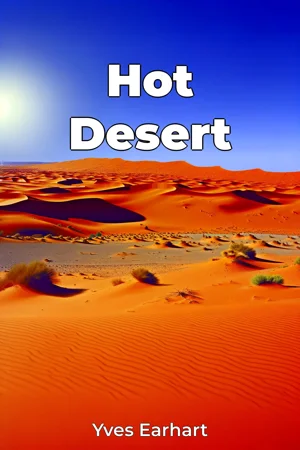
"Hot Desert" explores the fascinating world of hot desert environments, delving into the climate, geography, and geology that shape these arid landscapes. It examines how global climate patterns, such as Hadley cells and rain shadows, contribute to desertification. The book also highlights the extreme temperature regimes and the impact of minimal rainfall on soil, vegetation, and the unique adaptations of desert biota. These seemingly inhospitable regions are not barren wastelands but complex ecosystems. The book investigates the geological history of major hot deserts, like the Sahara and the Arabian, and sheds light on how these regions have evolved over time. Readers will discover the surprising ways in which desert surfaces regulate temperature and how plants and animals have adapted to survive in extreme conditions. By presenting meteorological data, satellite imagery, and ecological studies, "Hot Desert" emphasizes the need to view these regions as integral components of the global climate system. The book progresses logically, beginning with an overview of hot desert distribution, then analyzing atmospheric processes and thermal characteristics, and culminating in a discussion of challenges and opportunities. It connects to geography, biology, and environmental science, making it a valuable resource for understanding the dynamics of desert ecosystems and their relevance to global climate change.
Book Details
ISBN
9788233983208
Publisher
Publifye AS
Your Licenses
You don't own any licenses for this book
Purchase a license below to unlock this book and download the EPUB.
Purchase License
Select a tier to unlock this book
Need bulk licensing?
Contact us for enterprise agreements.