
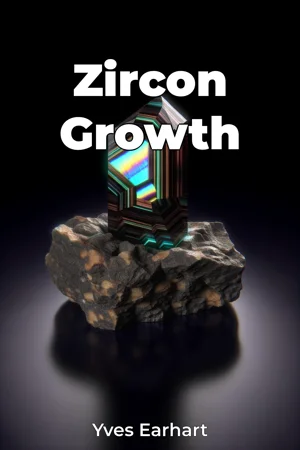
About This Book
Have you ever considered that a gemstone celebrated for its brilliance and color might hold secrets stretching back billions of years, revealing the very history of our planet and solar system? In "Zircon Growth," we delve into the fascinating world of zircon, not just as a diamond alternative appreciated in jewelry, but as a time capsule containing invaluable geological information. This book will explore the intricate processes of zircon formation, its diverse coloration, and its pivotal role in understanding Earth's ancient environments. The book concentrates on three primary themes: the genesis and growth mechanisms of zircon crystals, the causes and significance of their varied coloration, and the applications of zircon geochronology and geochemistry in unraveling Earth's early history. These topics are vital because zircon, due to its durability and ability to incorporate uranium, acts as a reliable recorder of geological events, often surviving even the most intense metamorphic processes. By studying zircon, we can access information about conditions prevalent on Earth billions of years ago, shedding light on the evolution of continents, oceans, and even life itself. To fully appreciate the significance of zircon research, a basic understanding of mineralogy and geology is helpful, but not essential. We will provide the necessary context on geological timescales, radioactive decay, and basic crystal structures. Historically, zircon has been recognized for its aesthetic qualities. Only recently have sophisticated analytical techniques revealed its true scientific value. "Zircon Growth" posits that the comprehensive study of zircon, encompassing its formation, coloration, and geochemical composition, provides a unique window into understanding the dynamic processes that shaped our planet and the early solar system. This viewpoint is important because it moves beyond the traditional view of gemstones as merely ornamental, highlighting their scientific importance in reconstructing Earth's history. The book begins by introducing the fundamental properties of zircon, its crystal structure, and the geological settings in which it forms. We then develop this foundation by exploring: a) The diverse environments in which zircon crystallizes, from magmatic intrusions to metamorphic terrains, and the factors influencing its growth rate and morphology. b) The causes of color variation in zircon, including trace element incorporation, radiation damage, and thermal history, connecting these variations to specific geological events. c) The application of zircon geochronology using uranium-lead dating and other isotopic techniques to determine the ages of rocks and geological processes. d) The culmination of understanding is demonstrated through specific case studies from various locations around the world. The central argument is supported by a wealth of data from field studies, experimental petrology, and advanced analytical techniques such as secondary ion mass spectrometry (SIMS) and electron microprobe analysis. We will present original data from our research, as well as synthesize findings from the wider scientific community. This book draws connections to other fields, including geochemistry, isotope geology, and materials science. The study of trace element partitioning in zircon is relevant to understanding magma evolution, while zircon geochronology provides critical constraints for tectonic models. The radiation damage in zircon serves as an analog for studying nuclear waste storage materials. "Zircon Growth" takes a holistic view, integrating multiple lines of evidence to provide a comprehensive perspective on zircon's role in understanding Earth's past. The material is presented in an academic, yet accessible style, suitable for upper-level undergraduate students, graduate students, researchers, and anyone with a professional interest in geology, mineralogy, or geochemistry. This book would be valuable to readers by providing a detailed and up-to-date synthesis of zircon research, offering insights into its formation, properties, and applications. As a work of non-fiction, "Zircon Growth" adheres to standards of accuracy, objectivity, and thorough citation. The scope of the book is intentionally broad, covering various aspects of zircon research, but with a focus on its application to understanding Earth's early history. While we discuss the use of zircon in jewelry, our primary focus remains on its scientific significance. Data derived from zircon analysis are used in myriad ways, including constraining the timing of ore deposit formation, refining our understanding of plate tectonics, and assessing the environmental conditions that prevailed during the early evolution of life. One area of active debate is the interpretation of extremely old zircon grains (older than 4 billion years) from Western Australia, with some researchers suggesting they indicate the presence of continental crust and liquid water much earlier than previously thought, while others argue for alternative explanations involving localized crustal recycling. This book will present both sides of this and other relevant debates.
Have you ever considered that a gemstone celebrated for its brilliance and color might hold secrets stretching back billions of years, revealing the very history of our planet and solar system? In "Zircon Growth," we delve into the fascinating world of zircon, not just as a diamond alternative appreciated in jewelry, but as a time capsule containing invaluable geological information. This book will explore the intricate processes of zircon formation, its diverse coloration, and its pivotal role in understanding Earth's ancient environments. The book concentrates on three primary themes: the genesis and growth mechanisms of zircon crystals, the causes and significance of their varied coloration, and the applications of zircon geochronology and geochemistry in unraveling Earth's early history. These topics are vital because zircon, due to its durability and ability to incorporate uranium, acts as a reliable recorder of geological events, often surviving even the most intense metamorphic processes. By studying zircon, we can access information about conditions prevalent on Earth billions of years ago, shedding light on the evolution of continents, oceans, and even life itself. To fully appreciate the significance of zircon research, a basic understanding of mineralogy and geology is helpful, but not essential. We will provide the necessary context on geological timescales, radioactive decay, and basic crystal structures. Historically, zircon has been recognized for its aesthetic qualities. Only recently have sophisticated analytical techniques revealed its true scientific value. "Zircon Growth" posits that the comprehensive study of zircon, encompassing its formation, coloration, and geochemical composition, provides a unique window into understanding the dynamic processes that shaped our planet and the early solar system. This viewpoint is important because it moves beyond the traditional view of gemstones as merely ornamental, highlighting their scientific importance in reconstructing Earth's history. The book begins by introducing the fundamental properties of zircon, its crystal structure, and the geological settings in which it forms. We then develop this foundation by exploring: a) The diverse environments in which zircon crystallizes, from magmatic intrusions to metamorphic terrains, and the factors influencing its growth rate and morphology. b) The causes of color variation in zircon, including trace element incorporation, radiation damage, and thermal history, connecting these variations to specific geological events. c) The application of zircon geochronology using uranium-lead dating and other isotopic techniques to determine the ages of rocks and geological processes. d) The culmination of understanding is demonstrated through specific case studies from various locations around the world. The central argument is supported by a wealth of data from field studies, experimental petrology, and advanced analytical techniques such as secondary ion mass spectrometry (SIMS) and electron microprobe analysis. We will present original data from our research, as well as synthesize findings from the wider scientific community. This book draws connections to other fields, including geochemistry, isotope geology, and materials science. The study of trace element partitioning in zircon is relevant to understanding magma evolution, while zircon geochronology provides critical constraints for tectonic models. The radiation damage in zircon serves as an analog for studying nuclear waste storage materials. "Zircon Growth" takes a holistic view, integrating multiple lines of evidence to provide a comprehensive perspective on zircon's role in understanding Earth's past. The material is presented in an academic, yet accessible style, suitable for upper-level undergraduate students, graduate students, researchers, and anyone with a professional interest in geology, mineralogy, or geochemistry. This book would be valuable to readers by providing a detailed and up-to-date synthesis of zircon research, offering insights into its formation, properties, and applications. As a work of non-fiction, "Zircon Growth" adheres to standards of accuracy, objectivity, and thorough citation. The scope of the book is intentionally broad, covering various aspects of zircon research, but with a focus on its application to understanding Earth's early history. While we discuss the use of zircon in jewelry, our primary focus remains on its scientific significance. Data derived from zircon analysis are used in myriad ways, including constraining the timing of ore deposit formation, refining our understanding of plate tectonics, and assessing the environmental conditions that prevailed during the early evolution of life. One area of active debate is the interpretation of extremely old zircon grains (older than 4 billion years) from Western Australia, with some researchers suggesting they indicate the presence of continental crust and liquid water much earlier than previously thought, while others argue for alternative explanations involving localized crustal recycling. This book will present both sides of this and other relevant debates.
"Zircon Growth" explores the multifaceted nature of zircon, positioning it as more than just a gemstone but as a critical archive for understanding Earth's history. Zircon's ability to incorporate uranium makes it invaluable for uranium-lead dating, providing insights into geological events spanning billions of years. The book delves into zircon formation, coloration, and the application of geochronology to uncover the secrets of Earth's early history. The book investigates the diverse environments where zircon crystallizes, from magmatic intrusions to metamorphic terrains, revealing how these conditions influence its growth and morphology. It also examines the causes of color variations in zircon, linking trace element incorporation and radiation damage to specific geological events. By integrating field studies, experimental petrology, and advanced analytical techniques, "Zircon Growth" provides a holistic view of this mineral's role in deciphering Earth's past. The book progresses across chapters that build upon each other, from introducing zircon's fundamental properties to exploring its applications through case studies.
Book Details
ISBN
9788233983123
Publisher
Publifye AS
Your Licenses
You don't own any licenses for this book
Purchase a license below to unlock this book and download the EPUB.
Purchase License
Select a tier to unlock this book
Need bulk licensing?
Contact us for enterprise agreements.