
About This Book
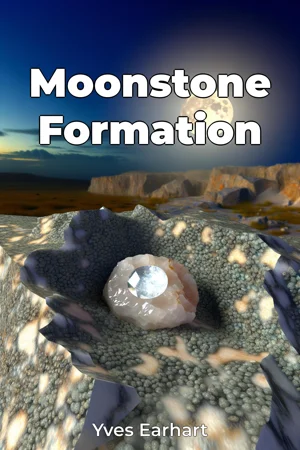
Have you ever held a moonstone and wondered about the secrets behind its ethereal glow? This book, "Moonstone Formation," delves into the geological processes that give rise to this captivating gem, exploring the intricate interplay of mineralogy, physics, and geological history. We will examine the fascinating story of how moonstones develop deep within the Earth, eventually gracing jewelry collections and capturing the imagination for centuries. This book focuses primarily on the formation of moonstones through the process of feldspar crystallization. Understanding this process is crucial, not only for appreciating the beauty of moonstones but also for gaining insight into the broader geological processes that shape our planet. Furthermore, we will investigate adularescence, the unique shimmering effect that defines moonstones, and the physical principles that cause it. Geologically, moonstone formation is intimately linked to the cooling and crystallization of igneous and metamorphic rocks. This book will clarify the geological conditions necessary for moonstone genesis, drawing on extensive field observations and laboratory analyses. The book will assume the reader has a basic understanding of rock types, mineral composition, and phase diagrams. Our central argument is that the adularescence observed in moonstones is a direct consequence of the exsolution lamellae that form during the cooling of alkali feldspars, coupled with light scattering principles. This detailed explanation will offer a comprehensive understanding of moonstone's optical properties. The structure of this book is as follows. First, we will explore the basic mineralogy of feldspars, focusing on the solid solution series between orthoclase and albite. Then, we discuss the conditions that enable exsolution – the separation of these solid solutions into distinct layers. Following this, we will delve into the physics of light scattering and how the specific dimensions of these lamellae interact with light to produce adularescence. Subsequently, we will examine specific geological settings where moonstones are commonly found, such as pegmatites and metamorphic terrains, along with their formation in these environments. Finally, we will explore the applications of studying moonstone formation in understanding broader petrological processes. The evidence presented in this book draws from a wide range of sources, including published research articles, mineralogical databases, and original analyses of moonstone samples using techniques such as X-ray diffraction and electron microscopy. We will also incorporate data from experimental petrology, which simulates mineral formation under controlled laboratory conditions. The study of moonstone formation has interdisciplinary connections. Firstly, it links to materials science, as the exsolution lamellae are analogous to nanoscale structures engineered for specific optical properties. Secondly, mineral optics play a crucial role, specifically the principles of light interference and diffraction. Thirdly, it relates to economic geology, given the role of moonstones in the gemstone industry. This book offers a unique approach by combining traditional petrological methods with modern analytical techniques to provide a more comprehensive understanding of moonstone formation than previously available. We connect the microscopic realm of crystal structures with the macroscopic phenomenon of adularescence. The tone will be informative and accessible, striking a balance between scientific rigor and readability. Complex concepts will be explained clearly and concisely, using diagrams, photographs, and real-world examples to enhance understanding. The target audience includes geology students, mineral collectors, gemologists, and anyone with an interest in the natural world and the science behind gemstone formation. The book fills a gap in the literature by providing a dedicated, in-depth exploration of moonstone formation, something previously only covered briefly within broader texts on mineralogy and petrology. As a work of Earth Sciences, this book strives to present the accepted scientific theories and data regarding moonstone formation, acknowledging the subjective nature of aesthetic appreciation and the complex history of human interaction with gemstones. We do not intend to provide a history of moonstone use, nor a comprehensive gemological guide. Our focus remains strictly its geological origins. While this book aims to be comprehensive, the scope is intentionally limited to the geological formation and optical properties of moonstones. We will not delve into the cultural significance or historical uses of moonstones, nor will we offer exhaustive details on the gem trade or lapidary techniques. The knowledge gained from understanding moonstone formation can be applied practically in several ways. Geologists can improve their ability to interpret the history of igneous and metamorphic rocks. Gemologists can better identify and assess the quality of moonstones. Mineral collectors can deepen their appreciation for the geological processes that create these beautiful gems. While the basic principles of feldspar exsolution are well-established, some details regarding the precise mechanisms and kinetics of lamellae formation are subject to ongoing debate within the geological community. This book will present different perspectives on these topics, acknowledging the areas of uncertainty and suggesting avenues for future research.
Have you ever held a moonstone and wondered about the secrets behind its ethereal glow? This book, "Moonstone Formation," delves into the geological processes that give rise to this captivating gem, exploring the intricate interplay of mineralogy, physics, and geological history. We will examine the fascinating story of how moonstones develop deep within the Earth, eventually gracing jewelry collections and capturing the imagination for centuries. This book focuses primarily on the formation of moonstones through the process of feldspar crystallization. Understanding this process is crucial, not only for appreciating the beauty of moonstones but also for gaining insight into the broader geological processes that shape our planet. Furthermore, we will investigate adularescence, the unique shimmering effect that defines moonstones, and the physical principles that cause it. Geologically, moonstone formation is intimately linked to the cooling and crystallization of igneous and metamorphic rocks. This book will clarify the geological conditions necessary for moonstone genesis, drawing on extensive field observations and laboratory analyses. The book will assume the reader has a basic understanding of rock types, mineral composition, and phase diagrams. Our central argument is that the adularescence observed in moonstones is a direct consequence of the exsolution lamellae that form during the cooling of alkali feldspars, coupled with light scattering principles. This detailed explanation will offer a comprehensive understanding of moonstone's optical properties. The structure of this book is as follows. First, we will explore the basic mineralogy of feldspars, focusing on the solid solution series between orthoclase and albite. Then, we discuss the conditions that enable exsolution – the separation of these solid solutions into distinct layers. Following this, we will delve into the physics of light scattering and how the specific dimensions of these lamellae interact with light to produce adularescence. Subsequently, we will examine specific geological settings where moonstones are commonly found, such as pegmatites and metamorphic terrains, along with their formation in these environments. Finally, we will explore the applications of studying moonstone formation in understanding broader petrological processes. The evidence presented in this book draws from a wide range of sources, including published research articles, mineralogical databases, and original analyses of moonstone samples using techniques such as X-ray diffraction and electron microscopy. We will also incorporate data from experimental petrology, which simulates mineral formation under controlled laboratory conditions. The study of moonstone formation has interdisciplinary connections. Firstly, it links to materials science, as the exsolution lamellae are analogous to nanoscale structures engineered for specific optical properties. Secondly, mineral optics play a crucial role, specifically the principles of light interference and diffraction. Thirdly, it relates to economic geology, given the role of moonstones in the gemstone industry. This book offers a unique approach by combining traditional petrological methods with modern analytical techniques to provide a more comprehensive understanding of moonstone formation than previously available. We connect the microscopic realm of crystal structures with the macroscopic phenomenon of adularescence. The tone will be informative and accessible, striking a balance between scientific rigor and readability. Complex concepts will be explained clearly and concisely, using diagrams, photographs, and real-world examples to enhance understanding. The target audience includes geology students, mineral collectors, gemologists, and anyone with an interest in the natural world and the science behind gemstone formation. The book fills a gap in the literature by providing a dedicated, in-depth exploration of moonstone formation, something previously only covered briefly within broader texts on mineralogy and petrology. As a work of Earth Sciences, this book strives to present the accepted scientific theories and data regarding moonstone formation, acknowledging the subjective nature of aesthetic appreciation and the complex history of human interaction with gemstones. We do not intend to provide a history of moonstone use, nor a comprehensive gemological guide. Our focus remains strictly its geological origins. While this book aims to be comprehensive, the scope is intentionally limited to the geological formation and optical properties of moonstones. We will not delve into the cultural significance or historical uses of moonstones, nor will we offer exhaustive details on the gem trade or lapidary techniques. The knowledge gained from understanding moonstone formation can be applied practically in several ways. Geologists can improve their ability to interpret the history of igneous and metamorphic rocks. Gemologists can better identify and assess the quality of moonstones. Mineral collectors can deepen their appreciation for the geological processes that create these beautiful gems. While the basic principles of feldspar exsolution are well-established, some details regarding the precise mechanisms and kinetics of lamellae formation are subject to ongoing debate within the geological community. This book will present different perspectives on these topics, acknowledging the areas of uncertainty and suggesting avenues for future research.
"Moonstone Formation" explores the fascinating geological origins of moonstones, focusing on how these gemstones acquire their captivating adularescence. The book delves into the processes of feldspar crystallization within igneous and metamorphic rocks, illuminating the conditions necessary for moonstone genesis. A key aspect is the detailed examination of exsolution lamellae, the microscopic structures responsible for the moonstone's unique shimmer, linking to the broader understanding of Earth Sciences. The book progresses from the mineralogy of feldspars to the physics of light scattering, explaining how light interacts with these lamellae to produce adularescence. It then examines geological settings like pegmatites and metamorphic terrains where moonstones are commonly found. The book explains the central argument that adularescence is a result of exsolution during alkali feldspar cooling, offering a comprehensive understanding of their optical properties while explaining the underlying geology. This book offers a unique, in-depth exploration of moonstone formation, bridging traditional petrological methods with modern analytical techniques. The book is valuable for geology students, mineral collectors, and gemologists interested in the science behind gemstone formation, providing a dedicated resource previously unavailable in broader texts.
Book Details
ISBN
9788233983086
Publisher
Publifye AS
Your Licenses
You don't own any licenses for this book
Purchase a license below to unlock this book and download the EPUB.
Purchase License
Select a tier to unlock this book
Need bulk licensing?
Contact us for enterprise agreements.