
About This Book
Have you ever wondered how seemingly static desert landscapes are, in reality, dynamic environments constantly sculpted by an invisible force? "Dune Formation" explores the fascinating processes by which wind relentlessly shapes sand dunes in both desert and coastal regions, transforming loose sediment into ever-shifting landforms. This book delves into two interconnected and fundamental dynamics: aeolian transport, the physics of how wind moves sediment, and the environmental factors that dictate dune morphology. Understanding these dynamics is crucial for geomorphologists, environmental scientists, and anyone interested in how landscapes evolve over time. This subject has deep roots in understanding Earth history, influencing our comprehension of past climates and environmental conditions recorded in ancient dune deposits, or paleodunes. It also connects to current environmental challenges like desertification and coastal erosion, where understanding dune formation and migration is paramount for effective management and mitigation strategies. The central argument of "Dune Formation" is that dune morphology is a direct consequence of the interaction between wind regime, sediment supply, and surface conditions. By dissecting each of these variables, we reveal the underlying principles governing dune development and behavior. This understanding is critical for predicting future landscape changes and addressing environmental challenges in susceptible regions. The book begins by introducing the basic principles of aeolian transport, explaining how wind speed, grain size, and surface roughness influence the movement of sand particles. It then investigates the diverse range of dune types, from crescentic barchans to linear seifs and complex star dunes, describing the specific conditions under which each form originates and evolves. A significant portion of the book considers the role of vegetation, moisture, and topography in modifying wind flow and sediment deposition, factors often overlooked in simpler models of dune formation. Finally, it concludes by exploring the applications of dune research to other fields. Throughout the book, evidence is drawn from extensive field observations, wind tunnel experiments, and computational models. Detailed case studies from various desert and coastal environments around the world illustrate the theoretical principles, offering practical examples of dune formation in action. The book also incorporates data from remote sensing technologies, such as satellite imagery and LiDAR, to analyze large-scale dune patterns and migration rates. "Dune Formation" further connects to other disciplines such as climatology, as wind patterns are a direct result of global atmospheric circulation; ecology, as plants and animals adapt to and influence dune environments; as well as engineering, where the principles of dune stabilization are applied to infrastructure protection along coastlines. By integrating these interdisciplinary perspectives, the book illustrates the broad relevance of dune research to understanding Earth's dynamic systems. The book takes a process-oriented approach, emphasizing the underlying physical mechanisms that drive dune formation. Rather than simply describing different dune types, it explores why specific forms develop in particular environments, providing a deeper and more nuanced understanding of these dynamic landscapes. With an accessible, yet rigorous style, "Dune Formation" is tailored for advanced undergraduate and graduate students in geography, geology, and environmental science, as well as researchers and professionals working in related fields. Anyone with a foundational knowledge of Earth sciences will find this book to be a valuable resource for understanding the complex interplay of forces shaping our planet's surface. The scope of the book is limited to the physical processes of dune formation, focusing on the interactions between wind, sediment, and surface conditions. While it acknowledges the role of human activities in altering dune environments, it does not delve deeply into the social or economic aspects of these changes. The principles outlined in "Dune Formation" have numerous real-world applications, from predicting coastal erosion rates to managing desertification and mitigating the impacts of sandstorms on infrastructure. By understanding the dynamics of dune formation, we can develop more effective strategies for protecting vulnerable landscapes and communities. Dune formation research continues to evolve, especially concerning the role of biological soil crusts in stabilizing dunes and the impact of climate change on wind patterns and sediment availability. "Dune Formation" addresses these ongoing discussions by presenting current research findings and highlighting areas for future investigation.
Have you ever wondered how seemingly static desert landscapes are, in reality, dynamic environments constantly sculpted by an invisible force? "Dune Formation" explores the fascinating processes by which wind relentlessly shapes sand dunes in both desert and coastal regions, transforming loose sediment into ever-shifting landforms. This book delves into two interconnected and fundamental dynamics: aeolian transport, the physics of how wind moves sediment, and the environmental factors that dictate dune morphology. Understanding these dynamics is crucial for geomorphologists, environmental scientists, and anyone interested in how landscapes evolve over time. This subject has deep roots in understanding Earth history, influencing our comprehension of past climates and environmental conditions recorded in ancient dune deposits, or paleodunes. It also connects to current environmental challenges like desertification and coastal erosion, where understanding dune formation and migration is paramount for effective management and mitigation strategies. The central argument of "Dune Formation" is that dune morphology is a direct consequence of the interaction between wind regime, sediment supply, and surface conditions. By dissecting each of these variables, we reveal the underlying principles governing dune development and behavior. This understanding is critical for predicting future landscape changes and addressing environmental challenges in susceptible regions. The book begins by introducing the basic principles of aeolian transport, explaining how wind speed, grain size, and surface roughness influence the movement of sand particles. It then investigates the diverse range of dune types, from crescentic barchans to linear seifs and complex star dunes, describing the specific conditions under which each form originates and evolves. A significant portion of the book considers the role of vegetation, moisture, and topography in modifying wind flow and sediment deposition, factors often overlooked in simpler models of dune formation. Finally, it concludes by exploring the applications of dune research to other fields. Throughout the book, evidence is drawn from extensive field observations, wind tunnel experiments, and computational models. Detailed case studies from various desert and coastal environments around the world illustrate the theoretical principles, offering practical examples of dune formation in action. The book also incorporates data from remote sensing technologies, such as satellite imagery and LiDAR, to analyze large-scale dune patterns and migration rates. "Dune Formation" further connects to other disciplines such as climatology, as wind patterns are a direct result of global atmospheric circulation; ecology, as plants and animals adapt to and influence dune environments; as well as engineering, where the principles of dune stabilization are applied to infrastructure protection along coastlines. By integrating these interdisciplinary perspectives, the book illustrates the broad relevance of dune research to understanding Earth's dynamic systems. The book takes a process-oriented approach, emphasizing the underlying physical mechanisms that drive dune formation. Rather than simply describing different dune types, it explores why specific forms develop in particular environments, providing a deeper and more nuanced understanding of these dynamic landscapes. With an accessible, yet rigorous style, "Dune Formation" is tailored for advanced undergraduate and graduate students in geography, geology, and environmental science, as well as researchers and professionals working in related fields. Anyone with a foundational knowledge of Earth sciences will find this book to be a valuable resource for understanding the complex interplay of forces shaping our planet's surface. The scope of the book is limited to the physical processes of dune formation, focusing on the interactions between wind, sediment, and surface conditions. While it acknowledges the role of human activities in altering dune environments, it does not delve deeply into the social or economic aspects of these changes. The principles outlined in "Dune Formation" have numerous real-world applications, from predicting coastal erosion rates to managing desertification and mitigating the impacts of sandstorms on infrastructure. By understanding the dynamics of dune formation, we can develop more effective strategies for protecting vulnerable landscapes and communities. Dune formation research continues to evolve, especially concerning the role of biological soil crusts in stabilizing dunes and the impact of climate change on wind patterns and sediment availability. "Dune Formation" addresses these ongoing discussions by presenting current research findings and highlighting areas for future investigation.
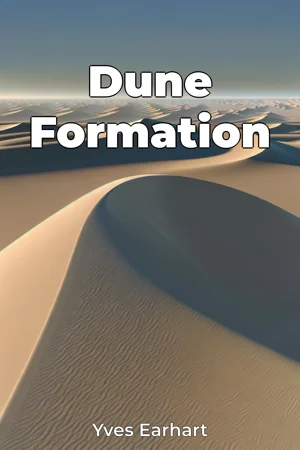
"Dune Formation" explores the fascinating world of how wind shapes sand dunes in both deserts and coastal regions. This book delves into the physics of aeolian transport, examining how wind moves sediment, and investigates the environmental factors influencing dune arrangement, or morphology. These factors are critical for geomorphologists and environmental scientists aiming to understand landscape evolution. The book argues that dune morphology directly results from the interplay between wind patterns, sediment supply, and surface conditions. It begins with aeolian transport principles, explaining how wind speed and grain size affect sand movement. From there, it examines different dune types, such as crescentic barchans and linear seifs, detailing the conditions that dictate their appearance and development. The book emphasizes the role of vegetation, moisture, and topography in modifying wind flow and sediment deposition. This unique approach makes "Dune Formation" a valuable resource for students, researchers, and professionals in geography, geology, and environmental science. By integrating field observations, experiments, and computational models, the book provides a detailed understanding of the complex processes shaping our planet's surface, offering insights into past climates recorded in paleodunes and helping to address current environmental challenges like desertification and coastal erosion.
Book Details
ISBN
9788233983062
Publisher
Publifye AS
Your Licenses
You don't own any licenses for this book
Purchase a license below to unlock this book and download the EPUB.
Purchase License
Select a tier to unlock this book
Need bulk licensing?
Contact us for enterprise agreements.