
About This Book
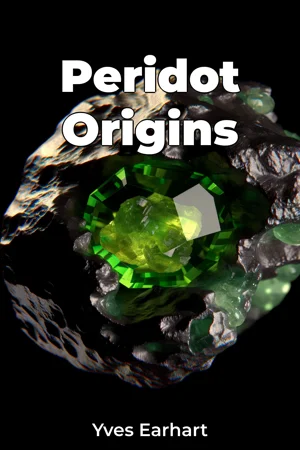
Have you ever held a piece of the Earth's mantle in your hand, or perhaps a fragment of a fallen star? This book, *Peridot Origins*, delves into the fascinating story of peridot, a gemstone whose vibrant green hue belies its often deep-seated origins. We explore not only its formation within the Earth’s volcanic rocks but also its surprising appearance in meteorites, offering a unique window into the processes that shaped our planet and solar system. This exploration is crucial for several reasons. First, understanding peridot's genesis provides valuable insights into magma genesis and mantle dynamics. Second, its presence in meteorites allows us to analyze the composition and conditions of the early solar system, offering clues about the formation of planets. Finally, its relatively simple chemistry makes it an ideal subject for understanding how trace elements influence the color and properties of minerals. *Peridot Origins* argues that studying peridot offers a multifaceted understanding of geological and astronomical processes, bridging the gap between terrestrial and extraterrestrial mineralogy. This argument is important because it challenges the traditional separation of these fields, demonstrating how the study of a single mineral can provide a holistic perspective on the evolution of our world and its cosmic neighborhood. The book begins by introducing the concept of peridot as a gem and its chemical formula as a solid solution between forsterite and fayalite. We then move to the Earth's mantle, explaining the conditions of pressure and temperature that allow peridot to form in the upper mantle. The book examines the processes of magma formation and ascent, detailing how peridot crystals are transported to the surface in volcanic rocks like basalts. A significant portion focuses on peridot's occurrence in meteorites, specifically pallasites, where it is found embedded in a nickel-iron matrix: this section entails the discussion of the formation mechanism of chondrules and the protoplanetary disk. The discussion culminates in a examination of the gemological properties, how color is influenced by iron content and the trace elements present, including a perspective on their impact. Lastly, we look to future research directions. This text presents data obtained from diverse sources, including laboratory experiments mimicking mantle conditions, field studies of peridot-bearing volcanic rocks, and analyses of meteorite samples. Isotope geochemistry data, trace element analysis via mass spectrometry, and X-ray diffraction techniques are employed. The study of peridot connects to several interdisciplinary fields. First, it intersects with volcanology, providing insights into the eruption dynamics and magma compositions. Second, it relates to cosmochemistry, helping to understand the formation and evolution of asteroids and planets. Third, it connects to materials science, as the relationship between peridot's composition, crystal structure and properties are important. *Peridot Origins* takes a compositional viewpoint, tying the mineral's occurrence and properties to the chemical conditions of its birth. The tone maintains scientific rigor while remaining accessible to those without extensive geological training. Our primary audience includes students and researchers in earth sciences, geology, mineralogy, and planetary science. Gemologists, lapidary enthusiasts and mineral collectors, will also benefit from this book. In keeping with the standards of scientific non-fiction, this book emphasizes empirical evidence, verifiable data, and logical reasoning. Sources are cited according to commonly accepted academic guidelines. The scope of this book is limited to geological and cosmochemical aspects of peridot: its formation, properties, and occurrence. It does not delve extensively into gem cutting, marketing, or the cultural history of peridot. Readers can apply the information from this book to better understand the origins of gemstones, the evolution of the Earth's mantle, and the formation processes in the solar system. Geologists can use the concepts described to interpret the origins of peridot-bearing rocks, while planetary scientists can apply the information to the study of meteorites and asteroids. While peridot's formation in the mantle is generally well understood, ongoing debates exist regarding the precise mechanisms of its transport to the surface and the contribution of different mantle sources to its formation.
Have you ever held a piece of the Earth's mantle in your hand, or perhaps a fragment of a fallen star? This book, *Peridot Origins*, delves into the fascinating story of peridot, a gemstone whose vibrant green hue belies its often deep-seated origins. We explore not only its formation within the Earth’s volcanic rocks but also its surprising appearance in meteorites, offering a unique window into the processes that shaped our planet and solar system. This exploration is crucial for several reasons. First, understanding peridot's genesis provides valuable insights into magma genesis and mantle dynamics. Second, its presence in meteorites allows us to analyze the composition and conditions of the early solar system, offering clues about the formation of planets. Finally, its relatively simple chemistry makes it an ideal subject for understanding how trace elements influence the color and properties of minerals. *Peridot Origins* argues that studying peridot offers a multifaceted understanding of geological and astronomical processes, bridging the gap between terrestrial and extraterrestrial mineralogy. This argument is important because it challenges the traditional separation of these fields, demonstrating how the study of a single mineral can provide a holistic perspective on the evolution of our world and its cosmic neighborhood. The book begins by introducing the concept of peridot as a gem and its chemical formula as a solid solution between forsterite and fayalite. We then move to the Earth's mantle, explaining the conditions of pressure and temperature that allow peridot to form in the upper mantle. The book examines the processes of magma formation and ascent, detailing how peridot crystals are transported to the surface in volcanic rocks like basalts. A significant portion focuses on peridot's occurrence in meteorites, specifically pallasites, where it is found embedded in a nickel-iron matrix: this section entails the discussion of the formation mechanism of chondrules and the protoplanetary disk. The discussion culminates in a examination of the gemological properties, how color is influenced by iron content and the trace elements present, including a perspective on their impact. Lastly, we look to future research directions. This text presents data obtained from diverse sources, including laboratory experiments mimicking mantle conditions, field studies of peridot-bearing volcanic rocks, and analyses of meteorite samples. Isotope geochemistry data, trace element analysis via mass spectrometry, and X-ray diffraction techniques are employed. The study of peridot connects to several interdisciplinary fields. First, it intersects with volcanology, providing insights into the eruption dynamics and magma compositions. Second, it relates to cosmochemistry, helping to understand the formation and evolution of asteroids and planets. Third, it connects to materials science, as the relationship between peridot's composition, crystal structure and properties are important. *Peridot Origins* takes a compositional viewpoint, tying the mineral's occurrence and properties to the chemical conditions of its birth. The tone maintains scientific rigor while remaining accessible to those without extensive geological training. Our primary audience includes students and researchers in earth sciences, geology, mineralogy, and planetary science. Gemologists, lapidary enthusiasts and mineral collectors, will also benefit from this book. In keeping with the standards of scientific non-fiction, this book emphasizes empirical evidence, verifiable data, and logical reasoning. Sources are cited according to commonly accepted academic guidelines. The scope of this book is limited to geological and cosmochemical aspects of peridot: its formation, properties, and occurrence. It does not delve extensively into gem cutting, marketing, or the cultural history of peridot. Readers can apply the information from this book to better understand the origins of gemstones, the evolution of the Earth's mantle, and the formation processes in the solar system. Geologists can use the concepts described to interpret the origins of peridot-bearing rocks, while planetary scientists can apply the information to the study of meteorites and asteroids. While peridot's formation in the mantle is generally well understood, ongoing debates exist regarding the precise mechanisms of its transport to the surface and the contribution of different mantle sources to its formation.
"Peridot Origins" explores the fascinating story of peridot, a gemstone offering insights into both Earth's geology and the solar system's formation. Peridot’s vibrant green color is a clue to its creation deep within Earth's mantle and its surprising presence in meteorites. The book emphasizes how studying peridot bridges terrestrial and extraterrestrial mineralogy. The book takes a compositional approach, linking peridot's properties to its formation environment. Beginning with an introduction to peridot's chemical formula, the book progresses to its formation in the Earth's mantle and its journey to the surface via volcanic rocks. A significant portion focuses on peridot within pallasite meteorites, offering clues about chondrule formation and the protoplanetary disk, before culminating in an examination of gemological properties and future research directions. Trace element analysis, isotope geochemistry data, and X-ray diffraction techniques are employed. The book is a valuable resource for students and researchers in earth sciences, geology, mineralogy, and planetary science. By examining peridot's formation, properties, and occurrence, readers gain a better understanding of magma genesis, solar system evolution, and the origins of gemstones.
Book Details
ISBN
9788233983055
Publisher
Publifye AS
Your Licenses
You don't own any licenses for this book
Purchase a license below to unlock this book and download the EPUB.
Purchase License
Select a tier to unlock this book
Need bulk licensing?
Contact us for enterprise agreements.