
About This Book
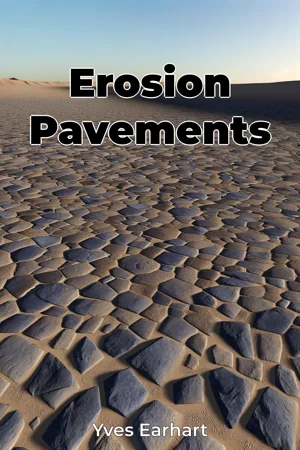
Have you ever wondered how seemingly barren deserts can possess such meticulously organized rock formations? "Erosion Pavements" delves into the fascinating world of desert pavement formation, revealing the intricate processes by which wind erosion sculpts and arranges landscapes over vast stretches of time. This book explores the geological mechanics behind these formations and highlights their ecological significance. Desert pavements are not just randomly scattered rocks. They are the result of complex interactions between wind, water, and geological materials. We will examine two key aspects of their formation: deflation and armoring. Deflation, the removal of fine particles by wind, is a primary driver. Armoring, the subsequent concentration and compaction of larger stones, protects the underlying soil from further erosion. Understanding these processes offers insights into broader environmental changes and landscape evolution that are critical in arid environments. This exploration begins by establishing a foundation in aeolian geomorphology, explaining basic principles of wind erosion and sediment transport, building upon concepts from introductory geology and climatology. No prior specialized knowledge is required, but a basic understanding of Earth science principles will be beneficial. The central argument of "Erosion Pavements" posits that desert pavement surfaces are dynamic equilibrium systems, constantly adapting to environmental forces. They are not static relics but rather evolving landscapes reflecting ongoing climatic and geological processes. This perspective challenges conventional views of desert landscapes as unchanging and highlights the responsiveness of these environments to shifts in climate and land use. The book is organized into three major sections. First, we introduce the fundamentals of desert pavement formation, detailing the processes of deflation, armoring, and surface stabilization. Second, we delve into the environmental factors that influence pavement development, such as wind patterns, rainfall intensity, and soil composition. Third, we examine the ecological roles of desert pavements and their significance for biodiversity, water conservation, and landscape stability. Each chapter builds upon the previous one, culminating in a comprehensive understanding of pavement dynamics. Our analysis relies on a synthesis of field observations, laboratory experiments, and remote sensing data. We present case studies from diverse desert regions around the world, including the Sahara, the Atacama, and the American Southwest. These examples will be supported by quantitative data on particle size distributions, surface roughness, and vegetation cover. The study of desert pavements connects to several other fields, including soil science, ecology, and archaeology. The book highlights how pavements influence soil moisture retention, impact plant communities, and preserve archaeological artifacts. These interdisciplinary connections enhance our understanding of desert pavements as integral components of larger environmental and cultural systems. "Erosion Pavements" offers a unique perspective by integrating traditional geomorphological approaches with ecological and archaeological insights. It provides a novel framework for understanding the complex interplay between geological processes, biological communities, and human activities in arid landscapes. The writing style is factual, analytical, and accessible to a broad audience. Complex scientific concepts are explained in plain language, with clear illustrations and examples. The target audience includes students and researchers in Earth sciences, environmental science, and geography, as well as land managers and conservation professionals. It is also suitable for general readers with an interest in deserts and landscape evolution. As a work of non-fiction Earth Science/Geography, it adheres to rigorous standards of scientific accuracy and evidence-based reasoning. All claims are supported by peer-reviewed research and empirical data. The scope of the book is limited to the formation, function, and significance of desert pavements. It does not delve into the broader aspects of desert geomorphology or specific engineering challenges related to desert pavements. The knowledge gained from this book has practical applications in land management, restoration ecology, and archaeological conservation. Understanding pavement dynamics can inform strategies for preventing soil erosion, promoting vegetation recovery, and protecting cultural resources in arid regions. While the fundamental processes of desert pavement formation are well-established, there are ongoing debates about the relative importance of different factors, such as the role of biological crusts and the influence of human activities. This book addresses these controversies by presenting alternative perspectives and highlighting areas of ongoing research. Readers will come to appreciate the complexities of desert pavement formation and the ongoing efforts to refine our understanding of these fascinating landscapes.
Have you ever wondered how seemingly barren deserts can possess such meticulously organized rock formations? "Erosion Pavements" delves into the fascinating world of desert pavement formation, revealing the intricate processes by which wind erosion sculpts and arranges landscapes over vast stretches of time. This book explores the geological mechanics behind these formations and highlights their ecological significance. Desert pavements are not just randomly scattered rocks. They are the result of complex interactions between wind, water, and geological materials. We will examine two key aspects of their formation: deflation and armoring. Deflation, the removal of fine particles by wind, is a primary driver. Armoring, the subsequent concentration and compaction of larger stones, protects the underlying soil from further erosion. Understanding these processes offers insights into broader environmental changes and landscape evolution that are critical in arid environments. This exploration begins by establishing a foundation in aeolian geomorphology, explaining basic principles of wind erosion and sediment transport, building upon concepts from introductory geology and climatology. No prior specialized knowledge is required, but a basic understanding of Earth science principles will be beneficial. The central argument of "Erosion Pavements" posits that desert pavement surfaces are dynamic equilibrium systems, constantly adapting to environmental forces. They are not static relics but rather evolving landscapes reflecting ongoing climatic and geological processes. This perspective challenges conventional views of desert landscapes as unchanging and highlights the responsiveness of these environments to shifts in climate and land use. The book is organized into three major sections. First, we introduce the fundamentals of desert pavement formation, detailing the processes of deflation, armoring, and surface stabilization. Second, we delve into the environmental factors that influence pavement development, such as wind patterns, rainfall intensity, and soil composition. Third, we examine the ecological roles of desert pavements and their significance for biodiversity, water conservation, and landscape stability. Each chapter builds upon the previous one, culminating in a comprehensive understanding of pavement dynamics. Our analysis relies on a synthesis of field observations, laboratory experiments, and remote sensing data. We present case studies from diverse desert regions around the world, including the Sahara, the Atacama, and the American Southwest. These examples will be supported by quantitative data on particle size distributions, surface roughness, and vegetation cover. The study of desert pavements connects to several other fields, including soil science, ecology, and archaeology. The book highlights how pavements influence soil moisture retention, impact plant communities, and preserve archaeological artifacts. These interdisciplinary connections enhance our understanding of desert pavements as integral components of larger environmental and cultural systems. "Erosion Pavements" offers a unique perspective by integrating traditional geomorphological approaches with ecological and archaeological insights. It provides a novel framework for understanding the complex interplay between geological processes, biological communities, and human activities in arid landscapes. The writing style is factual, analytical, and accessible to a broad audience. Complex scientific concepts are explained in plain language, with clear illustrations and examples. The target audience includes students and researchers in Earth sciences, environmental science, and geography, as well as land managers and conservation professionals. It is also suitable for general readers with an interest in deserts and landscape evolution. As a work of non-fiction Earth Science/Geography, it adheres to rigorous standards of scientific accuracy and evidence-based reasoning. All claims are supported by peer-reviewed research and empirical data. The scope of the book is limited to the formation, function, and significance of desert pavements. It does not delve into the broader aspects of desert geomorphology or specific engineering challenges related to desert pavements. The knowledge gained from this book has practical applications in land management, restoration ecology, and archaeological conservation. Understanding pavement dynamics can inform strategies for preventing soil erosion, promoting vegetation recovery, and protecting cultural resources in arid regions. While the fundamental processes of desert pavement formation are well-established, there are ongoing debates about the relative importance of different factors, such as the role of biological crusts and the influence of human activities. This book addresses these controversies by presenting alternative perspectives and highlighting areas of ongoing research. Readers will come to appreciate the complexities of desert pavement formation and the ongoing efforts to refine our understanding of these fascinating landscapes.
"Erosion Pavements" explores the captivating world of desert pavement formation, revealing how wind erosion shapes seemingly barren landscapes. These rock arrangements result from intricate interactions between wind, water, and geological materials. Deflation, the removal of fine particles by wind, initiates the process, followed by armoring, the concentration of larger stones that protect underlying soil. Understanding these dynamics provides insights into landscape evolution and environmental changes in Earth science and geography. The book examines how desert pavements act as dynamic equilibrium systems, constantly adapting to environmental forces, challenging the view of deserts as unchanging. Organized into three sections, it first introduces the fundamentals of pavement formation. It then delves into environmental factors influencing pavement development, such as wind patterns and soil composition. Finally, it examines the ecological roles of desert pavements, highlighting their significance for biodiversity and landscape stability. This approach offers a unique perspective on the interplay between geological processes and ecological systems in arid environments.
Book Details
ISBN
9788233982966
Publisher
Publifye AS
Your Licenses
You don't own any licenses for this book
Purchase a license below to unlock this book and download the EPUB.
Purchase License
Select a tier to unlock this book
Need bulk licensing?
Contact us for enterprise agreements.