
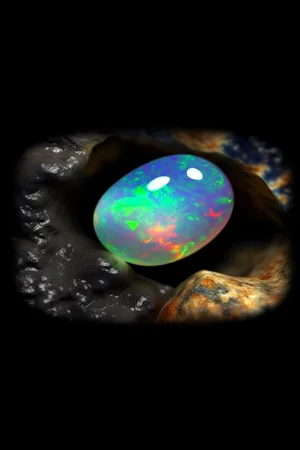
About This Book
Have you ever held a stone that seems to contain the very colors of the rainbow, shifting and dancing with every turn? This book, *Opal Formation*, delves into the captivating world of opals, revealing the secrets behind their creation and the science that gives rise to their renowned ‘play-of-color’ effects. We will explore the geological processes that lead to the formation of these unique gemstones, focusing on the critical role of silica deposits within the Earth's crust. This study is significant because understanding opal formation not only enhances our appreciation of these natural wonders but also provides insights into broader geological processes involving silica transport and deposition. Furthermore, a deeper knowledge of opal genesis aids in more effective exploration and sustainable mining practices. Our journey begins with the fundamental chemical properties of silica and its behavior in aqueous solutions. We will examine various geological settings where opals are found, from arid desert environments to volcanic terrains, providing the necessary context for understanding the conditions conducive to opal formation. We'll discuss the historical context of opal discovery and mining, exploring the cultural significance of these gemstones across different societies and time periods. The central argument presented in *Opal Formation* is that the unique characteristics of an opal – its structure, composition, and ultimately, its 'play-of-color' – are directly determined by the specific environmental conditions and geological history of its formation. This argument is crucial because it challenges simplified explanations and offers a more comprehensive model for understanding the diversity observed in natural opals. The book is structured to guide the reader through a logical progression of topics. First, we introduce the basics of opal composition and classification, distinguishing between precious and common opals. Next, we delve into the mechanics of silica gel formation and its subsequent hardening into opal, detailing the nanoscale structure responsible for the interference of light that creates the 'play-of-color'. Later chapters focus on the geological environments where opals are found, examining specific case studies from Australia, Ethiopia, and other opal-bearing regions. We will analyze the influence of local hydrology, rock chemistry, and tectonic activity on the resulting opal deposits. Finally, we explore the practical implications of opal research, including improved exploration techniques and the synthesis of artificial opals for various applications. The evidence presented throughout the book is drawn from a wide range of sources, including microscopic analyses of opal structures using scanning electron microscopy (SEM), geochemical analyses of opal composition using techniques like inductively coupled plasma mass spectrometry (ICP-MS), and field studies of opal-bearing geological formations. We will also incorporate experimental data from laboratory simulations of opal formation, providing a robust scientific basis for our conclusions. *Opal Formation* bridges several disciplines, connecting mineralogy, geochemistry, and geology. Furthermore, it intersects with materials science in the study of opal microstructure and its impact on optical properties. This interdisciplinary approach enriches the understanding of opal formation and highlights its relevance to various scientific fields. A unique aspect of this book is its comprehensive consideration of the environmental factors controlling opal genesis. We present an integrated model that takes into account not only the availability of silica but also the influence of pH, temperature, and the presence of other ions in solution. This holistic approach moves beyond simplistic explanations and provides a nuanced understanding of opal formation. The tone of the book is informative and accessible, aiming to convey complex scientific concepts in a clear and engaging manner. While grounded in rigorous research, the writing style avoids unnecessary jargon, making it suitable for a broad audience. The target audience includes geology students, mineral enthusiasts, gemologists, and anyone interested in the science behind natural phenomena. The book will be valuable to those seeking a deeper understanding of opal formation, whether for academic pursuits, professional applications, or personal enrichment. As a work of Earth Sciences and Nature, *Opal Formation* adheres to the genre’s conventions of factual accuracy, detailed descriptions, and evidence-based arguments. However, it also incorporates elements of narrative non-fiction to enhance readability and engagement. The scope of the book is limited to the formation of natural opals, with a focus on the geological and chemical processes involved. While the book touches upon synthetic opals, it does not delve into the specifics of their manufacturing processes. The knowledge gained from *Opal Formation* can be applied to various real-world applications, including the identification of geological formations with potential for opal deposits, the development of more effective mining techniques, and the creation of more realistic synthetic opals for jewelry and other applications. The book addresses ongoing debates within the field regarding the precise mechanisms of silica transport and deposition, presenting various perspectives and offering a balanced assessment of the current state of knowledge.
Have you ever held a stone that seems to contain the very colors of the rainbow, shifting and dancing with every turn? This book, *Opal Formation*, delves into the captivating world of opals, revealing the secrets behind their creation and the science that gives rise to their renowned ‘play-of-color’ effects. We will explore the geological processes that lead to the formation of these unique gemstones, focusing on the critical role of silica deposits within the Earth's crust. This study is significant because understanding opal formation not only enhances our appreciation of these natural wonders but also provides insights into broader geological processes involving silica transport and deposition. Furthermore, a deeper knowledge of opal genesis aids in more effective exploration and sustainable mining practices. Our journey begins with the fundamental chemical properties of silica and its behavior in aqueous solutions. We will examine various geological settings where opals are found, from arid desert environments to volcanic terrains, providing the necessary context for understanding the conditions conducive to opal formation. We'll discuss the historical context of opal discovery and mining, exploring the cultural significance of these gemstones across different societies and time periods. The central argument presented in *Opal Formation* is that the unique characteristics of an opal – its structure, composition, and ultimately, its 'play-of-color' – are directly determined by the specific environmental conditions and geological history of its formation. This argument is crucial because it challenges simplified explanations and offers a more comprehensive model for understanding the diversity observed in natural opals. The book is structured to guide the reader through a logical progression of topics. First, we introduce the basics of opal composition and classification, distinguishing between precious and common opals. Next, we delve into the mechanics of silica gel formation and its subsequent hardening into opal, detailing the nanoscale structure responsible for the interference of light that creates the 'play-of-color'. Later chapters focus on the geological environments where opals are found, examining specific case studies from Australia, Ethiopia, and other opal-bearing regions. We will analyze the influence of local hydrology, rock chemistry, and tectonic activity on the resulting opal deposits. Finally, we explore the practical implications of opal research, including improved exploration techniques and the synthesis of artificial opals for various applications. The evidence presented throughout the book is drawn from a wide range of sources, including microscopic analyses of opal structures using scanning electron microscopy (SEM), geochemical analyses of opal composition using techniques like inductively coupled plasma mass spectrometry (ICP-MS), and field studies of opal-bearing geological formations. We will also incorporate experimental data from laboratory simulations of opal formation, providing a robust scientific basis for our conclusions. *Opal Formation* bridges several disciplines, connecting mineralogy, geochemistry, and geology. Furthermore, it intersects with materials science in the study of opal microstructure and its impact on optical properties. This interdisciplinary approach enriches the understanding of opal formation and highlights its relevance to various scientific fields. A unique aspect of this book is its comprehensive consideration of the environmental factors controlling opal genesis. We present an integrated model that takes into account not only the availability of silica but also the influence of pH, temperature, and the presence of other ions in solution. This holistic approach moves beyond simplistic explanations and provides a nuanced understanding of opal formation. The tone of the book is informative and accessible, aiming to convey complex scientific concepts in a clear and engaging manner. While grounded in rigorous research, the writing style avoids unnecessary jargon, making it suitable for a broad audience. The target audience includes geology students, mineral enthusiasts, gemologists, and anyone interested in the science behind natural phenomena. The book will be valuable to those seeking a deeper understanding of opal formation, whether for academic pursuits, professional applications, or personal enrichment. As a work of Earth Sciences and Nature, *Opal Formation* adheres to the genre’s conventions of factual accuracy, detailed descriptions, and evidence-based arguments. However, it also incorporates elements of narrative non-fiction to enhance readability and engagement. The scope of the book is limited to the formation of natural opals, with a focus on the geological and chemical processes involved. While the book touches upon synthetic opals, it does not delve into the specifics of their manufacturing processes. The knowledge gained from *Opal Formation* can be applied to various real-world applications, including the identification of geological formations with potential for opal deposits, the development of more effective mining techniques, and the creation of more realistic synthetic opals for jewelry and other applications. The book addresses ongoing debates within the field regarding the precise mechanisms of silica transport and deposition, presenting various perspectives and offering a balanced assessment of the current state of knowledge.
"Opal Formation" explores the fascinating geological processes behind the creation of opals, those gemstones celebrated for their captivating "play-of-color." This book reveals how specific environmental conditions and geological history determine an opal's unique traits. You'll discover that the formation of opals involves silica deposits and transport, crucial for understanding broader geological phenomena. The book also highlights that deeper knowledge of opal genesis aids in more effective exploration and sustainable mining practices. The book begins by introducing opal composition and then examines silica gel formation, explaining how its hardening results in the nanoscale structure responsible for the "play-of-color." It explores diverse geological settings, from arid deserts to volcanic terrains, showcasing where opals form. Case studies from regions like Australia and Ethiopia demonstrate the influence of local hydrology, rock chemistry, and tectonic activity on opal deposits. By bridging mineralogy, geochemistry, and geology, this study presents an integrated model of opal genesis, considering factors like pH and temperature, making it valuable for geology students, mineral enthusiasts, and gemologists alike.
Book Details
ISBN
9788233982706
Publisher
Publifye AS
Your Licenses
You don't own any licenses for this book
Purchase a license below to unlock this book and download the EPUB.
Purchase License
Select a tier to unlock this book
Need bulk licensing?
Contact us for enterprise agreements.