
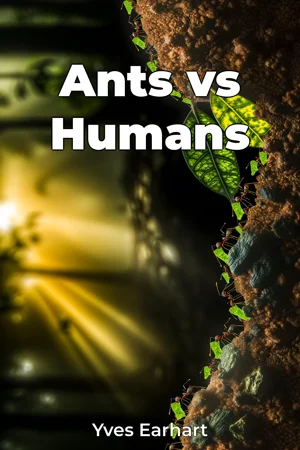
About This Book
What if the most dominant species on Earth isn't actually humans? "Ants vs Humans" presents a comprehensive analysis of two of Earth's most successful social species, examining their parallel evolution, population dynamics, and ecological impacts through the lens of modern science. This research-driven exploration delves into the remarkable similarities and stark differences between human and ant societies, drawing from decades of myrmecological studies and demographic research. The book systematically compares the biomass, distribution patterns, and ecological roles of both species, revealing that ants, with their quadrillion-strong global population, may outweigh humanity's influence in numerous ecosystems. The narrative unfolds across three main sections. The first examines population dynamics, comparing ant colonies' exponential growth patterns with human demographic trends. It analyzes how both species achieve numerical dominance through social organization, division of labor, and resource exploitation. The second section focuses on ecosystem impact, documenting how ants and humans modify their environments, from soil composition to species diversity. The final section explores the future implications of these population patterns and their environmental consequences. Through detailed case studies, the book presents evidence from various global locations where ant and human populations interact, compete, or coexist. It incorporates research from leading universities and environmental institutions, utilizing advanced population modeling techniques and long-term ecological studies. The data demonstrates how ant colonies can process more organic matter than humans in certain ecosystems, while human activities often disrupt established ant networks. The work connects biology with environmental science, sociology, and urban planning, showing how understanding ant population dynamics can inform human sustainability practices. For instance, ant colonies' efficient resource distribution systems have inspired new approaches to urban design and waste management. The book maintains an objective, data-driven tone while remaining accessible to readers with basic scientific literacy. It specifically targets environmental scientists, urban planners, and informed general readers interested in ecology and population biology. Technical terms are carefully explained, and complex concepts are illustrated through practical examples. A unique aspect of this work is its parallel examination of two seemingly disparate species through identical analytical frameworks, revealing unexpected commonalities in social organization and resource utilization patterns. It challenges conventional perspectives on species dominance by presenting quantitative measures of ecological impact rather than relying on traditional anthropocentric views. The research addresses current debates in population ecology, including the measurement of species impact on ecosystems and the definition of biological success. It examines controversial topics such as the long-term sustainability of human population growth compared to the stability of ant colonies over millions of years. The book's scope encompasses both micro and macro scales, from individual colony dynamics to global population patterns, while acknowledging limitations in data collection for ant populations in certain regions. It provides practical insights for conservation biology, urban development, and ecosystem management, offering readers a new framework for understanding species interaction and environmental impact. This comprehensive analysis contributes to ongoing discussions about sustainable human development while highlighting the often-overlooked significance of insects in maintaining ecological balance. The work presents a balanced view of both species' roles, supported by current scientific research and field studies.
What if the most dominant species on Earth isn't actually humans? "Ants vs Humans" presents a comprehensive analysis of two of Earth's most successful social species, examining their parallel evolution, population dynamics, and ecological impacts through the lens of modern science. This research-driven exploration delves into the remarkable similarities and stark differences between human and ant societies, drawing from decades of myrmecological studies and demographic research. The book systematically compares the biomass, distribution patterns, and ecological roles of both species, revealing that ants, with their quadrillion-strong global population, may outweigh humanity's influence in numerous ecosystems. The narrative unfolds across three main sections. The first examines population dynamics, comparing ant colonies' exponential growth patterns with human demographic trends. It analyzes how both species achieve numerical dominance through social organization, division of labor, and resource exploitation. The second section focuses on ecosystem impact, documenting how ants and humans modify their environments, from soil composition to species diversity. The final section explores the future implications of these population patterns and their environmental consequences. Through detailed case studies, the book presents evidence from various global locations where ant and human populations interact, compete, or coexist. It incorporates research from leading universities and environmental institutions, utilizing advanced population modeling techniques and long-term ecological studies. The data demonstrates how ant colonies can process more organic matter than humans in certain ecosystems, while human activities often disrupt established ant networks. The work connects biology with environmental science, sociology, and urban planning, showing how understanding ant population dynamics can inform human sustainability practices. For instance, ant colonies' efficient resource distribution systems have inspired new approaches to urban design and waste management. The book maintains an objective, data-driven tone while remaining accessible to readers with basic scientific literacy. It specifically targets environmental scientists, urban planners, and informed general readers interested in ecology and population biology. Technical terms are carefully explained, and complex concepts are illustrated through practical examples. A unique aspect of this work is its parallel examination of two seemingly disparate species through identical analytical frameworks, revealing unexpected commonalities in social organization and resource utilization patterns. It challenges conventional perspectives on species dominance by presenting quantitative measures of ecological impact rather than relying on traditional anthropocentric views. The research addresses current debates in population ecology, including the measurement of species impact on ecosystems and the definition of biological success. It examines controversial topics such as the long-term sustainability of human population growth compared to the stability of ant colonies over millions of years. The book's scope encompasses both micro and macro scales, from individual colony dynamics to global population patterns, while acknowledging limitations in data collection for ant populations in certain regions. It provides practical insights for conservation biology, urban development, and ecosystem management, offering readers a new framework for understanding species interaction and environmental impact. This comprehensive analysis contributes to ongoing discussions about sustainable human development while highlighting the often-overlooked significance of insects in maintaining ecological balance. The work presents a balanced view of both species' roles, supported by current scientific research and field studies.
"Ants vs Humans" challenges our understanding of Earth's most dominant species by presenting a fascinating comparison between human civilization and ant colonies. This groundbreaking analysis reveals that ants, with their quadrillion-strong global population, may actually outweigh humanity's influence in many ecosystems, processing more organic matter and maintaining more extensive distribution networks than humans in certain environments. The book progresses through three main sections, beginning with a detailed examination of population dynamics and social organization in both species. It then explores their ecological impacts, from soil modification to species diversity, before concluding with future implications of these population patterns. Through detailed case studies and research from leading institutions, readers discover how ant colonies' efficient resource distribution systems have even inspired new approaches to urban design and waste management. What makes this work particularly valuable is its unique parallel examination of two seemingly different species through identical analytical frameworks, revealing surprising similarities in social organization and resource utilization. The book maintains an accessible tone while presenting complex scientific concepts, making it relevant for environmental scientists, urban planners, and general readers interested in ecology. By connecting biology with environmental science and urban planning, it offers practical insights for sustainable development while highlighting the often-overlooked ecological significance of ant societies in maintaining environmental balance.
Book Details
ISBN
9788233982058
Publisher
Publifye AS
Your Licenses
You don't own any licenses for this book
Purchase a license below to unlock this book and download the EPUB.
Purchase License
Select a tier to unlock this book
Need bulk licensing?
Contact us for enterprise agreements.